The Self-Driving Car That Explains Itself: MIT and Motional's CW-Net Cracks the AV Black Box
Published in Nature today, CW-Net translates an autonomous vehicle's hidden reasoning into human concepts in real time — and helped safety drivers predict when a real robotaxi was about to make a mistake.
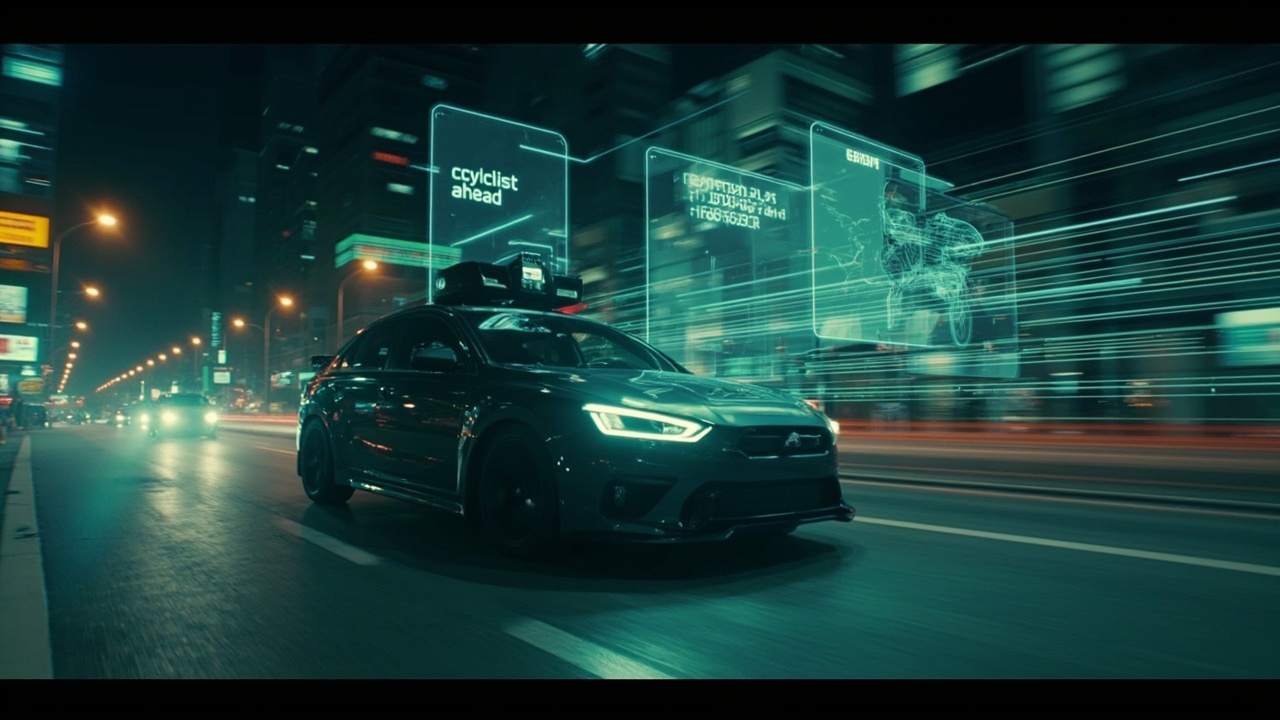
Self-driving cars are controlled by deep neural networks that sometimes fail in ways no one — not the passengers, not the safety drivers, not even the engineers — can easily explain. A vehicle might brake hard for no visible reason, or block the path of an oncoming ambulance. Today in Nature, researchers from MIT and autonomous vehicle company Motional published a method that pulls back the curtain: the Concept-Wrapper Network, or CW-Net, an explainability module that translates a self-driving planner’s internal reasoning into human-understandable concepts, in real time, without degrading the vehicle’s driving performance.
Why the black box is a safety problem
Machine-learning-based planners are the “brain” of a modern autonomous vehicle. They ingest camera and lidar data, build a summary of the environment, decide what the car should do next, and output a trajectory. The problem is that these planners are black boxes: their decision-making process is so deeply entangled in millions of parameters that it is effectively impossible to inspect directly.
That opacity has real consequences. When a robotaxi makes an unexpected decision — the industry calls it “phantom braking” — a human in the driver’s seat may have seconds to react and prevent a collision, yet has no way to anticipate what the system will do next. Interpretability research has surged in response, but as the authors note in the paper, most of it has been confined to simulations or toy setups, because deploying explanation systems on real vehicles is genuinely hard. Whether such techniques would actually help humans in realistic conditions remained an open question — until now.
How CW-Net works
CW-Net is a “concept classifier”: an AI algorithm trained to predict high-level concepts present in the input data. The trick is where it sits. The researchers plug the CW-Net module into the middle of the vehicle’s existing machine-learning planner architecture, rather than bolting an interpreter on after the fact. It translates the planner’s internal reasoning into concepts like “approaching stopped vehicle” or “close to cyclist” — and then forces the final stage of the planner to actually use those concepts when deciding what the car does next.
That design choice is what makes the explanations causally faithful. Because the concepts genuinely drive the decision, they are guaranteed to reflect the true reasons behind the car’s behavior, not a plausible-sounding rationalization. “Especially in high-stakes settings like self-driving cars, it’s important that the explanations are not potentially misleading,” said lead author Eoin Kenny, a former MIT postdoc now at J.P. Morgan Chase. “Because CW-Net is causally faithful in how it makes decisions, that provides certain guarantees around the explanations.”
To make the concept detection robust, the team trained CW-Net on a dataset of 130 million examples of scenes from self-driving cars, each labeled with multiple concepts. They also designed the module to mimic the driving decisions of the original planner, so adding it does not hurt vehicle performance. The concepts are then rendered into clear natural-language explanations and output alongside the vehicle’s trajectory in real time.
The cyclist that wasn’t detected
The most striking result comes from road tests on a private track, with CW-Net deployed on an actual Motional robotaxi carrying a safety driver. In one revealing scenario, the vehicle consistently stopped when approaching a cyclist — and the safety driver naturally assumed the car had detected the cyclist and yielded. CW-Net’s explanations showed otherwise: the planner wasn’t properly configured to detect the cyclist at all, and had initially chosen a trajectory that would have caused a collision. The car stopped only because its emergency braking procedure kicked in when it got too close.
That is exactly the kind of misconception that erodes safety margins. Armed with the real explanation, the safety driver knew to reduce speed or take manual control earlier in similar situations — and engineers knew precisely which part of the model to fix. “Instead of just wondering why the car stopped, having real-time data provides feedback that lets you test the system during deployment,” Kenny said. “You could also give that data to an engineer to potentially improve the system.”
The private-track findings were replicated at scale in online simulation studies built from real driving situations captured on the streets of Las Vegas. There, CW-Net explanations significantly improved nonexpert participants’ ability to predict how the autonomous vehicle would behave — particularly in surprising situations, where the vehicle deviated from what users expected.
Interpretability as an engineering tool
The senior authors frame the contribution as more than an interface feature. “This work shows how explanations are supportive to the human’s mental model and understanding of the behavior of a system, and how it could be used in engineering and development to improve the technology,” said Julie Shah, MIT professor of aeronautics and astronautics, director of the Interactive Robotics Group at CSAIL, and co-senior author of the paper. “Unless we are building these technologies in a way that we can rely on and predict their behavior, then it is a shaky and unsafe foundation for their use.”
She is joined by co-senior author Momchil Tomov, a staff research scientist at Motional, along with Motional team members Akshay Dharmavaram, Sang Uk Lee, Tung Phan-Minh, Shreyas Rajesh, Yunqing Hu, and Laura Major, president and CEO of Motional.
The implications reach beyond robotaxis. The authors argue the same deployment-validated pathway could apply to other safety-critical autonomous systems — drones, robotic surgery — and to other architectures, including end-to-end learning systems and vision-language-action models of the kind now driving the agentic AI wave.
The road ahead
The team plans to extend CW-Net to cover a broader set of concepts and to explore alternative training and design techniques that could further improve performance and interpretability. The longer-term stakes are trust: as autonomous vehicles scale from pilot deployments to everyday transport, the ability to say why the car did what it did — accurately, in real time, with causal guarantees — may prove as important as raw driving ability.
For an industry that has long asked the public to trust systems it cannot explain, a Nature-published, road-tested method for faithful machine explanations is a meaningful milestone. “Our study shows how crucial interpretability can be to these high-stakes environments,” Kenny said, “and how it should be on the mind of people as they are making AI in the future, for self-driving cars or other safety-critical environments.”
Sources
- [1] https://news.mit.edu/2026/system-helps-humans-predict-when-self-driving-cars-will-make-mistakes-0902
- [2] https://www.nature.com/articles/s41586-026-10950-5
- [3] https://arxiv.org/html/2411.18714v3
- [4] https://www.artificialintelligence-news.com/news/motional-and-mit-ai-explains-self-driving-car-decisions/