NVIDIA's Cosmos 3 Edge Puts a 4B World Model Inside Every Robot
NVIDIA's open-source 4B-parameter world model runs real-time perception, prediction, and action generation directly on edge GPUs — no cloud required.
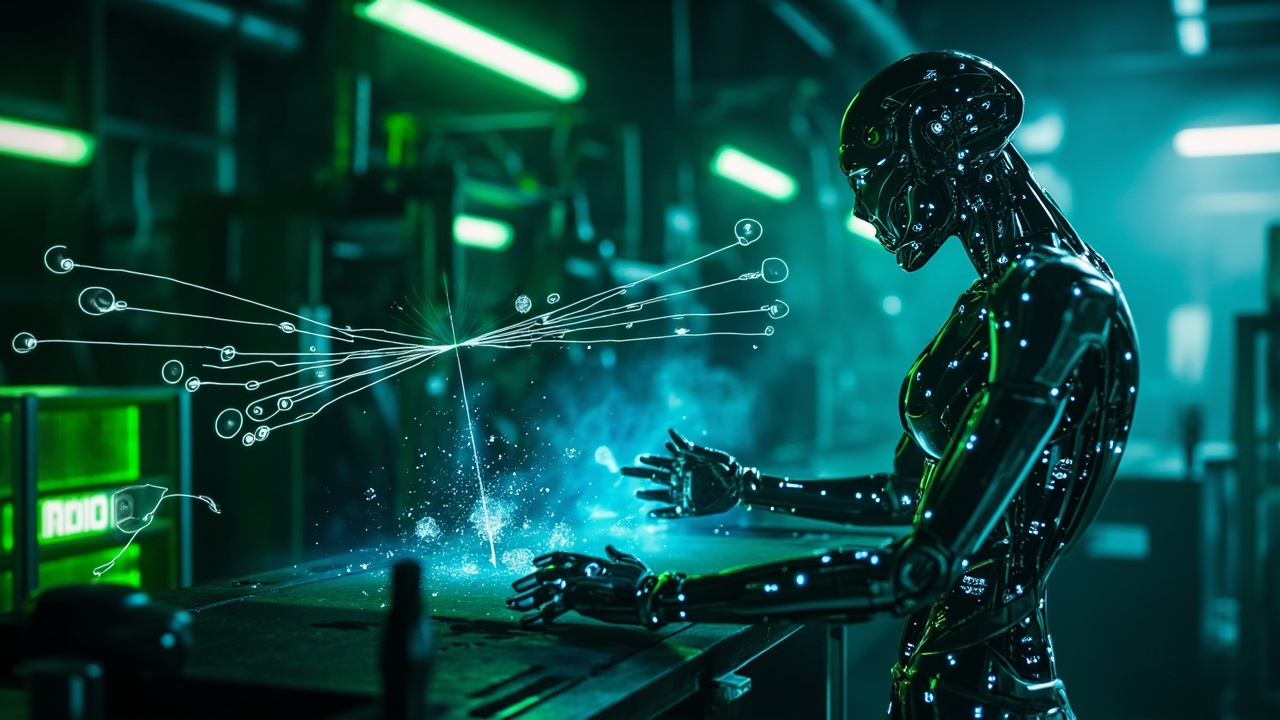
For years, the promise of autonomous robotics has run headlong into a stubborn bottleneck: the smartest AI models are too large, too power-hungry, and too dependent on cloud round-trips to run on the robot itself. At SIGGRAPH 2026 in July, NVIDIA tore up that assumption. The company released Cosmos 3 Edge, a 4-billion-parameter open world model that unifies perception, reasoning, world prediction, and robot action generation in a single architecture — designed to run entirely on-device, with no cloud connection required.
It is the first time a frontier-grade world model has been packaged for the edge at this scale, and it arrives alongside NVIDIA’s new Jetson Thor compute modules that make deployment feasible on everything from factory arms to autonomous vehicles.
What Cosmos 3 Edge Actually Does
Cosmos 3 Edge is a post-trained World Action Model (WAM) — a model that doesn’t just understand a scene or describe it, but actually generates the sequence of physical actions a robot should take. The model processes five modalities natively: text, images, video, ambient sound, and action commands. That omnimodal design means a single network handles tasks that previously required separate vision, planning, and control systems.
At its core, Cosmos 3 Edge performs three things in real time:
- Scene understanding — it ingests live camera feeds at 640×360 resolution and constructs a rich semantic and spatial representation of the environment.
- World prediction — it simulates what happens next, generating future frames and predicting how objects and agents will move.
- Action generation — it outputs 32 discrete actions per inference, directly driving robotic manipulators, wheels, or other actuators.
The result is a tight 15 Hz control loop — fast enough for smooth real-time robot operation — running entirely on edge hardware. A robot equipped with Cosmos 3 Edge and a Jetson Thor module can perceive a cluttered table, predict how objects might shift, and reach for a target item without phoning home to a data center.
Built on Nemotron, Optimized for the Edge
Cosmos 3 Edge inherits from the broader Cosmos 3 family, which NVIDIA introduced in May 2026 as the first fully open omnimodel for physical AI. The full Cosmos 3 architecture was described in an arXiv paper (2606.02800) as a family of omnimodal world models designed to jointly process and generate language, image, video, audio, and action.
The Edge variant is a distilled and optimized 4B-parameter configuration built on NVIDIA’s Nemotron foundation, specifically tuned for memory-efficient deployment. It targets the new Jetson Thor SoC family — NVIDIA’s latest edge robotics platform featuring Blackwell GPUs with up to 2,070 FP4 TFLOPS (sparse) and 96 fifth-generation Tensor Cores. On a Jetson T3000 module with 32 GB of LPDDR5X memory and 273 GB/s bandwidth, Cosmos 3 Edge achieves full real-time operation. The lower-power T2000 module (400 FP4 TFLOPS) supports the same model with slightly reduced throughput.
Crucially, the model runs equally well on NVIDIA RTX consumer GPUs, DGX systems, and cloud instances — but its defining feature is that it doesn’t need them. The edge-native design is the point.
Open Weights, Real Accessibility
Perhaps the most consequential decision is the licensing. NVIDIA released Cosmos 3 Edge under an open model license on Hugging Face (nvidia/Cosmos3-Edge), with full weights, inference code, and integration into the Hugging Face Diffusers library. Researchers and companies can download, fine-tune, and deploy the model freely. NVIDIA also open-sourced synthetic data generation (SDG) datasets covering robotics, physics simulations, and driving scenarios — the training substrates that make the world model robust.
This is a sharp departure from the closed world models emerging from other frontier labs. Where competitors lock physical AI behind APIs and usage fees, NVIDIA is betting that an open ecosystem — downloadable models, open datasets, and commodity edge hardware — will accelerate the entire physical AI field faster than any single company could on its own.
The Japan Coalition: Industrial Robotics Meets AI
The model does not exist in a vacuum. Days before the SIGGRAPH launch, NVIDIA CEO Jensen Huang flew to Tokyo and returned with a sweeping set of partnerships. Japan’s industrial robotics titans — FANUC, Yaskawa Electric, Kawasaki Heavy Industries, and Fujitsu — all joined the “NVIDIA Cosmos Coalition” to build open frontier physical AI models. Sony and Hitachi also signaled support.
The pairing is strategically obvious. Japan possesses the most advanced industrial robotics manufacturing base on earth — FANUC alone has deployed over 750,000 industrial robots globally. NVIDIA provides the AI substrate. Together, the coalition plans to deploy Cosmos 3 Edge-powered systems in factories, warehouses, and autonomous driving scenarios, with FANUC specifically targeting voice-controlled robot operation and AI-agent-driven manufacturing lines.
Fujitsu framed the partnership as “the societal implementation of physical AI,” a signal that these companies view on-device world models not as research curiosities but as deployment-ready infrastructure for the next decade of automation.
Why Edge-First Matters
The shift from cloud-dependent to edge-native robotics carries implications that go far beyond latency:
- Reliability. A warehouse robot that can reason without a network connection doesn’t go dark when WiFi drops. Factory floors, mines, and offshore platforms — environments where connectivity is unreliable — become viable for autonomous systems.
- Privacy and security. On-device inference means camera feeds never leave the robot. For applications in healthcare, defense, or sensitive manufacturing, this is a prerequisite, not a nice-to-have.
- Cost. Cloud inference for continuous robot operation at 15 Hz would be prohibitively expensive. Edge deployment converts a recurring API cost into a one-time hardware purchase.
- Safety determinism. Real-time control loops demand predictable latency. Edge hardware delivers deterministic timing; cloud round-trips cannot.
Benchmark and Performance Context
NVIDIA reported Cosmos 3 Edge results on VANTAGE-Bench, its benchmark suite for physical AI world models, covering perception accuracy, prediction horizon, and action success rate across manipulation, navigation, and driving tasks. On Jetson Thor hardware, the model sustains its 15 Hz control loop while generating the full 32-action sequence per inference — a throughput that enables planning several steps ahead at each control cycle.
For comparison, most existing vision-language-action (VLA) models either run at 1–3 Hz on edge hardware or require cloud offloading to reach usable frequencies. Cosmos 3 Edge’s combination of resolution, action horizon, and frequency represents a meaningful step-change in what’s possible on-device.
The Bigger Picture
Cosmos 3 Edge is not just a product launch — it is a thesis statement. NVIDIA is arguing that the next frontier of AI is not larger language models in the cloud but smaller, smarter models that live inside the machines that move through the physical world. The bet is backed by open weights, open data, commodity edge hardware, and industrial partnerships with the companies that actually build robots at scale.
Whether or not Cosmos 3 Edge becomes the de facto standard, it has already redrawn the boundaries. The question for the rest of 2026 is no longer whether world models can run on robots — NVIDIA has answered that. It’s how quickly the rest of the industry catches up.
Sources
- [1] https://huggingface.co/blog/nvidia/cosmos3edge
- [2] https://www.nvidia.com/en-us/events/siggraph/
- [3] https://blogs.nvidia.com/blog/siggraph-news-2026/
- [4] https://blogs.nvidia.com/blog/jetson-thor-robotics-edge-ai-agent/
- [5] https://www.buildfastwithai.com/blogs/nvidia-cosmos-3-edge-complete-guide-2026
- [6] https://nvidianews.nvidia.com/news/japans-robotics-and-manufacturing-leaders-build-on-nvidia-cosmos-to-advance-physical-ai-frontier
- [7] https://arxiv.org/abs/2606.02800
- [8] https://www.techtimes.com/articles/321401/20260723/nvidia-siggraph-cosmos-3-edge-brings-physical-ai-pipeline-single-gpu.htm
- [9] https://developer.nvidia.com/blog/develop-physical-ai-reasoning-world-and-action-models-with-nvidia-cosmos-3/
- [10] https://www.reddit.com/r/machinelearningnews/comments/1v2bxwc/nvidia_releases_cosmos_3_edge_a_4bparameter_open/