Anthropic Bets $9.1 Billion on a Texas Bitcoin Mine for Two Decades of AI Compute
Anthropic locked in 191 MW of data-center capacity for 20 years from Riot Platforms' Rockdale, Texas campus — the largest AI-mining infrastructure deal yet.
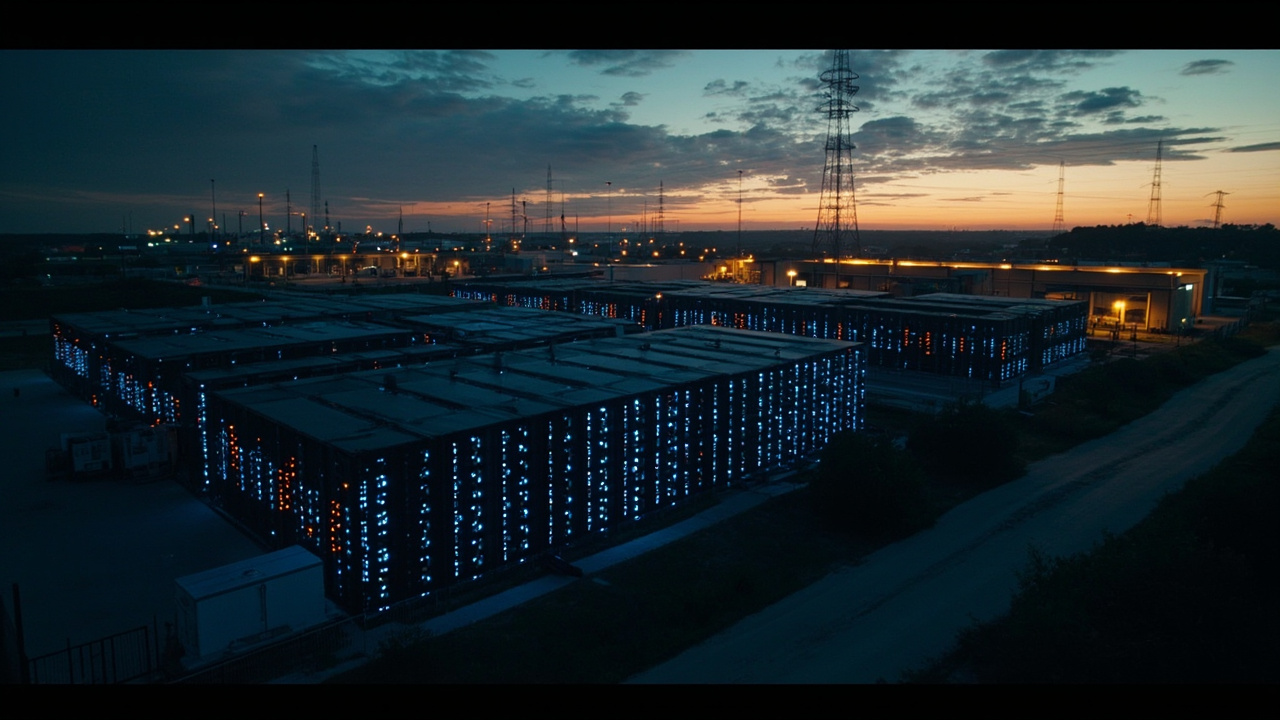
Anthropic has struck one of the largest private infrastructure deals in the history of artificial intelligence: a $9.1 billion, 20-year agreement with Bitcoin miner Riot Platforms to lease 191 megawatts of data-center capacity at Riot’s Rockdale, Texas campus. Announced alongside Riot’s second-quarter 2026 financial results on August 11, the contract locks in compute supply for Anthropic’s frontier model development through June 2048 — and, with extensions, could ultimately be worth as much as $16.1 billion.
The deal in numbers
The headline figures are staggering by any standard:
- 191 MW of critical IT capacity — enough to power roughly 143,000 homes — from Riot’s Rockdale facility, which currently hosts up to 700 MW of developed Bitcoin-mining infrastructure.
- A base contract value of $9.1 billion over 20 years, running through June 2048.
- Two five-year extension options that, if exercised, would push the total to approximately $16.1 billion.
- A phased delivery timeline: 96 MW online by December 2027, with the full 191 MW live by June 2028.
- The capacity is structured as a build-to-suit Tier 3 data center, meaning Riot will retrofit and purpose-build the space to Anthropic’s specifications rather than leasing off-the-shelf colocation.
Riot Platforms disclosed the agreement in its Q2 2026 earnings report, describing it as a landmark in the company’s strategic pivot from pure cryptocurrency mining toward AI and high-performance computing. Riot’s stock surged roughly 20% in pre-market trading on the news, reflecting investor enthusiasm for the revenue diversification.
Why Anthropic needs the power
For Anthropic, the deal is about securing the one resource that matters most for frontier AI: reliable, long-term access to electricity and compute. Training and running large language models like the Claude family requires enormous clusters of GPUs — and those GPUs require equally enormous amounts of power, cooling, and physical space.
The economics of frontier model development have shifted dramatically. Where two years ago the bottleneck was acquiring chips, today the binding constraint is increasingly power and land. The most coveted resource in AI is no longer Nvidia silicon — it’s a megawatt-hour of electricity at a site with cooling infrastructure and fiber connectivity. Anthropic’s decision to sign a 20-year lease, rather than rely on short-term cloud rentals, signals a bet that compute demand will remain intense for at least two more decades.
Rockdale, Texas is an attractive location for several reasons. The state boasts some of the cheapest industrial electricity rates in the United States, thanks to its deregulated grid and abundant natural gas and wind resources. Riot’s campus already has substations, transformers, and high-voltage transmission lines built for Bitcoin mining — infrastructure that can be repurposed for AI workloads with modifications. And Rockdale’s rural setting offers room for expansion and lower land costs than the hyperscaler-dense corridors of Northern Virginia or Phoenix.
The Bitcoin-mining-to-AI pivot
The deal is the most dramatic example yet of a trend that has been building for over a year: Bitcoin miners repositioning themselves as AI infrastructure providers. When cryptocurrency prices fall and the block reward halving compresses margins, mining facilities — which are essentially warehouses full of power-hungry machines sitting on cheap electricity — become tempting candidates for conversion into AI data centers.
Riot is far from alone. CoreWeave, originally a GPU-mining operation, transformed into an AI cloud provider valued in the tens of billions and counts Microsoft among its major customers. Hut 8, Iris Energy, and Hut 8 have all struck partnerships or retooled capacity for AI workloads. What makes the Anthropic-Riot deal stand out is its scale and duration. At $9.1 billion, it dwarfs most prior mining-to-AI conversions and ties both parties together for two decades — an eternity in an industry where technology roadmaps rarely extend beyond three years.
What this means for the industry
The implications ripple in several directions:
For Anthropic, the deal secures a strategic moat. By owning (via long-term lease) power capacity rather than renting it from hyperscalers like Amazon Web Services or Google Cloud, Anthropic gains cost predictability and insulation from cloud price increases. It also reduces dependence on any single cloud provider — a notable move for a company that has received billions in investment from Amazon.
For Riot and the mining sector, it validates the AI-pivot thesis at scale. A $9.1 billion contract from a private AI company — not a public cloud giant — demonstrates that there is deep, structural demand for mining-site compute from the AI labs themselves. Expect other miners to aggressively market their power capacity to AI firms.
For the Texas grid and local communities, the deal means a massive industrial load coming online in stages through 2028. ERCOT, the Texas grid operator, will need to plan for the added demand, though Riot’s existing interconnection agreements should ease integration.
For the broader AI arms race, it underscores that the competition among frontier labs is now fought on infrastructure as much as algorithms. OpenAI, Google, Meta, and xAI have all been securing power through various means — nuclear deals, solar farms, dedicated gas plants. Anthropic’s move shows that even well-funded labs without their own cloud empires can compete by going directly to the source of cheap power.
Risks and open questions
The 20-year horizon is bold. Technology cycles in AI are measured in months, not decades. Will the compute architectures of 2040 still benefit from a Tier 3 data center built in 2027? Liquid cooling, on-chip photonics, and entirely new accelerator designs could render today’s facility conventions obsolete. Anthropic is betting that power, cooling, and land retain value even as the silicon inside the racks changes — a reasonable wager, but not a certain one.
There are also geopolitical and regulatory dimensions. The Rockdale deal keeps Anthropic’s compute on US soil, consistent with growing export-control pressure and national-security scrutiny of AI infrastructure. And as AI data centers draw increasing scrutiny for their environmental footprint, locking in 191 MW of Texas grid power — still substantially fossil-fueled — may draw criticism from sustainability advocates.
Bottom line
The Anthropic-Riot Platforms agreement is a watershed moment for AI infrastructure. It demonstrates that the frontier-lab compute race has entered a new phase: one defined not by who can buy the most GPUs, but by who can secure the most megawatts for the longest time at the best price. With $9.1 billion committed — and potentially $16.1 billion on the table — Anthropic has made clear it intends to be in the compute business for the long haul.
Sources
- [1] https://www.cnbc.com/2026/08/11/riot-platforms-signs-anthropic-deal-as-miners-shift-to-ai-infrastructure-.html
- [2] https://www.coindesk.com/business/2026/08/11/riot-platforms-surges-20-in-pre-market-trading-on-usd9-1-billion-anthropic-deal
- [3] https://www.barrons.com/articles/anthropic-riot-platforms-deal-ai-bitcoin-f59f7a15
- [4] https://www.riotplatforms.com/riot-platforms-reports-second-quarter-2026-financial-results-and-strategic-highlights/
- [5] https://www.tradingkey.com/analysis/stocks/us-stocks/262095019-anthropic-riot-91-billion-ai-compute-bitcoin-mining-data-center-transition-tradingkey