China's AI Weather Models Outperform Supercomputers: Fengwu Pinned Typhoon Dolphin to Within 30 Minutes
Chinese AI weather models Fengwu, Pangu, and Fuxi are matching or surpassing conventional supercomputer forecasts, with Fengwu predicting Typhoon Dolphin's landfall to within 30 minutes and 30 kilometers — five days in advance.
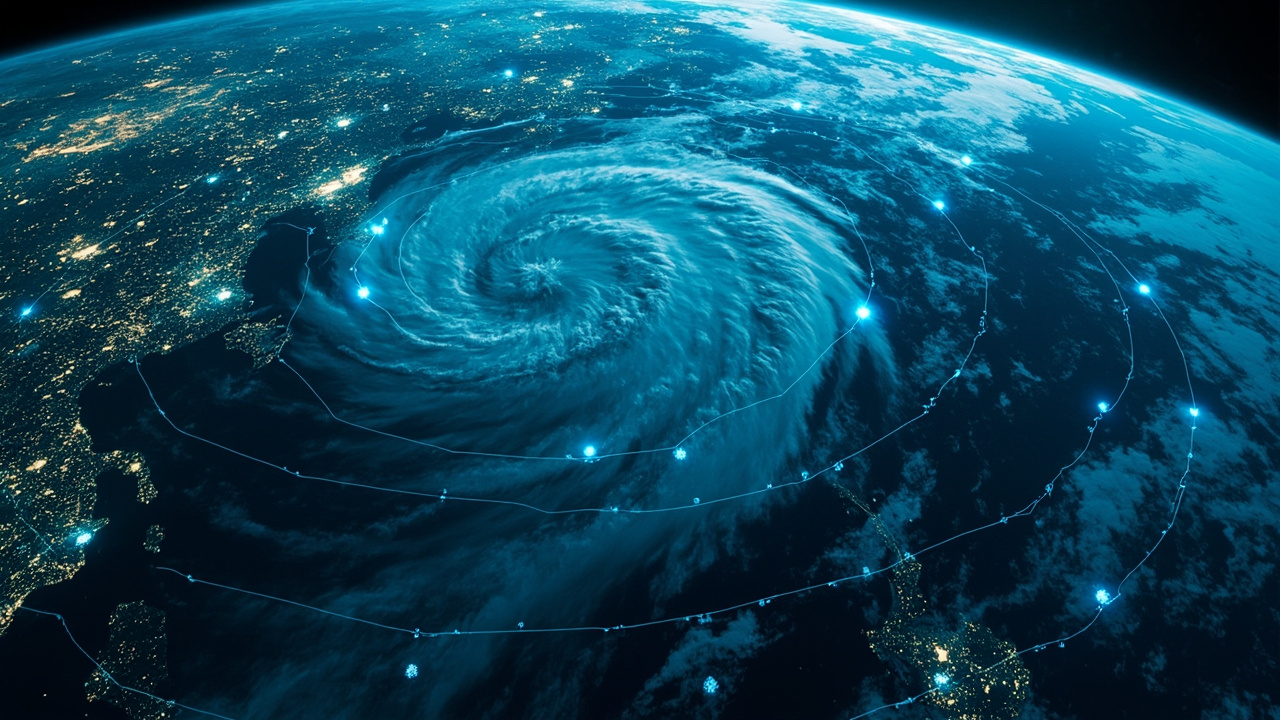
When Typhoon Dolphin bore down on China’s southern coast in August 2026, a new generation of artificial intelligence weather models was watching — and they saw the storm coming with a precision that would have been unthinkable just two years ago. Five days before landfall, the Fengwu model, developed by the Shanghai AI Laboratory, predicted the exact time and location of impact to within 30 minutes and 30 kilometers. That level of accuracy, delivered on a fraction of the computing power required by traditional numerical weather prediction (NWP) systems, marks a turning point in how the world may forecast extreme weather.
Three Models, Three Institutions
China’s AI weather forecasting effort is led by three homegrown systems, each developed by a different institution — a deliberately distributed strategy that puts a state laboratory, a tech giant, and a leading university into the same competitive race.
Fengwu comes from the Shanghai AI Laboratory. It has drawn global attention after developers demonstrated that it outperformed Google DeepMind’s GraphCast model across roughly 80% of the weather variables it was tested on. Fengwu pushed skillful forecasts beyond the ten-day mark, which has traditionally been the practical limit of useful weather prediction.
Pangu is built by Huawei. It was the first AI model to surpass conventional NWP in forecast accuracy while dramatically improving computational efficiency, according to research published in Nature. Its global seven-day forecast can be generated in seconds rather than the hours required by physics-based supercomputer simulations.
Fuxi is developed by Fudan University. Together with Fengwu and Pangu, it represents a coordinated national push to make AI-driven meteorology a core piece of China’s climate resilience infrastructure.
The Typhoon Dolphin Test
Typhoon Dolphin provided a vivid real-world benchmark. As the storm tracked toward China’s coast, the Fengwu model produced a five-day-ahead forecast that pinned landfall to within 30 minutes of the actual time and within 30 kilometers of the actual location — roughly 19 miles.
That precision matters enormously for disaster response. The difference between a typhoon hitting one city versus another, or arriving at noon versus midnight, determines evacuation orders, port closures, agricultural mobilization, and military readiness. When the forecast is accurate and arrives days in advance, authorities gain the time needed to move millions of people out of harm’s way.
According to Sun Zhi of the firm Techwind, AI models are already capable of predicting the path of typhoons with operational-grade reliability. “With more extreme weather, people need information to make decisions — both local governments, the national government, also the average person, farmers and fishermen,” Sun said, framing the work not as an academic benchmark exercise but as a public service whose stakes are measured in lives.
Speed and Cost: The Structural Advantage
The appeal of AI weather models goes beyond accuracy. These systems generate predictions orders of magnitude faster than conventional NWP, which requires massive supercomputers to solve the physical equations governing atmospheric dynamics. AI models, by contrast, learn statistical patterns from decades of historical weather data and then infer future conditions in seconds.
This speed-to-cost ratio is transformative. A conventional global weather simulation can take hours on a multi-million-dollar supercomputer. An AI model can produce a comparable forecast on a single GPU in under a minute. For developing nations that cannot afford the supercomputer infrastructure traditionally required for high-quality forecasting, AI models could democratize access to life-saving weather intelligence.
For China specifically, the calculus is strategic. The country runs some of the world’s most weather-exposed agriculture and coastline. Faster, cheaper, and more accurate forecasts directly translate into economic savings and reduced casualties from floods, typhoons, and droughts.
The Global Race
China is not alone in this field. Western labs have moved aggressively into AI weather forecasting. Google DeepMind’s GenCast is a probabilistic system that generates ensemble forecasts. Nvidia’s FourCastNet leverages GPU architecture for atmospheric prediction. The European Centre for Medium-Range Weather Forecasts (ECMWF) has developed its own AIFS model. A Swiss startup has even claimed its system outperforms both Microsoft and Google’s offerings.
But China’s approach is distinctive in its speed of operational deployment. While Western AI weather models largely remain in research or pilot phases, China has been integrating Fengwu, Pangu, and Fuxi into its national meteorological workflow. During the 2025 typhoon season, the Fengwu model reportedly provided operational guidance alongside traditional forecasts, and its performance during Typhoon Ilsa — where it accurately predicted the trajectory about five days in advance — was documented in a Nature Communications Earth & Environment paper.
What AI Still Cannot Do
Despite the headline-grabbing accuracy on storm tracks, China’s forecasters are candid about the limitations. AI models still lag behind traditional methods in predicting storm intensity — the difference between a manageable blow and a catastrophic one. A model that nails where a typhoon will land can still be wildly wrong about how hard it will hit.
They also remain untested against major, longer-term climate developments that fall outside their training data. AI weather models learn from historical observations, and a warming climate is serving up conditions that no training set has seen before. A storm that intensifies rapidly due to unusually warm ocean temperatures, or a jet stream pattern shifted by Arctic ice loss, may produce surprises that statistical pattern-matching cannot anticipate.
These caveats are why meteorologists view AI as a complement to — not a replacement for — physics-based forecasting. The most effective approach may be a hybrid one, where AI models provide fast initial guidance and NWP systems refine the most critical predictions.
Why This Matters Beyond Weather
The weather forecasting race is an unusually revealing arena for the broader US-China AI rivalry because the referee is physics itself. A chatbot can be graded on taste, but a typhoon forecast is either right or wrong — and ground truth arrives on schedule, every time.
This makes weather an honest benchmark for comparing AI capabilities across nations and institutions. It also makes it strategically significant. The country that can read the atmosphere fastest, cheapest, and most accurately gains an advantage measured not in benchmark scores but in economic resilience, agricultural output, disaster preparedness, and human lives.
As climate change intensifies extreme weather events worldwide, the demand for rapid, accurate, and affordable forecasting will only grow. China’s three-model approach — combining state laboratory research, corporate engineering, and university innovation — is producing results that the rest of the world can no longer afford to ignore.
Whether the future of weather forecasting belongs to AI, to supercomputers, or to some synthesis of both, one thing is clear: the old order, in which Western institutions set the global standard for meteorological prediction, is being disrupted. And the storm clouds gathering over the Pacific are carrying more than rain.
Sources
- [1] https://www.reuters.com/business/environment/china-bets-ai-weather-forecasting-extreme-weather-intensifies-2026-08-11/
- [2] https://thenextweb.com/news/china-ai-weather-forecasting-extreme-weather
- [3] https://www.nature.com/articles/s43247-025-02502-y
- [4] https://table.media/en/china/news/extreme-weather-how-china-aims-to-position-itself-as-a-leader-in-ai-based-weather-forecasting
- [5] https://www.reuters.com/video/watch/idRW492312082026RP1
- [6] https://www.calcalistech.com/ctechnews/article/h14ixfolgg