Mirage Launches the World's First AI-Run 24/7 News Network
Mirage, the AI video company formerly known as Captions, debuted the Mirage News Network — the first 24/7 news channel researched, written, and delivered entirely by AI agents.
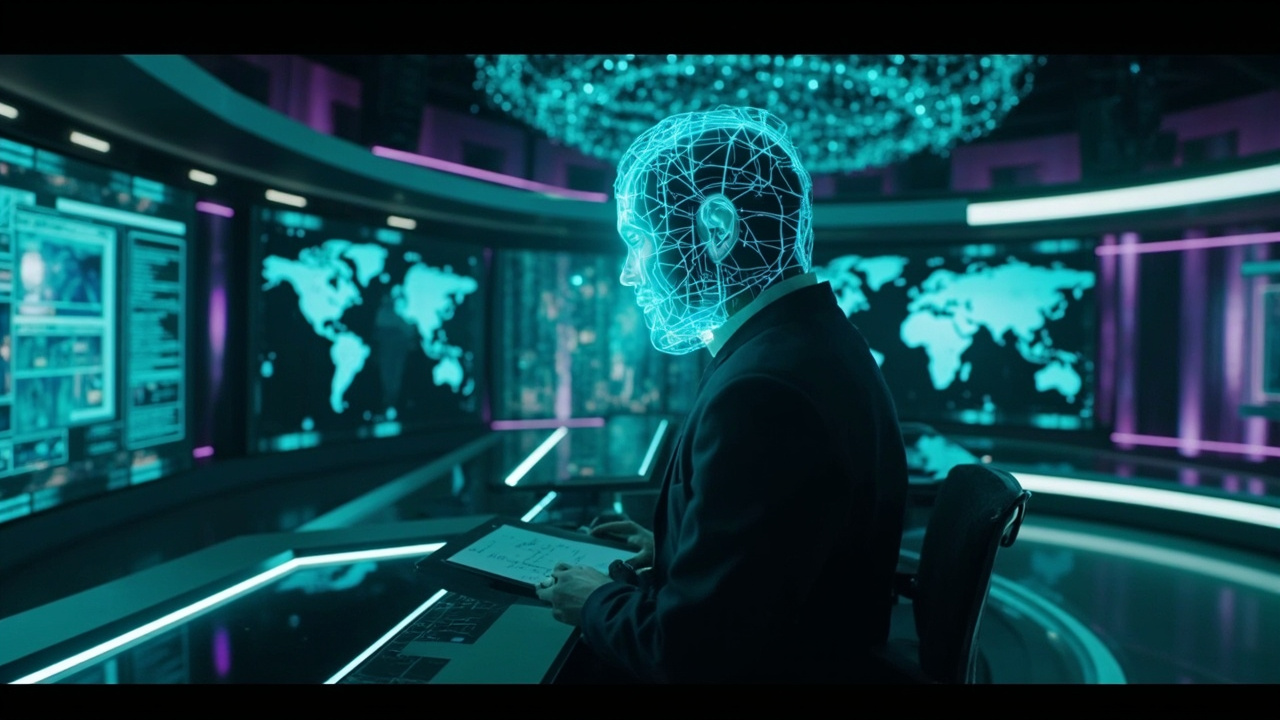
Mirage Launches the World’s First AI-Run 24/7 News Network
On August 11, 2026, a quiet but potentially seismic shift in the media landscape took place: Mirage, the AI video company formerly known as Captions, launched the Mirage News Network (MNN) — the world’s first 24-hour news channel researched, written, and delivered entirely by artificial intelligence. The broadcast went live at 12:00 PM Eastern Time, streaming on X (formerly Twitter) under the handle @trymirage, and within hours it had generated a firestorm of reactions ranging from awe to deep unease.
What Is the Mirage News Network?
The Mirage News Network is described by its creators as “the first news channel run entirely by AI.” According to the company’s announcements on X, LinkedIn, and Instagram, every component of the news production pipeline — from story discovery and research to scriptwriting, anchor presentation, and even interviews — is handled autonomously by AI agents. There are no human presenters, no human writers, and no human producers in the loop during the live broadcast.
The network promises several capabilities that traditional newsrooms cannot match:
- Real-time story detection and breaking news coverage, with AI agents monitoring global events and generating broadcast segments within minutes.
- AI-generated interviews, in which synthetic versions of real guests — including notable tech figures — are interviewed by the network. The launch featured an interview with an AI-generated version of Lenny Rachitsky, the well-known startup newsletter author.
- 24/7 continuous broadcasting with no breaks, no fatigue, and no staffing constraints.
- Interactive audience engagement, with viewers invited to comment or message the network on social media to be featured in upcoming segments.
The production leverages Mirage’s proprietary video generation models, the same underlying technology that powers the company’s popular Captions app, which serves over 20 million creators and businesses worldwide.
The Company Behind It
Mirage was founded by Gaurav Misra and Dwight Churchill, who originally built the company under the name Captions. The startup began as an AI-powered video editing tool focused on auto-captioning and short-form content creation. In late 2025, the company rebranded to Mirage to reflect its broader ambition: becoming a frontier AI research lab focused on video generation.
The rebrand coincided with a significant capital infusion. In March 2026, Mirage raised $75 million in growth financing from General Catalyst’s Customer Value Fund (CVF), bringing the company’s total funding to well over $100 million. The round was earmarked for building proprietary video models and expanding into Asian markets. The company also recently launched Avatar X, a feature that can clone creators from as little as 10 seconds of footage, demonstrating the maturity of their video synthesis pipeline.
Mirage is headquartered in New York City and has positioned itself at the intersection of AI research and media production. The News Network represents the most ambitious deployment of their technology stack to date — a fully autonomous media operation running on their proprietary models.
How It Works
While Mirage has not published a detailed technical architecture document, the available evidence points to a multi-agent system that orchestrates several AI components:
- Story discovery agents scan news feeds, social media trends, and web sources to identify breaking stories and trending topics.
- Research agents gather facts, corroborate sources, and compile briefing materials for each story.
- Writing agents draft broadcast scripts in a news anchor voice, complete with transitions and editorial framing.
- Video generation models produce the visual output: synthetic anchors reading the news, b-roll footage, graphics, and lower-thirds — all rendered in real time.
- Interview synthesis creates AI-generated versions of guests based on their public personas, then conducts conversational interviews using the company’s video cloning technology.
The result is a polished, continuous news broadcast that looks and sounds remarkably like a traditional cable news network — except no human is in the studio. Early viewers reported being genuinely impressed by the production quality, with many noting that the synthetic anchors are nearly indistinguishable from human presenters at a glance.
Why It Matters
The launch of the Mirage News Network touches on several of the most pressing debates in AI today:
Trust and authenticity. A news channel where every story is researched, written, and delivered by AI raises immediate questions about accuracy, bias, and accountability. Who is responsible when the AI gets a story wrong? Mirage has not yet detailed editorial oversight mechanisms, and the absence of human fact-checkers is a significant concern. The network’s tagline — “real-time reporting at internet speed” — cuts both ways: speed is valuable, but it also amplifies the risk of errors and misinformation spreading before corrections can be issued.
The economics of synthetic media. Traditional news networks employ hundreds of people — reporters, editors, producers, camera operators, and on-air talent. MNN replaces all of them with a software stack. If the model proves viable, it could dramatically lower the cost of running a news operation, but it could also displace large numbers of media workers. The implications for the journalism industry are profound and worrying.
Regulatory implications. The launch comes at a moment of heightened regulatory attention to AI-generated content. The EU AI Act became fully applicable on August 2, 2026, with strict transparency requirements for synthetic media. In the United States, the Trump administration’s June 2026 executive order on AI innovation and security established a framework for voluntary safety testing of frontier models. A fully autonomous news network will almost certainly attract scrutiny from regulators on both sides of the Atlantic, particularly around labeling requirements and the provenance of AI-generated news content.
The future of the interview format. Perhaps the most conceptually striking feature of MNN is the AI-generated interview. By creating synthetic versions of real people and conducting interviews with them, the network is pioneering a format that blurs the line between journalism and simulation. While guests reportedly consent to having their AI likeness used, the practice raises thorny questions about consent, misrepresentation, and the authenticity of quoted statements.
Industry Context and Reactions
The launch has drawn comparisons to earlier attempts at AI-powered news. In 2018, China’s Xinhua News Agency debuted an AI news anchor, though it was limited to reading pre-written scripts. In 2023, a startup called NewsGPT launched a channel claiming to be the first AI-generated news service, but it failed to gain traction. In 2024, Channel 1 announced plans for an AI-personalized news network but struggled with the same trust and quality challenges.
Mirage’s attempt differs in a critical way: it is the first to combine frontier video generation technology with autonomous AI agents in a live, continuous broadcast format. The company’s existing user base of 20 million Captions users gives it a distribution advantage that earlier efforts lacked, and its substantial funding provides the runway needed to iterate on the concept.
Early reactions from viewers have been mixed. Many praised the production quality and the novelty of the format. Others expressed discomfort with the idea of news delivered without human judgment, particularly given the well-documented tendency of language models to fabricate information. Skeptics on social media questioned whether the network could be trusted to cover sensitive topics — political conflicts, financial markets, health crises — without the editorial oversight that human newsrooms provide.
Looking Ahead
The Mirage News Network is still in its earliest days. Whether it becomes a durable media institution or a provocative experiment depends on several factors: its ability to maintain factual accuracy over time, the evolution of regulatory frameworks governing AI-generated content, and whether audiences will trust news delivered by machines.
What is certain is that the launch marks a milestone in the deployment of autonomous AI agents. For the first time, a complete media production pipeline — from story idea to finished broadcast — is running without human intervention, in real time, around the clock. The implications extend far beyond journalism. If AI agents can run a news network, they can run a customer support operation, a research desk, a financial analysis team, or any other knowledge-work pipeline that has traditionally required teams of humans.
Mirage has not disclosed future plans for the network beyond the initial launch. But given the company’s trajectory — from a captioning app to a frontier video lab to a fully autonomous news network in just five years — it would be unwise to bet against what comes next.
One thing is clear: the line between human-created and AI-generated media has just become significantly harder to see.
Sources
- [1] https://x.com/trymirage/status/2087207006415258049
- [2] https://insideai.news/news/generative-ai/mirage-launches-worlds-first-ai-news-network-streaming-live-on-x/7732/
- [3] https://beingguru.com/the-worlds-first-ai-powered-news-network-just-went-live/
- [4] https://www.linkedin.com/posts/trymirage_major-announcement-mirage-news-network-activity-7492653606253416448-3KSq
- [5] https://www.techjuice.pk/the-worlds-first-ai-news-network-just-went-live/
- [6] https://techcrunch.com/2026/03/24/mirage-raises-75m-to-continue-building-models-for-its-ai-video-editing-app-captions/
- [7] https://mirage.app/about-us