FT Tally: 60 Planned AI Data Centres Could Emit as Much as 27 Coal Plants
A fresh Financial Times analysis finds the 60 largest planned data centres could match the annual emissions of 27 coal plants or 24 million cars, as Meta's lease obligations swell past a quarter-trillion dollars.
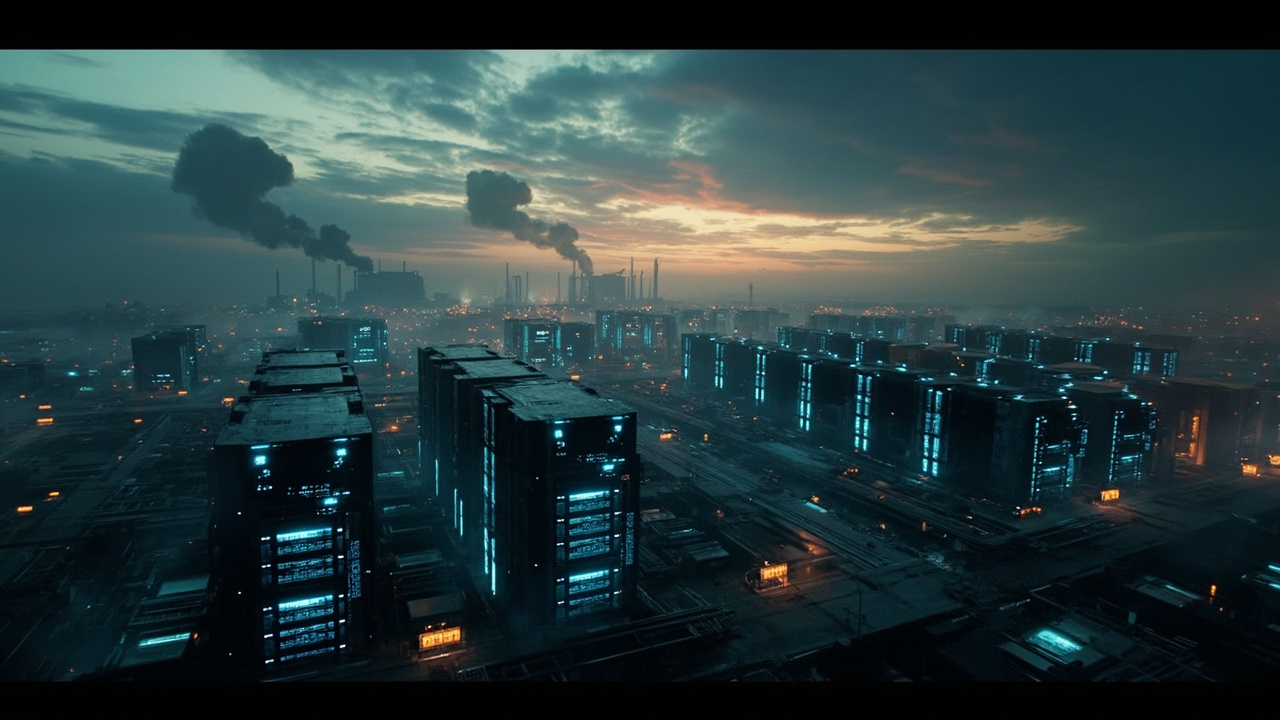
The AI industry’s favourite rhetorical move is to compare its infrastructure to clean, weightless software. A new analysis from the Financial Times, published on August 16, 2026, makes that framing much harder to sustain: the 60 largest data centres currently on Big Tech’s drawing boards could, once operating, emit as much carbon dioxide every year as 27 coal-fired power plants — or 24 million cars.
The FT’s tally is the sharpest attempt yet to size the collision course between the generative AI build-out and the climate commitments the same companies have made very publicly. And it lands in a week when the industry’s own numbers already looked grim.
The headline numbers
At the centre of the analysis are the mega-facilities being planned across the United States and beyond — campuses consuming hundreds of megawatts, in some cases more than a gigawatt, to train and serve frontier AI models. The FT examined the 60 largest planned facilities and converted their projected power consumption into annual emissions equivalents. The result: collectively, they could match the yearly output of 27 average coal plants, or put another 24 million petrol cars on the road.
One facility that features in the reporting is Meta’s billion-dollar, 520-acre data centre — the scale of single-site projects that is now routine rather than exceptional. These are no longer server warehouses; they are industrial installations with industrial footprints.
Big Tech’s emissions are already climbing
The timing matters, because the sector’s latest sustainability disclosures show the trend line bending the wrong way. According to the companies’ most recent annual reports, as compiled in a July 2026 Guardian analysis:
- Microsoft’s carbon emissions jumped roughly 25% in a single year, to about 20 million tonnes of CO2-equivalent, driven largely by datacentre construction and AI compute.
- Google reported an emissions increase of about 18%.
- Amazon posted a 16% rise.
Taken together, the Guardian calculated that the three companies’ combined carbon footprints have grown to roughly a third of France’s total national emissions — a comparison that would have sounded like a typo five years ago.
The International Energy Agency’s baseline view is that emissions from datacentre electricity use grow from about 180 million tonnes today to 300 million tonnes by 2035, and up to 500 million tonnes in its more aggressive “Lift-Off” scenario. Morgan Stanley’s earlier projection that global datacentre emissions will cumulatively reach 2.5 billion tonnes of CO2 through 2030 now looks conservative rather than alarmist.
A quarter-trillion dollars of locked-in concrete
What makes the FT’s framing pointed is the word planned. These emissions are not historical accidents; they are being contractually locked in right now.
The clearest example is Meta. In its latest quarterly regulatory filing, the company disclosed nearly $279 billion in future lease obligations, overwhelmingly tied to AI data centres and network infrastructure. That figure represents a 53% jump from the $182.9 billion Meta reported just one quarter earlier — an astonishing single-quarter acceleration. Bloomberg’s broader accounting puts Meta’s total future spending commitments at close to $700 billion, including $349.3 billion of non-cancelable contractual commitments covering third-party cloud deals, servers and networking gear.
The leases are expected to begin between 2026 and 2036, with some agreements running as long as 30 years. In other words: infrastructure being signed today will still be humming — and drawing power from whatever grid mix exists in the 2050s.
Meta and Microsoft together anchor what industry trackers describe as an $850 billion boom in data centre leasing, a figure that dwarfs most national infrastructure programmes. Every one of those leases is a bet that electricity will be available, affordable and — if the companies’ net-zero pledges mean anything — increasingly clean.
The accounting fog
There is a vigorous argument about how bad all this really is, and much of it turns on accounting.
Tech companies typically report emissions using “market-based” accounting, which lets them claim renewable energy credits and power purchase agreements against their consumption. Critics argue this understates the physical reality: a data centre plugging into a fossil-heavy grid at night or during peak hours is causing real emissions regardless of what paper certificates say. Academic work has suggested in-house datacentre emissions from companies including Microsoft, Meta and Apple may have been several times higher than officially reported in earlier years.
There are also genuine counterpoints. A May 2026 Congressional Research Service review found that, between 2019 and 2025, US states with the largest datacentre demand growth actually saw electricity price decreases on average — complicating the popular narrative that AI is directly spiking consumer bills. And the companies themselves are pouring money into clean energy: nuclear PPAs, geothermal pilots, and carbon removal contracts, even as critics note that removal purchases have at times been scaled back when budgets tighten.
Why it matters
The FT analysis crystallises three tensions the industry can no longer finesse:
Physics versus pledges. Net-zero targets set in 2020-2021 assumed flat or falling compute energy use. Frontier AI has broken that assumption, and no amount of creative accounting changes the grid math.
Lock-in versus optionality. Thirty-year leases and gigawatt-scale campuses are bets that AI demand grows indefinitely. If it does, emissions follow; if it doesn’t, the financial exposure is enormous. Either way, the commitment is already signed.
Local cost, global benefit. Data centres concentrate pollution and grid stress in specific communities — often rural ones recruited with tax incentives — while the AI services they enable are consumed globally. That asymmetry is fuelling the community opposition now delaying projects across the US and Europe.
None of this means the build-out stops. The competitive logic of frontier AI — whoever has the most compute wins — makes voluntary restraint nearly impossible. What the FT’s coal-plant arithmetic does is strip away the abstraction: behind every chatbot session is a building, a transformer yard, and a power purchase agreement. The industry’s climate story now depends less on pledges and more on whether clean generation can be built faster than AI can consume it.
The 27-coal-plant number is a projection, not a measurement, and the companies will contest the methodology. But the direction is unambiguous, and the contracts underwriting it are already on file with regulators.
Sources
- [1] https://www.ft.com/content/8158cb5a-4bbd-43fd-b329-15a54e8422c8
- [2] https://www.theguardian.com/us-news/2026/jul/11/microsoft-amazon-google-datacentre-carbon-emissions-france
- [3] https://www.bloomberg.com/news/articles/2026-07-30/meta-reports-279-billion-in-future-data-center-leases-for-ai
- [4] https://www.businessinsider.com/meta-future-ai-data-center-leases-quarter-trillion-dollars-2026-7
- [5] https://www.iea.org/reports/energy-and-ai/executive-summary