Tesla's Cybercab Gets Factory-Built Starlink: Satellite Internet Becomes Robotaxi Infrastructure
Tesla has confirmed factory-integrated Starlink V5 terminals in the Cybercab robotaxi — a flush roof panel delivering ~375 Mbps satellite connectivity for fleet management, remote support and in-cabin 4K streaming, blurring the line between Musk's car and rocket empires.
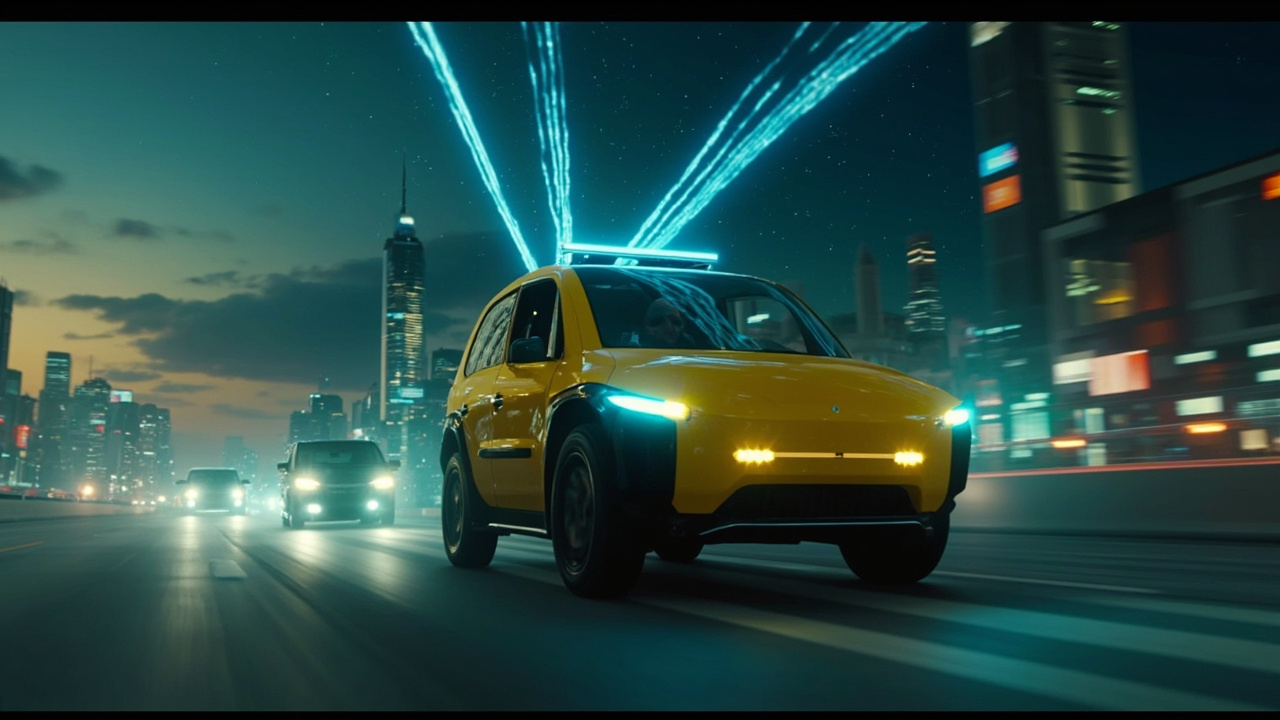
Tesla’s two-seat, steering-wheel-free Cybercab robotaxi has quietly gained its most consequential feature since entering production: a Starlink satellite terminal built directly into the bodywork at the factory. Photos published on August 17, 2026 show the low-profile panel sitting flush where the rear windscreen would normally be, painted in the vehicle’s signature gold. What looks like a minor design flourish is actually a structural bet — that a driverless ride-hailing fleet can only be operated at scale if every vehicle carries an always-on orbital data link, independent of cellular coverage.
What Tesla actually confirmed
The vehicle in question was photographed at Giga Texas, and Tesla’s official Robotaxi account captioned the images “First Cybercab with Starlink integration.” The hardware is the new Starlink V5 terminal — not the raised “pizza box” dish familiar from RVs and boats, but a roughly square panel molded into the roof sheet metal. According to Motor1’s reporting, the terminal ties into the robotaxi’s self-driving computer, microphones, emergency stop hardware, and backs up the vehicle’s 5G and LTE antennas rather than replacing them.
The V5 terminal’s specifications matter here. Tesla says it delivers download speeds of about 375 Mbps or higher, with an average power draw between 35 and 50 watts — roughly half the appetite of the earlier V4 unit. On a 48 kWh battery pack, that power budget is small enough to run continuously without meaningfully denting the Cybercab’s 600+ km EPA-certified range. The flush integration also answers an aerodynamic objection before it’s raised: a bolt-on dish would spoil the efficiency of a 1,412 kg vehicle engineered to shed over 400 kg versus a Model 3.
Elon Musk framed the passenger-facing side of the feature on X: “You will be able to watch live sports in 4k or movies or games or productivity!” The Driven’s report confirms newer Cybercab models will ship with the Starlink hardware as standard, with riders getting fast in-cabin internet as part of the service.
The real reason: fleet operations, not passenger Wi-Fi
The more revealing statements came from Ashok Elluswamy, Tesla’s Head of AI, when the integration was first confirmed in July. Responding to assumptions that the terminal existed for passenger entertainment, Elluswamy was blunt: “It is still not required for safe operation of the vehicle. Connectivity is primarily meant for navigation, customer service and, in general, fleet management.”
That one quote reframes the entire feature. A driverless fleet with no human aboard produces an operational problem cellular networks were never designed to solve: dispatch systems need continuous telemetry to know where every vehicle is, remote support staff need to be able to reach a stranded passenger, and vehicles need current map data even when they wander into cellular dead zones. Starlink gives each Cybercab a data lifeline that never drops because the car drove past a coverage hole.
The operational context is material. The Cybercab entered production at Giga Texas in April 2026, with nearly 250 units spotted in factory lots by late July as Tesla built fleets for Austin, Houston, Dallas, Miami, Tampa, and Orlando. Tesla’s robotaxi operations have also drawn regulatory attention — NHTSA data shows the Austin fleet involved in multiple reported incidents since launch. In that environment, the ability to reach a vehicle and its passenger instantly, from anywhere, is not an amenity. It is the difference between a stuck car and a service failure.
Vertical integration, Musk-style
Electrek’s analysis pointed at the business logic underneath: bolting a Starlink terminal into every Cybercab is a recurring subscription line for SpaceX, paid for by Tesla’s fleet. This is the Musk ecosystem closing a loop — SpaceX launches the satellites, Tesla’s robotaxi fleet consumes the bandwidth, and the cost flows between two companies that already share a majority shareholder.
It also creates a moat competitors can’t easily copy. Waymo, Zoox, and other robotaxi operators buy connectivity from carriers on commercial terms. Tesla’s fleet carries hardware manufactured by an affiliated company, on a launch cadence and cost curve Tesla partially controls. If satellite connectivity becomes table stakes for driverless fleets — and the logic above suggests it will — Tesla has pre-paid for an advantage its rivals must now negotiate for.
Engineering and economics of a connected pod
The Cybercab itself remains a study in subtraction. Unveiled at the “We, Robot” event in late 2024, it is a two-seater with no steering wheel or pedals, engineered with roughly 50% fewer parts than a Model 3 according to Tesla engineers. EPA approval documentation revealed the lightest configuration uses a 48 kWh battery feeding a front motor — the smallest pack in Tesla’s lineup — yet still delivers over 600 km of range thanks to the low weight. Pricing is expected around the mid-$40,000s (roughly A$45,000), positioning it as a purpose-built revenue asset rather than a consumer car.
Starlink integration slots neatly into that philosophy. The panel replaces hardware (a rear windscreen and its wiper mechanism) with capability (an orbital uplink). Every subsystem on the vehicle has to justify itself against fleet economics, and a terminal that keeps cars dispatchable, updatable over the air, and reachable by support staff clears that bar easily — especially at 35-50 watts.
What it means
Three implications are worth watching. First, the robotaxi connectivity stack is becoming a differentiator: reliability of the data link now sits alongside sensor suites and driving policy as core fleet infrastructure. Second, the Tesla-SpaceX relationship is moving from familial overlap to operational dependency, which will be interesting the first time regulators or investors ask where one company’s costs end and the other’s revenue begins. Third, in-cabin connectivity as a service — 4K live sports in a driverless pod — previews a future where the ride itself becomes a media surface, and attention, not just transport, is monetized.
None of this guarantees the Cybercab succeeds. Production numbers are still modest, the regulatory spotlight is real, and unsupervised driverless operation remains the hardest problem in the industry. But the Starlink integration is a genuine signal of how Tesla thinks a robotaxi business must be built: not as cars that happen to be autonomous, but as a distributed, always-connected system on wheels, with a constellation overhead.
Sources
- [1] https://thedriven.io/2026/08/17/tesla-showcases-new-cybercab-now-with-starlink-integrated/
- [2] https://www.motor1.com/news/804605/tesla-cybercab-debuts-factory-style/
- [3] https://www.teslarati.com/teslas-reason-for-starlink-integration-on-cybercab-might-surprise-you/
- [4] https://electrek.co/2026/07/20/tesla-starlink-cybercab-integration-why/