'Country Hicks' vs. 'Come Build Here': AI Data Centers Split Rural America
One Kentucky family refused $26.48 million for land held for 200 years; a Missouri farmer is begging developers to come. The same AI data center boom is tearing rural America in two.
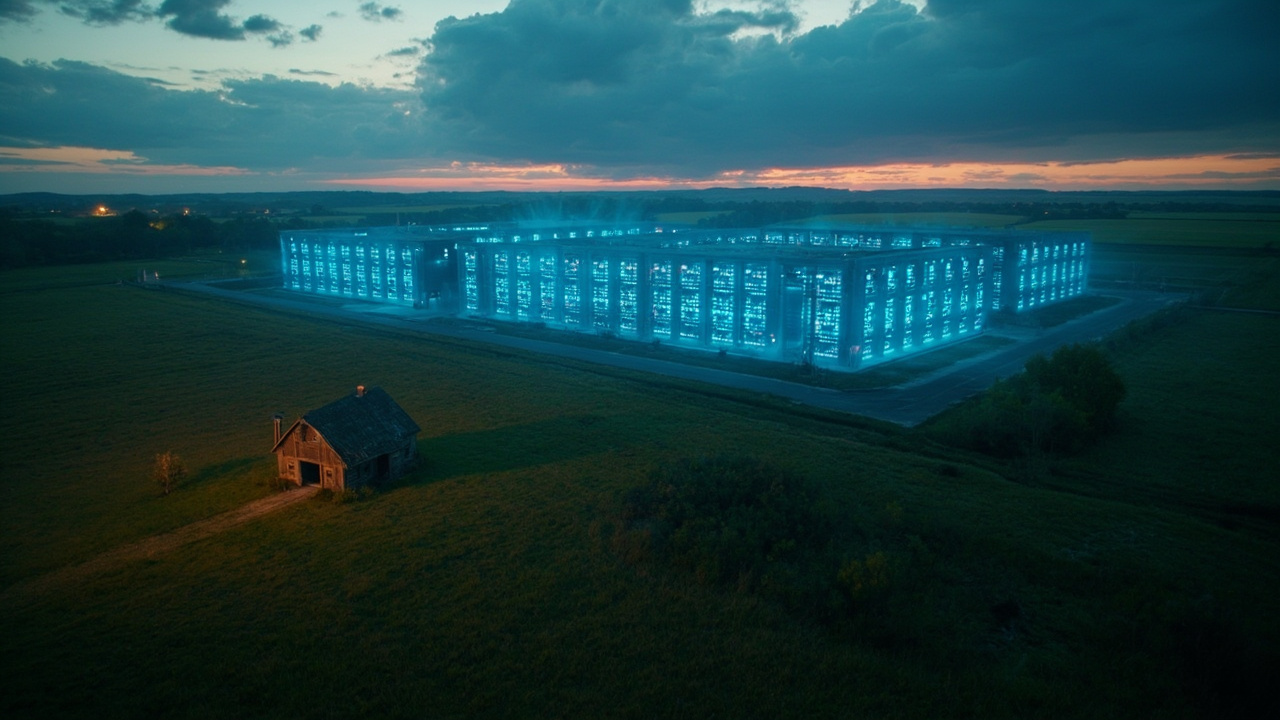
In Maysville, Kentucky, a mother and daughter were offered $26.48 million — nearly ten times market value — for farmland their family has worked for close to two centuries. They said no, and then they sued. In Tarkio, Missouri, a farmer wrote an opinion piece in The Wall Street Journal with a very different message: “If you’d like to build a data center, my farm is available.”
These two farms sit a few hundred miles apart in the American heartland, but they represent opposite answers to the same question: what happens to rural America when the AI boom comes knocking with generational wealth in one hand and a 2-gigawatt power bill in the other? The contrast, laid out in a pair of Wall Street Journal stories published within days of each other, has become the defining image of the newest phase of the AI infrastructure race — the moment it collided with people who never asked to be part of it.
The Kentucky holdouts
Delsia Bare and her mother, Ida Huddleston, farm in Mason County near Maysville. Last year, an unnamed Fortune 100 technology company — widely reported to be Meta — approached the family with an offer of $26.48 million for roughly 1,200 acres needed as part of a sprawling, roughly 2.2-gigawatt data center complex. The offer was nearly ten times the land’s appraised market value. The family refused it outright.
“They call us old stupid farmers,” Huddleston told local media earlier this year, “but we’re not.” Bare was blunter in conversations reported by the Journal and the New York Post: the money, she argued, doesn’t account for what the land actually is — a living connection to five generations, a working farm, and a watershed the family fears would be drained, noisy, and industrialized beyond recognition.
Refusing the check was only the first step. The family has since sued the local government over the rezoning and tax incentives approved for the project, arguing that officials fast-tracked a development that would transform their community without meaningfully consulting the people who live there. Residents opposed to the project cite the standard now-familiar list: constant fan noise, enormous water consumption for cooling, strain on the local grid, and the practical reality that data centers create few permanent jobs relative to their footprint.
The Missouri welcome mat
Blake Hurst’s answer looks nothing like theirs. Hurst is a greenhouse grower in Atchison County who has worked the land around Tarkio for nearly 50 years and is a past president of the Missouri Farm Bureau. In his Journal opinion piece, he did something almost no farmer in America has done voluntarily: he publicly invited data center developers to bid on his farm.
Hurst isn’t naive about the trade-offs — he names the same concerns his Kentucky counterparts raise. His argument is about trajectory. Tarkio, like much of rural Missouri, has been slowly losing people, businesses, and tax base for decades. A proposed 500-acre, multi-billion-dollar data center project near the town is projected to deliver more than $1 billion in tax revenue over 35 years and around 130 new households, alongside roughly 130 permanent jobs. For a community watching its school enrollment shrink every year, Hurst argues, the choice between preservation and revival isn’t much of a choice at all.
His piece landed as the local project faces growing opposition of its own, putting Hurst in the minority in his own county — a farmer publicly urging his neighbors to sell while a coalition works to stop the same development.
The economics of the standoff
Set aside the personalities and the numbers behind both positions are stark.
For landowners, AI data center demand has created the strangest seller’s market in American agriculture. Developers, racing to lock in sites near power and fiber, are routinely paying multiples of farm land values — the Kentucky offer works out to somewhere near ten times market rate. Turning that down, as the Bare-Huddleston family did, means declining more money than most farm families see in a lifetime of harvests.
For communities, the fiscal case runs the other way. Data centers pay enormous property taxes while demanding almost no schools, roads, or social services in return — a handful of on-site staff per building, no children enrolled. That’s why struggling counties court them, and why Tarkio’s projections run to a billion dollars over the project’s life.
For opponents, the costs are real and local: water tables drawn down by evaporative cooling, substations and transmission lines carved through farmland, diesel backup generators, and the low industrial hum of cooling plants that never stops. A Harvard Gazette interview earlier this year summarized the research consensus bluntly — community concerns over power rates, water use, and environmental impact are “legitimate,” even as the buildout accelerates.
A national fault line hardening
What makes the Kentucky-Missouri split more than a human-interest story is how fast it is scaling nationally.
The Daily Yonder, mapping rural data center development as of June 2026, counted 529 data centers in operation in the US, with only about 30 — roughly 6% — in rural counties. But that ratio is about to invert in the pipeline: more than 1,000 new data centers are planned, many of them gigawatt-scale campuses that can only fit in rural areas, from a 5.2-gigawatt Meta project in Louisiana to a fiercely disputed 9-gigawatt proposal elsewhere. The countryside is where the next decade of AI infrastructure is going to be built, or not built.
The pushback is organizing just as fast. Reuters reported earlier this year that nearly half of the US data centers planned for 2026 were facing delays or cancellations, with roughly 5 gigawatts of an announced 12–16 actually under active construction. Polling cited by the Institute for Energy Research in June found that over half of Americans strongly oppose a data center near their home, and over half blame the industry for rising electricity prices. TriplePundit has tracked data center opposition becoming a genuine midterm election issue in affected counties.
Why this matters for AI
The AI industry tends to talk about compute constraints in terms of chips, gigawatts, and capital expenditure. The Maysville and Tarkio stories are a reminder that the binding constraint increasingly looks like social permission — zoning boards, county commissions, courtrooms, and families who simply decline to sell.
A single holdout family can’t stop a hyperscale campus, but a movement of them can shape where trillion-dollar capex plans actually land. Every refused offer raises the price of the next one. Every lawsuit adds months to timelines measured against competitors’ training runs. And every community that votes a project down pushes the industry toward the communities that vote yes — concentrating both the tax windfalls and the environmental burden.
The bare fact at the center of both stories is the same: the AI boom has run out of remote places. There are no more deserts and no more “empty” land within reach of power and fiber — only places where people live, with two-hundred-year attachments or fifty-year business plans, making choices the tech industry can’t algorithm its way around.
In Kentucky, they call the holdouts stubborn. In Missouri, they call Hurst a sellout. Both labels miss the point. Rural America isn’t unified in resistance or in welcome — it is doing what it has always done when an extractive industry arrives: calculating, arguing, and deciding family by family what the future is worth.
Sources
- [1] https://www.wsj.com/tech/ai/ai-data-center-rural-america-backlash-c0af4e16
- [2] https://www.wsj.com/opinion/if-youd-like-to-build-a-data-center-my-farm-is-available-8603ff38
- [3] https://nypost.com/2026/08/16/us-news/country-hick-kentucky-farmers-reject-ai-companys-26m-offer-to-build-data-centers-on-land/
- [4] https://www.kq2.com/news/2026/08/16/meet-blake-hurst-the-missouri-farmer-who-is-welcoming-data-centers/
- [5] https://www.tomshardware.com/tech-industry/data-centers/former-missouri-farm-bureau-president-offers-his-farm-for-a-data-center
- [6] https://m.economictimes.com/news/international/global-trends/missouri-farmer-invites-data-center-developers-to-buy-his-land-as-6-3b-project-faces-growing-local-opposition-and-communities-push-back-on-ai-expansion/articleshow/133298207.cms
- [7] https://dailyyonder.com/we-mapped-rural-data-center-development-and-opposition-heres-what-we-found/2026/06/29/
- [8] https://triplepundit.com/2026/opposition-data-centers-election-issue-midterms/