Beijing's Robot Week: Unitree's $50B Market Debut, 2,000 Competing Machines, and the Race for a 'ChatGPT Moment'
As the World Robot Conference wraps and the World Humanoid Robot Games open in Beijing, Unitree closed its first trading day up some 460% at a ~$50B valuation — and China's robotics chiefs are promising embodied AI's 'ChatGPT moment' by the end of 2027.
If you want to know where the robotics industry’s center of gravity sits in 2026, look at Beijing this week. Between August 19 and 26, the Chinese capital is hosting back-to-back the 2026 World Robot Conference (WRC), the industry’s largest trade show, and the second World Humanoid Robot Games, a five-day sports competition for humanoid machines. Sandwiched between them was one of the most spectacular stock market debuts of the year: Unitree, China’s best-known humanoid robot maker, surged as much as 629% on its first day of trading in Shanghai.
A conference scaled like an exposition
The World Robot Conference, running August 19–23 under the theme of “Human-Robot Symbiosis,” has grown into something closer to a national exposition. More than 300 exhibitors from 26 countries are presenting, organizers count over 2,000 exhibits, and more than 100 new robots are making their debuts — roughly twice the number of new launches at last year’s edition, according to event materials. Visitors have watched humanoids box and dance, quadrupeds navigate obstacle courses, and rescue and service robots demonstrate tasks from lawn care to industrial inspection.
The scale is the message. As the Associated Press reported, the conference is explicitly a showcase for China’s expanding robotics industry at a moment when the government is pushing “new quality productive forces” — a policy banner that has channeled subsidies, local-government funds, and enormous public attention into embodied AI. Euronews noted the subtext: as US export curbs squeeze Chinese firms’ access to advanced chips, events like the WRC are increasingly used to demonstrate that Chinese robotics can stand on its own supply chain, and to court overseas buyers as firms look abroad for growth.
Unitree’s staggering debut
The financial centerpiece of the week was Unitree. On August 6, the Hangzhou-based company priced its IPO on Shanghai’s STAR Market at 150.8 yuan (about $22.34) per share, valuing the firm at roughly 61 billion yuan — just over $9 billion — and raising about 6.1 billion yuan ($904 million). Retail demand was extraordinary, with the offering reported at around 8,000 times oversubscribed.
Then came August 19 — the same day the WRC opened. Unitree’s shares leapt as much as 629% in early trading, and even after settling, the stock closed the day around 460% above its IPO price, valuing the company at approximately $50 billion (with intraday market cap touching nearly $60 billion at the peak). That is a more than fivefold re-rating in a single session, turning a nine-figure raise into one of the largest robotics companies on any exchange by market value.
Skeptics will note the arithmetic: a $50 billion valuation on a company that still earns most of its revenue from consumer quadruped robots and educational products implies enormous faith in the humanoid future. Bulls will note the same thing. The IPO’s structure — a small float, massive oversubscription, and a listing timed to the industry’s biggest week — practically guaranteed a violent first-day pop. What happens over the next six months will be a referendum on how quickly humanoids can move from conference demos to shipped products with real unit economics.
The ‘ChatGPT moment’ thesis
The phrase on everyone’s lips in Beijing this week was borrowed from software. Unitree’s founder Wang Xingxing told Reuters that robots are poised for their own “ChatGPT moment” — the point where capability, price, and reliability cross a threshold and adoption suddenly compounds. His benchmark is ambitious: he hopes Unitree robots will eventually complete 80% of household tasks autonomously.
A day later, ACE Robotics’ chairman put a date on it. “We expect to reach the ‘ChatGPT moment’ for embodied intelligence by the end of next year, driven by world models and environmental data,” the executive told Reuters at the conference on August 21, arguing that humanoid robot brains could see a breakthrough by late 2027 similar to the dramatic impact ChatGPT had on AI usage.
The technical claim underneath the slogan deserves attention. What separates a conference demo from a useful robot is generalization — the ability to handle novel environments without per-task engineering. The industry’s current bet is that world models, neural networks trained to predict how environments evolve and respond to actions, plus massive environmental data collection, will do for robot control what next-token prediction did for language. It is a plausible thesis and an unproven one; today’s most impressive humanoids still largely excel in structured settings, as both the graceful and the not-so-graceful moments at this week’s demos showed.
Robots in competition
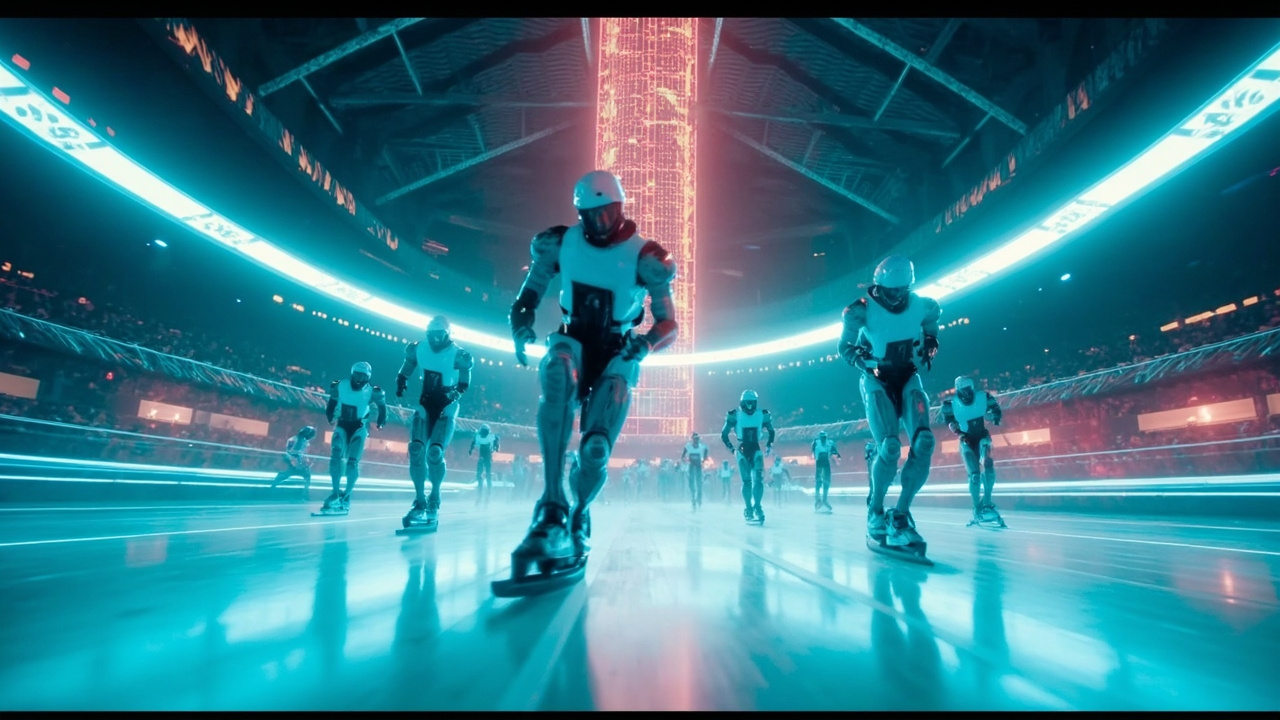
On August 22, the National Speed Skating Oval — the “Ice Ribbon” built for the 2022 Winter Olympics — reopened its doors to a different kind of athlete. The second World Humanoid Robot Games runs through August 26, with more than 2,000 robots from 16 countries fielded by over 600 teams, competing in events from sprint races and soccer to kickboxing and object manipulation.
The first Games, held in Beijing in August 2025, went viral as much for the stumbles as the successes. That is precisely the point: competitive stress-testing in public is how the field measures progress. A robot that can recover from a shove mid-kickboxing match, or re-localize after falling on a track, is demonstrating exactly the robustness that warehouse and household deployments demand. Expect the outtakes — a clip of a humanoid thrashing on the floor during one demo already circulating this week — alongside the highlights. Both are data.
Why this week matters
Three threads came together in Beijing: state-backed industrial policy at maximum volume, public-market capital arriving in size (Unitree will not be the last robotics IPO of this cycle), and a credible technical roadmap — world models plus embodied data — for getting from demos to deployment. If the executives’ 2027 timeline is even half right, this week will be remembered as the moment the humanoid race stopped being a research story and became an industrial one.
The open questions are the ones that always accompany booms: whether valuations like Unitree’s can be justified by demand that mostly doesn’t exist yet, whether the US-China technology split will fragment the field’s supply chains before they mature, and whether “ChatGPT moment” becomes this cycle’s “full self-driving coming next year.” For now, the machines are boxing in Beijing, the market has spoken loudly, and the countdown to the end of 2027 has visibly started.
Sources
- [1] https://www.reuters.com/technology/ace-robotics-ceo-says-robot-brains-will-have-chatgpt-moment-by-end-2027-2026-08-21/
- [2] https://apnews.com/article/china-robot-conference-951ebd3cddaccf5afcedc68174ba626a
- [3] https://finance.yahoo.com/markets/stocks/articles/unitree-robotics-stock-soars-460-111514463.html
- [4] https://www.cnbc.com/2026/08/06/chinese-humanoid-robot-maker-unitree-prices-ipo-at-9-billion-valuation.html
- [5] https://english.beijing.gov.cn/latest/news/202608/t20260815_4824032.html
- [6] https://www.france24.com/en/china-robots-box-and-dance-at-beijing-s-2026-world-robot-conference
- [7] https://www.reuters.com/world/asia-pacific/robots-poised-chatgpt-moment-unitree-ceo-says-2026-08-20/
- [8] https://www.euronews.com/video/2026/08/20/china-showcases-nextgen-humanoid-robots-as-us-curbs-push-firms-abroad