Nvidia Buys Into the Ground Floor: Minority Stake in Power-Site Developer Cloverleaf
Nvidia made a minority investment in Cloverleaf Infrastructure, the two-year-old developer that has already sold 7+ gigawatts of powered land — extending its reach from chips all the way down to dirt, power and water rights.
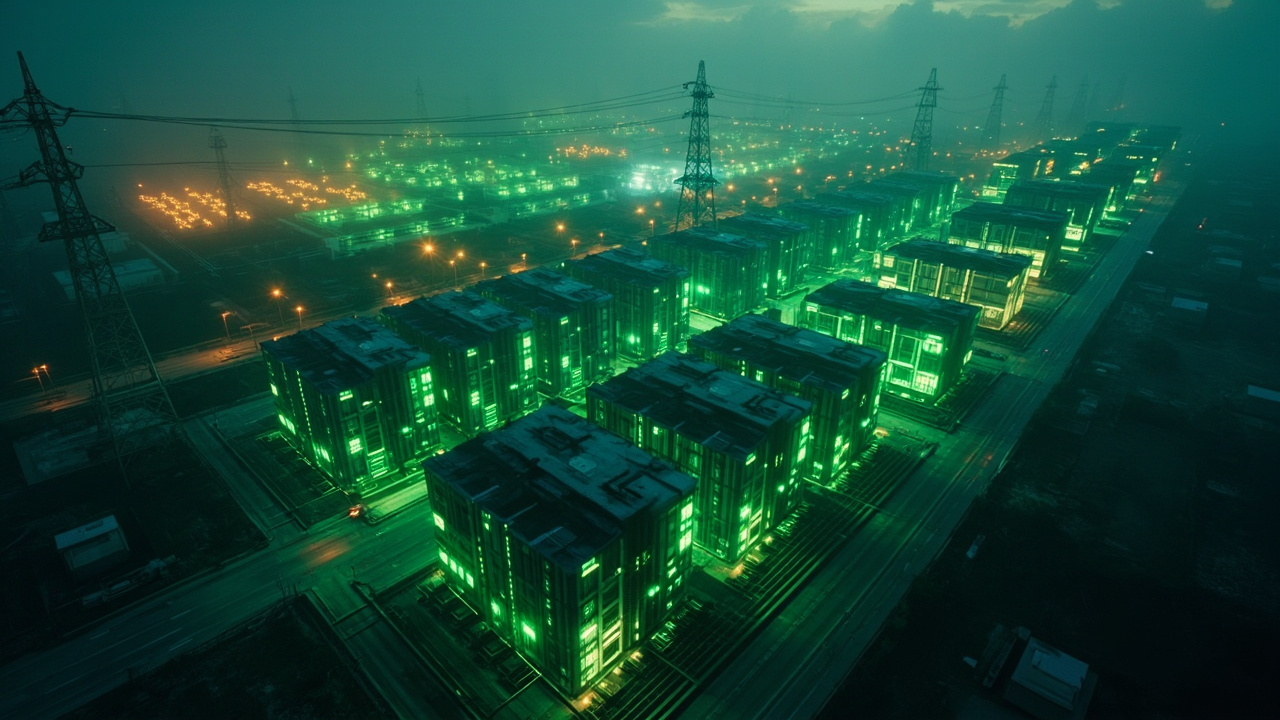
For most of the past decade, Nvidia’s business ended where its silicon ended: sell the GPU, ship the InfiniBand, let someone else worry about the substations. On August 21, 2026, the company pushed that boundary one layer further down the stack. Nvidia confirmed a minority investment in Cloverleaf Infrastructure, a two-year-old real-estate and power developer whose entire business is finding land, attaching clean energy to it, and selling “shovel-ready” gigawatt-scale sites to whoever needs to build the next AI factory.
The Wall Street Journal, which first reported the talks, pegged the investment at several hundred million dollars. Neither company disclosed the exact figure or the valuation, but the strategic logic is unusually legible for a deal of this kind: in 2026, the binding constraint on AI compute is no longer chip fabrication — it is powered land, interconnection queues, and the years-long process of getting utilities to say yes.
What Cloverleaf actually does
Cloverleaf Infrastructure was formed in 2024 by two power-sector veterans, CEO David Berry and Jonathan Abebe, with an initial $300 million commitment split between Sandbrook Capital and NGP Energy Capital. Its product is not data centers. It is sites — parcels of land that have already been matched with generation resources, grid interconnects, water access, and permitting, so that a hyperscaler or AI-native builder can break ground immediately instead of spending three to five years in utility studies.
By the company’s own account, it has since delivered multiple gigawatt-scale projects across North America, and the Journal reports it has sold projects comprising more than 7 gigawatts of powered land — an extraordinary throughput for a company that did not exist when ChatGPT launched the current boom. Its flagship development, Red Granite, is a large-scale clean-energy and data-infrastructure site in a high-growth Midwestern US corridor, and reported target pipelines run to 10–15 gigawatts of peak capacity across states including Wisconsin and Georgia.
“AI is accelerating demand for digital infrastructure at an unprecedented scale and driving strong economic development opportunities for American communities,” Berry said in the announcement. “This partnership strengthens Cloverleaf’s ability to identify and develop high-quality sites that provide the compute power for our country’s growth and security.”
The DSX angle: software eating site selection
The equity stake is only half the story. Under the partnership, Cloverleaf will deploy Nvidia’s DSX platform — the company’s data-center infrastructure design and simulation software — to collapse a workflow that has historically run on spreadsheets, utility studies, and hope.
Per the announcement, Cloverleaf will use DSX to “bring site, power, cooling, computing and facility decisions together earlier in the design phase,” letting customers evaluate tradeoffs — how much compute fits within an available power envelope, what a cooling choice does to water budgets, how rack design interacts with grid constraints — before concrete is poured. Once a site is operational, DSX infrastructure and software continue to optimize energy use and computing capacity against real-time conditions.
“AI factories are the infrastructure of the intelligence age, and land, power and shell are their foundation,” said Nico Caprez, Vice President of Global AI Infrastructure Growth at Nvidia. “Cloverleaf brings deep expertise in power and site development to create exceptional, long-lived sites for generations of accelerated computing.”
The phrase “long-lived” is doing quiet strategic work in that sentence. A site developed to the “Cloverleaf Standard” — the company’s framework for responsibly developing critical infrastructure — is designed to survive multiple generations of hardware. For Nvidia, that means a site justified for Blackwell-era racks is plausibly reusable for Rubin and whatever follows, and each refresh cycle sells more of its silicon into the same physical footprint.
Vertical integration, one layer at a time
The Cloverleaf deal fits a pattern. In May 2026 Nvidia struck a comparable arrangement with IREN, the data-center operator, targeting up to 5 gigawatts of DSX-aligned capacity. It has guaranteed up to $105 billion in leases to help OpenAI occupy a massive Ohio site. It took a $3 billion stake in SB Energy, and Bloomberg reported this week that some of its largest customers are being told server prices — including Vera Rubin and Grace Blackwell systems — will rise more than 15% as component costs climb.
Taken together, Nvidia is progressively de-risking every input to AI factory construction: the chips, the racks, the financing, and now the land and electrons. Where competitors still treat infrastructure as someone else’s problem, Nvidia is assembling what amounts to a full-stack industrial company with a software monoculture at its center — every Cloverleaf site designed in DSX is a site that specifies Nvidia networking, Nvidia software, and Nvidia silicon by default.
Why it matters
The AI buildout’s economics increasingly hinge on questions a chip company was never supposed to answer: where the power comes from, who owns the land under the transformer yard, and whether a community will accept the substation at all. Politicians who once courted data centers — including governors in Texas and Pennsylvania — have begun slowing projects as local resistance to grid strain and water use grows, and the WSJ reported this week that the backlash has turned siting into a live political battleground.
Owning a piece of the solve is a rational hedge. If power is the bottleneck, the company that controls the funnel of shovel-ready gigawatts controls the pace at which its own products can be absorbed. Cloverleaf’s 7 gigawatts of delivered powered land — and its pipeline beyond that — now sit partially inside Nvidia’s orbit, complete with a J.P. Morgan-advised, Kirkland & Ellis-counseled structure that leaves the startup operationally independent.
For the utilities, the deal signals that their counterparty is no longer just a landlord or a cloud provider, but the most valuable semiconductor company on earth. For competitors like AMD — which is racing to line up its own rack-scale “Helios” deployments — it is one more moat to cross. And for the rest of the industry, it is confirmation of a thesis that has been building all year: in the intelligence age, the winners will be decided as much below the floor slab as above it.
Sources are listed in the metadata of this article.
Sources
- [1] https://www.reuters.com/technology/nvidia-invests-data-center-developer-cloverleaf-infrastructure-2026-08-21/
- [2] https://www.wsj.com/business/deals/nvidia-in-talks-to-invest-in-data-center-power-developer-cloverleaf-infrastructure-ff94c556
- [3] https://www.prnewswire.com/news-releases/cloverleaf-infrastructure-forms-strategic-partnership-with-nvidia-to-accelerate-data-center-infrastructure-development-302857329.html
- [4] https://techcrunch.com/2026/08/21/nvidia-partners-with-data-center-developer-cloverleaf/
- [5] https://www.unite.ai/nvidia-takes-minority-stake-in-cloverleaf-infrastructure/
- [6] https://www.sandbrook.com/portfolio/cloverleaf-infrastructure
- [7] https://ngpenergy.com/news/cloverleaf-infrastructure-forms-strategic-partnership-with-nvidia-to-accelerate-data-center-infrastructure-development/