Nvidia Pays $6 Billion to License Poolside's Model Factory
Nvidia licenses Poolside's model-building software for $6B, hires 109 staff, and invests $1B in what remains — the third 'license-not-acquire' mega-deal reshaping how big tech absorbs AI startups.
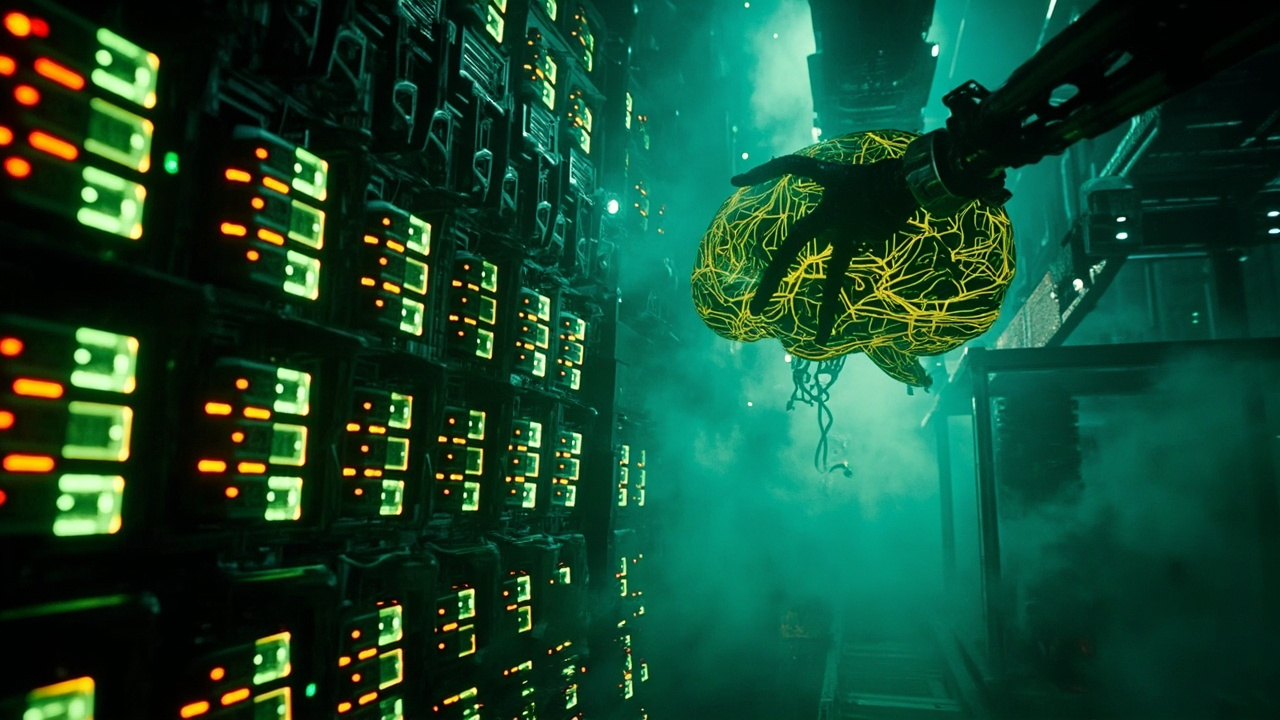
On Friday, August 21, an investor letter from AI coding startup Poolside revealed one of the strangest and most consequential deal structures of the current AI boom: Nvidia has agreed to pay $6 billion to license the startup’s “Model Factory” — the internal system Poolside used to train its models — while simultaneously extending job offers to 109 of its employees and investing $1 billion at a $12 billion pre-money valuation in what remains of the company.
The letter, first reported by Newcomer, is emphatic: the arrangement is “not an acquisition and it is not an acquihire.” The three founders are staying. The license is non-exclusive, meaning Poolside remains free to license the same software to other buyers. And Poolside plans to distribute the full $6 billion to its investors by the end of next year.
It is a deal that raises an obvious question — why would Nvidia pay more for a software license than most AI startups are worth in total — and in answering it, the letter accidentally documents how brutally the economics of frontier AI development have hardened over the past eighteen months.
What Nvidia is actually buying
The asset at the center of the deal is the “Model Factory” — Poolside’s end-to-end system for building, training, and iterating on AI models. This is not a consumer product or a foundation model checkpoint. It is the industrial tooling: data pipelines, training infrastructure, evaluation harnesses, and the accumulated know-how of a team that shipped the Laguna family of open-weight coding models.
The 109 employees receiving Nvidia offers worked on Laguna. By Poolside’s own accounting, that is nearly the entire technical core of the company. CEO Eiso Kant said on the Latent Space podcast last month that “less than 70 people built this model” and that fewer than 115 people worked across engineering and research in total. The arithmetic behind calling this a “reverse-execuhire” is stark: Nvidia is absorbing the model-building organization while formally leaving the company behind.
The strategic logic for Nvidia is not hard to see. Nvidia already builds its own open models in the Nemotron line and, as reported this month, is working toward a trillion-parameter open model. Poolside’s Laguna — trained on Nvidia server silicon and pitched as the West’s answer to DeepSeek and Qwen — was built by a remarkably lean team. Whatever made that efficiency possible is exactly what Nvidia wants inside its own model efforts, which increasingly compete with its own customers.
The deal Nvidia keeps doing
This is the third time Nvidia has used this exact template, and the pattern is now too clear to call coincidence:
- Groq (December): roughly $20 billion for inference technology and top engineers. Groq stayed independent and subsequently raised $350 million at a $3.5 billion valuation, with Nvidia participating.
- Enfabrica: approximately $900 million for the networking chip startup’s technology and team, structured the same way.
- Poolside (August): $6 billion license + 109 hires + $1 billion investment.
Each deal has the same shape: buy a non-exclusive license, hire the staff, take an equity stake, and let the company continue as an independent entity. The structure lets Nvidia lock in technology and talent without an outright acquisition — and without triggering the antitrust review that a formal purchase of an AI leader would invite. For a company already selling to nearly every AI lab on earth while building competing models of its own, keeping regulators at arm’s length is not a side benefit. It is the point.
The letter’s real story: the cluster Poolside lost
The most revealing passage in the investor letter is not about Nvidia at all. It explains why Poolside stopped building frontier models — and it reads like a casualty report from the compute arms race:
“At the end of last year, we had a 6 week window in which to raise $2 billion dollars to pay for a 40,000 GB300 cluster coming online in January. We didn’t close it in time, and we lost the cluster.”
The letter adds that Poolside believes it could have built a frontier-rivalling model with 10,000 to 20,000 of those GB300 chips. But next year’s frontier, it argues, needs “far more than an order of magnitude larger cluster,” and the binding constraint is “not only capital, it is physical data center space and contracted compute.”
This is the part outsiders most often miss about the 2026 AI landscape. The gap between the frontier labs and everyone else is no longer primarily a talent gap or an algorithm gap. It is a contracted compute gap. A startup can be, in the letter’s words, “directionally correct” for three and a half years — building credible models with sub-70-person teams — and still be eliminated from the frontier race because it could not raise $2 billion inside a six-week window. Capital requirements, as the letter puts it, “went vertical.”
What is left of Poolside
Poolside is not winding down. The company spun out its infrastructure arm — Poolside Infrastructure Company — in January, which is building a 1.2GW data center in Texas, with a CEO appointed two months ago and a CFO named this week. The founders say they are “not ready to share the updated vision,” but the letter’s thesis is pointed: human-level capability will be “fully commoditized by open source models,” which suggests the remaining company will bet on infrastructure and application layers rather than racing on raw model capability.
There is a certain irony in the pivot. Poolside was founded in early 2023 by Jason Warner — the former CTO of GitHub who incubated Copilot — and Eiso Kant, on the stated premise that AI is “too important to be controlled” by a handful of giants. Three years later, the frontier pursuit has been surrendered to capital scale, the model-building machinery is licensed to the largest GPU vendor on earth, and the company’s future is selling data center capacity.
Why the price tag matters
The Information’s Amir Efrati noted that it is not clear why the license is worth $6 billion, and Nvidia has not publicly commented. Two readings are possible, and they are not mutually exclusive.
The first is defensive: $6 billion is cheap insurance for Nvidia’s own open-model ambitions, and the non-exclusive structure means Poolside can monetize the same asset again — with Microsoft, Meta, or any other buyer who wants a proven model factory.
The second is that the deal reprices what “AI software” means. Nvidia recently halved a $250 billion commitment to OpenAI, and the Groq deal suggests a deliberate portfolio strategy: rather than one giant exclusive bet, Nvidia is buying slices of the model-building ecosystem — inference at Groq, training infrastructure at Poolside, networking at Enfabrica — while the companies themselves remain standing.
Either way, the message to the startup ecosystem is uncomfortable. If you are a sub-frontier model lab in 2026, your most valuable exit may not be an IPO or a product breakout. It may be licensing your internal tooling to the compute provider everyone already depends on — and watching the frontier move on without you.
Sources
- [1] https://the-decoder.com/nvidia-is-acquiring-poolsides-model-factory-and-109-employees-for-6-billion/
- [2] https://thenextweb.com/news/nvidia-poolside-6bn-model-factory-licence
- [3] https://www.newcomer.co/p/sources-poolside-strikes-6-billion
- [4] https://www.reuters.com/technology/artificial-intelligence/