ZEST: Atlas Learns to Breakdance, Army-Crawl, and Backflip From Any Motion Source — Zero-Shot
Science Robotics' August humanoid special issue leads with ZEST, a motion-imitation framework from the RAI Institute and Boston Dynamics that trains whole-body policies from mocap, monocular video, or raw animation — then deploys them to Atlas, Unitree G1, and Spot with no per-skill engineering.
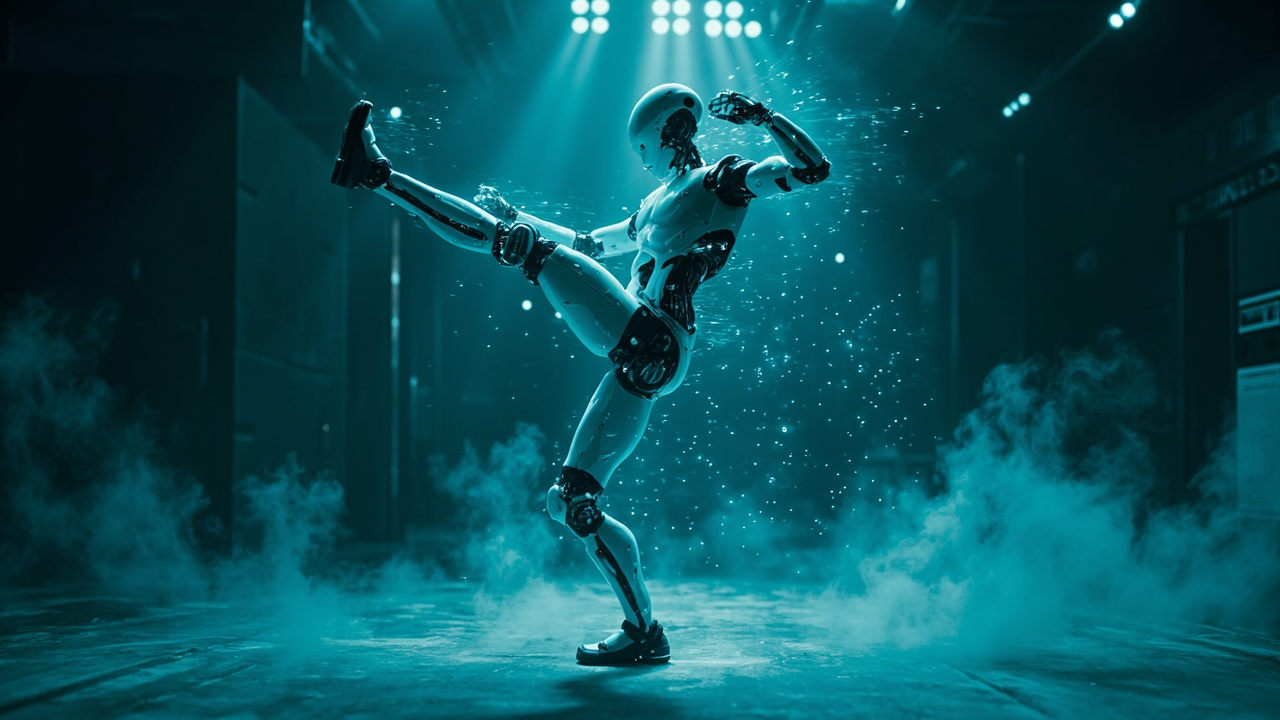
For years, the gap between a viral robot demo and a deployable robot skill has been measured in engineer-months. Every new behavior — a backflip, a crawl under a pipe, a dance routine — traditionally demanded its own controller, its own reward-function tuning, and its own brittle path from simulation to hardware. The August 2026 special issue of Science Robotics (Vol 11, Issue 117), dedicated entirely to humanoid robots, features a cover paper that aims to collapse that pipeline into a single interface: ZEST, or Zero-shot Embodied Skill Transfer, developed by the RAI Institute together with Boston Dynamics.
The claim in the paper’s title is blunt: athletic robot control without per-skill engineering. On Boston Dynamics’ all-electric Atlas humanoid, policies trained with ZEST learned dynamic multi-contact skills — army crawls, breakdancing — directly from motion-capture data. Expressive dance and scene-interaction behaviors such as box-climbing transferred from ordinary monocular video onto both Atlas and Unitree’s G1. And the framework’s reach extends beyond bipeds: on the Spot quadruped, ZEST used non-physics-constrained animation keyframes to produce acrobatics up to a continuous backflip. Every one of these policies was trained entirely in simulation and deployed to real hardware zero-shot — no fine-tuning on the physical robot.
Why per-skill engineering was the bottleneck
Whole-body control on humanoids is hard because the behaviors that matter are contact-rich and long-horizon. A breakdance windmill involves hands, shoulders, and torso exchanging support roles while momentum swings the legs overhead; an army crawl requires sustaining contact on forearms and knees while dragging the rest of the body forward. Classical pipelines approach each such skill as a bespoke control problem: engineers script contact schedules, design reward terms around each phase, and hand-tune gains until the simulated behavior survives transfer to metal.
ZEST’s bet is that almost none of that per-skill scaffolding is necessary. The framework, described by authors including Jean-Pierre Sleiman, He Li, Scott Kuindersma, and Farbod Farshidian, takes motion references from three heterogeneous sources — high-fidelity motion capture, noisy monocular video, and animation that was never physics-constrained in the first place — and trains reinforcement-learning policies that track those references on hardware. Crucially, the system avoids contact labels, reference or observation windows, state estimators, and extensive reward shaping: the four crutches that normally make motion-imitation pipelines skill-specific.
The two tricks that make it work
Two mechanisms do the heavy lifting inside the training loop. The first is adaptive sampling, which continuously identifies the most difficult segments of a motion clip — the moment a breakdancer’s weight shifts onto one hand, say — and concentrates training compute there, rather than wasting it on the easy 80% of the trajectory. The second is an automatic curriculum built around a model-based assistive wrench: early in training, the simulator quietly applies external forces that help the robot through motions it cannot yet perform, then withdraws that assistance as the policy improves. Together, the two let a single training recipe carry policies through dynamic, long-horizon maneuvers that previously required staged, hand-authored curricula.
The paper also contributes on the actuator-modeling side, which sim-to-real work often glosses over. ZEST includes a refined actuator model and a procedure for selecting joint-level gains from approximate analytical armature values for closed-chain actuators — the kind of parallel-linkage joints used in Atlas’s limbs. Getting actuator dynamics right in simulation is unglamorous, but it is a large part of why zero-shot deployment succeeds or fails; a policy that has learned to exploit a mis-modeled actuator will discover the discrepancy the first time it touches real hardware.
Moderate domain randomization — varying physical parameters, latencies, and sensor noise during training — rounds out the recipe, making policies robust to the gap between simulator and machine without the extreme randomization that can cripple final performance.
A scalable interface between human and robot motion
The framing the authors offer in the paper’s conclusion deserves attention: ZEST, they argue, establishes itself as “a scalable interface between biological movements and their robotic counterparts.” That is a bigger claim than a list of stunts suggests. If any human motion — captured by mocap, spotted in a YouTube video, or keyframed by an animator — can become a robot skill through one pipeline, then the supply of robot behaviors is no longer bounded by robotics engineers’ time. It is bounded by the entire corpus of human movement, which is to say: effectively unbounded.
The industrial context makes the timing pointed. In May 2026, Boston Dynamics described how it uses reinforcement learning to train Atlas for hard industrial work like lifting and carrying heavy loads, coordinating its whole body as a single learned system. ZEST is the complementary half of that program: a general-purpose importer of new skills onto the platform. The same week the special issue published, more than 2,000 humanoid robots were competing in Beijing at the World Humanoid Robot Games — an event whose viral stumbles illustrate exactly the robustness gap between demo and deployment that frameworks like ZEST are trying to close.
Inside the special issue
ZEST is the cover article of a humanoid-focused issue that reads like a snapshot of the field’s current agenda. Neighbor papers include SONIC, which “supersizes” motion tracking for natural humanoid whole-body control; a review tracing the evolution of humanoid locomotion control; a perspective arguing that physical AI is enabled by mechanical hardware, not just learning algorithms; and research on vision-driven reactive soccer skills for humanoids. The collective message is consistent: after a decade in which software ate robotics demos, the frontier has shifted to making whole-body, contact-rich behavior routine — reproducible, transferable, and trainable from whatever motion data happens to exist.
For practitioners, the practical takeaways are concrete. Reference data need not be clean: monocular video suffices for a useful class of expressive and scene-interaction skills. Morphology need not match the source: animation authored for a cartoon character transfers to a quadruped. And deployment need not be gradual: with adaptive sampling, an assistive-wrench curriculum, and honest actuator models, simulation-trained policies can land on hardware cold. The engineering-months per skill may finally be on their way out — and the arXiv preprint (2602.00401) has been available since January for anyone who wants to check the math.
Sources
- [1] https://www.science.org/doi/10.1126/scirobotics.aec7695
- [2] https://arxiv.org/abs/2602.00401
- [3] https://www.science.org/toc/scirobotics/11/117
- [4] https://interestingengineering.com/ai-robotics/humanoid-robot-master-complex-movements
- [5] https://robotharbour.com/zest-robot-skills-simulation-hardware/
- [6] https://www.dongascience.com/en/news/79408
- [7] https://bostondynamics.com/blog/training-a-humanoid-robot-for-hard-work/