From Fortnite to Four Legs: General Intuition's Value Nearly Triples to $6B on the 'Large Action Model' Bet
Valor Equity, Point72 Ventures and Seven Seven Six are backing world-model startup General Intuition at a $6B pre-money valuation — nearly triple its $2.3B mark from just eight weeks ago — as the Medal spin-out pushes its action-labeled gameplay models into robotic embodiments.
Eight weeks. That is all it took for General Intuition to go from a $2.3 billion valuation to a $6 billion one. According to TechCrunch, the New York-based startup is finalizing a new funding round at a $6 billion pre-money valuation with new investors Valor Equity Partners, Point72 Ventures and Seven Seven Six, while existing backers Khosla Ventures and General Catalyst re-up. A source close to the deal says the round is oversubscribed as the company continues to field inbound interest. In a summer when AI valuations have been scrutinized as harshly as AI capabilities, this is one of the fastest mark-ups the industry has seen — and it rests entirely on an unusual asset: hundreds of millions of hours of video game footage, annotated with every button press behind every move.
What General Intuition actually builds
The company was spun out last October from Medal, the gameplay clip-sharing platform founded by Dutch entrepreneur Pim de Witte. Medal users upload roughly one billion clips per year, and General Intuition was built on a single conviction: today’s AI is book smart, and the next leap requires machines that are street smart. Instead of training only on text, images and video — all secondhand representations of the world — its models learn from gameplay clips with embedded action labels: precise records of which inputs a player pressed and when.
That distinction is the core of the pitch. Most world-model competitors try to infer actions from raw video alone, which de Witte calls insufficient. Action data lets a model separate the self from the environment and build a causal understanding of “if I do this, then that happens.” The research splits into two model families: action models that decide which actions to take, and world models that predict the outcomes of actions.
The public showcase of the second family is MIRA, built with French lab Kyutai in collaboration with Epic Games. It is a playable multiplayer world model trained on 10,000 hours of Rocket League data, generating its environment frame by frame at 20 frames per second with no traditional game engine underneath. When a TechCrunch reporter tested it by walking straight into walls, the agent refused to pass through — from millions of hours of gameplay it had absorbed that walls are walls, ladders are for climbing, and shadows lengthen as the sun moves.
Why Valor is writing the check
The most striking detail in the new round is who is leading it into uncharted territory. Valor Equity Partners is known primarily for backing SpaceX, and TechCrunch notes that General Intuition would be the first AI lab the fund has invested in since SpaceX. Point72 Ventures and Alexis Ohanian’s Seven Seven Six round out the new money, with Khosla Ventures and General Catalyst participating.
Vinod Khosla has been the company’s loudest champion. He argues that if reasoning was the quantum leap for large language models, the quantum leap for world models will be the “emergence of intuition” — a humanlike capability that grows out of human action-and-reaction data in games, letting a model generalize across tasks it was never explicitly trained on.
The company has refused to sell along the way. Medal reportedly drew acquisition interest from OpenAI at around $500 million in early 2025, and at least one major lab has made an offer since. Khosla’s take: buying the company now would amount to a data acquisition, which he considers uninteresting. Total disclosed funding stood at $454 million before this round, with much of the June capital earmarked for compute through a partnership with neocloud CoreWeave.
The robot in the room
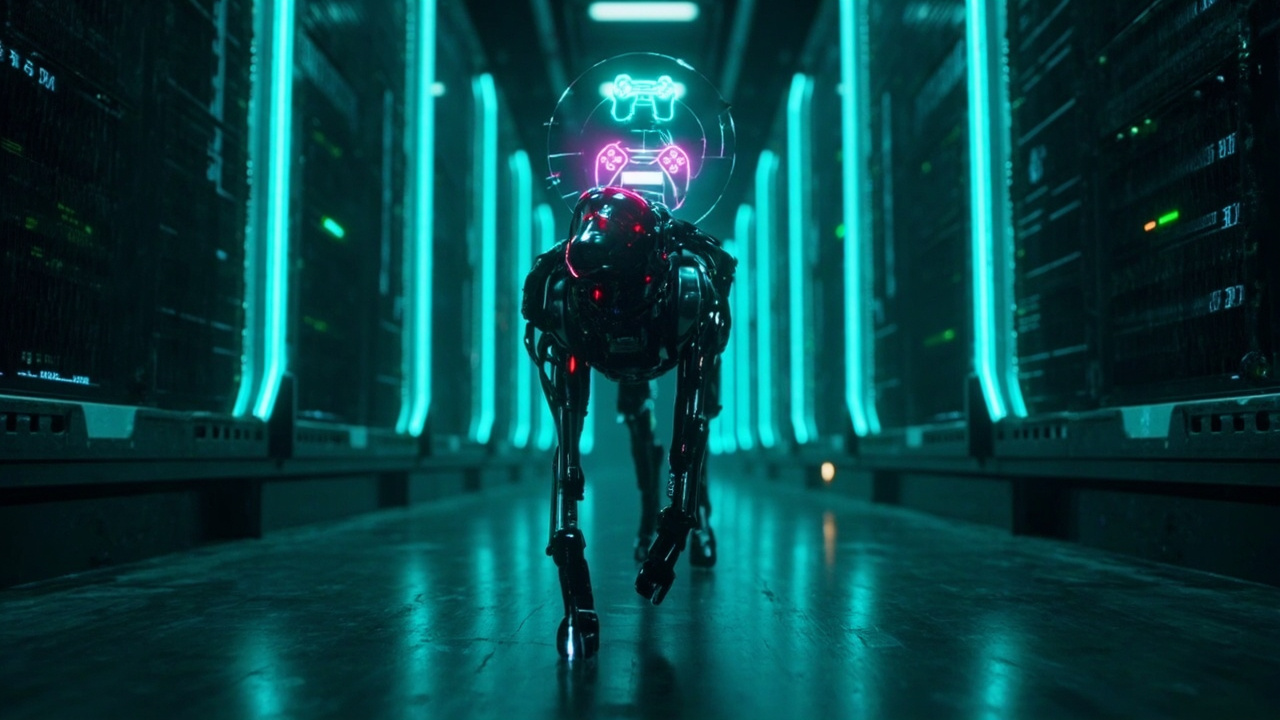
The stated use of the new funds is to improve the general model with a focus on robotic embodiments — more compute, more talent, more hardware in the loop. The company’s favorite demo makes the thesis tangible. On one monitor, an agent plays a game like Fortnite and has been playing for 100 hours straight. Across the office, a large quadruped robot — nicknamed Clippord — roams on a single camera feed in default exploration mode, occasionally clipping a chair leg like a toddler still learning how its body relates to the world. The same brain powers both.
Adapting the game-trained model to the quadruped took just eight minutes of real-world robotics data, collected on the sidewalk outside. The robot carries no maps and no LiDAR; one camera processes pixels, ships them to a data center, and receives the next movement command ten times per second — faster than human reaction time. “Everybody is collecting way too much,” de Witte told Upstarts, arguing that robotics companies overspend on bespoke training data when Fortnite will do.
Commercially, General Intuition wants to be an ecosystem enabler in the mold of Anthropic or OpenAI: a model provider others build on. “We’re not gonna build a self-driving car company,” de Witte says. “We’re gonna make it 10 times easier for the next person to build a self-driving car company.” Early API customers span gaming, simulation and robotics — testing robots in digital twins of factory floors, powering humanlike bots inside games, sending quadrupeds into hazardous environments — with a broader API release planned for the end of summer.
The Wall Street Journal puts a name on it
The round lands days after Christopher Mims profiled the company in The Wall Street Journal under the headline “AI’s Next Big Leap Is Into the Real World,” treating “large action models” — world models trained on videogames and simulations to pilot robots — as a distinct emerging category. The piece frames world and action models as the missing runtime layer between vision-language perception and physical control, quoting founders who argue that physical systems demand decision-making at machine speed, not tokens per second.
That framing matters for the funding story. Investors are not just underwriting one startup; they are taking positions on a thesis — that the next foundation-model category after language is action, and that gameplay data is the cheapest large-scale source of it. If embodied AI becomes the dominant investment theme of 2027 the way language models were for 2023–2025, the companies holding action-labeled data will look like the GPU owners of the last cycle.
Caveats worth keeping in view
The push into robotics is unproven revenue-wise. The WSJ notes that potential investors and business partners keep asking how soon the models translate into deployed, revenue-generating robots — and the honest answer is that a quadruped clomping around an office, however impressively zero-shot, is not a warehouse contract. Quadruped demos are now a fixture at tech conferences, and competitors training directly in simulation environments have deeper robotics pedigrees. An eight-week tripling of valuation priced in a thesis, not a product line.
Still, the signal from the market is unambiguous. When the fund most associated with SpaceX makes its first AI-lab bet since that company, and the round is oversubscribed at triple the prior mark, the “games-to-robots” thesis has crossed from curiosity to consensus-adjacent. The end-of-summer API release will be the first real test of whether General Intuition’s general intuition is worth $6 billion — or considerably more.
Sources
- [1] https://techcrunch.com/2026/08/24/valor-point72-back-general-intuition-at-6b-valuation-as-ai-startup-pushes-into-robotics/
- [2] https://www.wsj.com/tech/ai/ai-world-models-robotics-33ab46cb
- [3] https://techcrunch.com/2026/06/25/general-intuitions-2-3b-bet-that-video-games-can-train-ai-agents-for-the-real-world/
- [4] https://www.i-scoop.eu/general-intuition-bets-billions-that-video-games-can-teach-ai-to-act-in-the-real-world/
- [5] https://www.upstartsmedia.com/p/general-intuition-robots-video-games