NVIDIA's Jetson Orin Nano 2 Doubles Edge AI Performance for Robots and Drones
NVIDIA's new entry-level robotics computer delivers 2x inference performance and 40% lower power, putting frontier-class physical AI within reach of millions of developers.
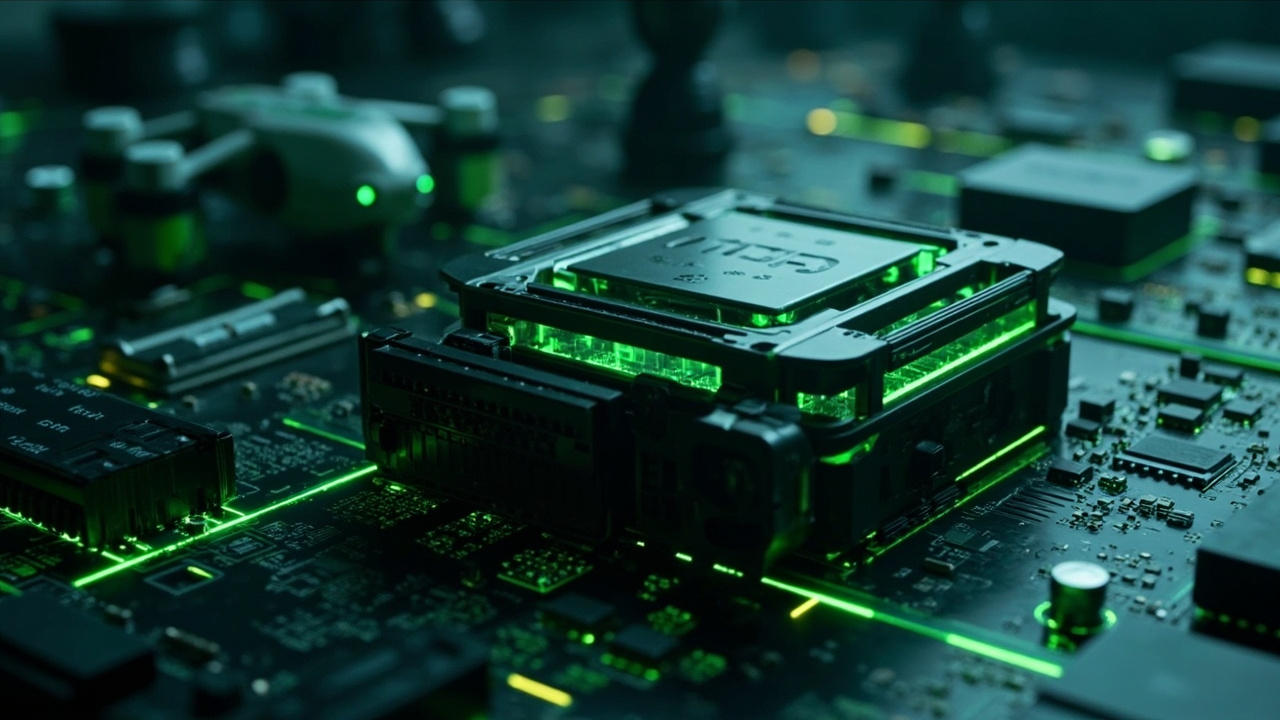
NVIDIA today pulled back the curtain on Jetson Orin Nano 2, a new robotics computer aimed squarely at the entry level of edge AI. The announcement, made August 25, is less about raw horsepower and more about a strategic bet: as frontier AI models shrink, the boundary between data-center intelligence and pocket-sized autonomy is dissolving — and NVIDIA wants to own both sides of that line.
What’s in the box
The headline numbers are straightforward. Jetson Orin Nano 2 packs 78 TOPS (trillion operations per second) of AI compute, 8GB of memory, and an eight-core Arm CPU into the same compact form factor as its predecessor. According to NVIDIA, that translates to 2x the inference performance of the Jetson Orin Nano Super it succeeds, achieved through improved Tensor Cores and higher memory bandwidth rather than a bigger board.
The efficiency story is arguably more interesting than the speed story. In its 15-watt mode, the new module consumes 40% less power to deliver the same performance as the previous generation. For battery-constrained platforms — delivery drones, inspection robots, home cleaning machines — that ratio is the difference between a 20-minute mission and a half-hour one.
Deepu Talla, vice president of robotics and edge AI at NVIDIA, framed the release around a broader industry shift: “Today’s small and medium frontier models have reached the accuracy of last year’s largest frontier models, unlocking real-time intelligence for edge devices.” In other words, the software finally caught up to the hardware constraint — distilled models are now good enough to run meaningful reasoning on-device, and the Jetson Orin Nano 2 is built to meet that moment.
Physical AI, not just chatbots
The module is explicitly positioned for what NVIDIA calls physical AI: machines that understand context, interpret language and images, and act in the real world in real time. The company highlights three adoption categories — robots, delivery and inspection drones, and vision AI systems — with early customers already building on the platform.
Wing, Alphabet’s drone delivery subsidiary, is using the current Orin Nano Super in its fleet and plans to evaluate the new module for real-time AI perception and reasoning. “Drone delivery depends on AI that can enable fast, reliable understanding of the real world,” said Dinuka Abeywardena, head of perception at Wing. “Wing is exploring Jetson Orin Nano 2 to give us a path to more responsive, energy-efficient drones.”
Matic Robotics, a consumer robotics company, is adopting the module to give its home cleaning robots conversational AI, gesture detection, precision mapping, and semantic understanding of the home layout. Cofounder and CEO Navneet Dalal described the goal as running state-of-the-art models at the edge in a compact platform “built for real-time perception, interaction and navigation.” Industrial vision company Cognex and construction equipment maker Doosan Bobcat are also among the first adopters.
Software stack and ecosystem
Hardware is only half the pitch. Jetson Orin Nano 2 runs NVIDIA’s open software stack alongside what the company calls “Jetson agent skills,” and is tuned to run modern large language models and vision-language models optimized for memory-efficient edge inference — including open models like NVIDIA Cosmos, NVIDIA Nemotron, Gemma 4, and Qwen 3. The ability to run genuinely capable VLMs in 8GB of memory is the quiet technical achievement here: it’s what lets a robot interpret a scene rather than just detect objects in it.
The ecosystem plays a serious supporting role. NVIDIA says more than 3 million developers have built on its robotics stack, and a long list of partners — AAEON, ADLINK, Advantech, Aetina, Antmicro, Aptiv, Connect Tech, Seeed Studio, RidgeRun, and roughly a dozen more — are building carrier boards, complete hardware systems, and reference solutions around the new module. Seeed Studio announced its support program within days of launch, signalling how quickly the accessory market moves.
The entry-level question
There is a caveat worth noting: availability. The Jetson Orin Nano 2 module and developer kit are expected to ship in the first half of 2027 — a lead time of several quarters. The entry-level edge AI market is not standing still in the meantime, and competitors across the Arm SoC and accelerator space will use that window. The $249 price point that made the original Orin Nano Super such a hit set an expectation NVIDIA will need to meet or beat.
Even so, the direction is clear. When the previous generation launched, running a frontier-class model on a $249 developer board was a stretch. With doubled inference performance, 40% lower power draw, and a software stack that treats LLMs and VLMs as first-class edge workloads, Jetson Orin Nano 2 marks the point where physical AI stops being a premium feature and starts being the default assumption for new robot and drone designs.
For developers, students, and makers watching the space, the message from NVIDIA is blunt: the next generation of autonomous machines will be built on hardware you can buy for the price of a mid-range GPU — and the models it runs will be nearly as smart as the ones in the cloud.
Sources
- [1] https://nvidianews.nvidia.com/news/nvidia-announces-jetson-orin-nano-2-robotics-computer-to-redefine-entry-level-edge-ai
- [2] https://www.therobotreport.com/jetson-orin-nano-2-doubles-inference-performance-robotics-edge-says-nvidia/
- [3] https://www.seeedstudio.com/blog/2026/08/25/seeed-studio-announces-support-for-nvidia-jetson-orin-nano-2-expanding-scalable-physical-ai-and-robotics-ecosystem/