Taiwan Indicts Nine in Nvidia B300 Server Smuggling Ring — 74 Racks Reached China
Taiwanese prosecutors charged nine people — including an Nvidia senior manager and two Supermicro employees — with forging documents to smuggle 130 B300 AI servers to China; 74 got through via Indonesia, Japan, and Hong Kong before customs caught the rest.
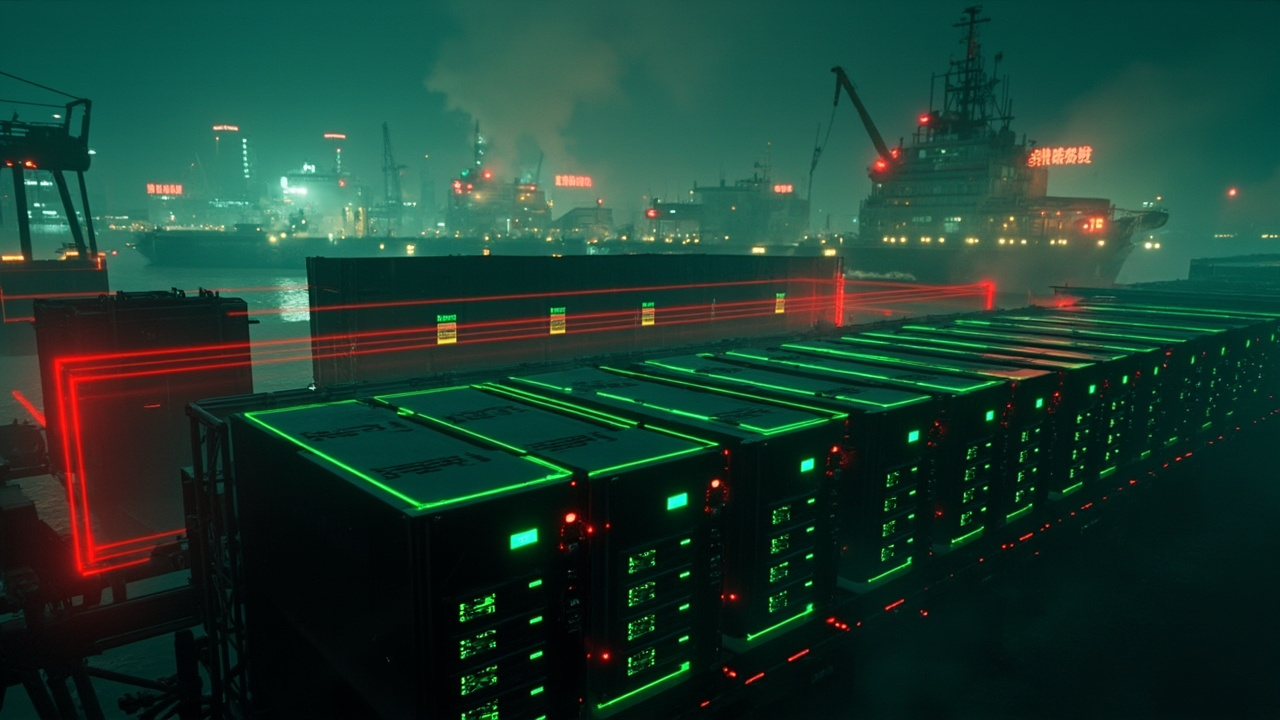
Taiwanese prosecutors announced indictments on Monday, August 24, charging nine individuals with breach of trust and document forgery for orchestrating the illegal export of high-end AI servers to mainland China. Among the accused are a senior manager at Nvidia’s Taiwan office and two employees of Super Micro Computer’s local subsidiary — the first time staff from the chip designer itself have been directly implicated in the smuggling networks that have quietly moved restricted American AI hardware to Chinese customers for years.
The case is the latest and most concrete escalation in an enforcement dragnet that began when US federal authorities charged Supermicro co-founder Yih-Shyan “Wally” Liaw in March with helping funnel roughly $2.5 billion in restricted AI servers to China since 2024. Taiwan opened a parallel investigation, and this week’s charges are the result.
What happened
According to the Keelung District Prosecutors’ Office, the scheme centered on 130 servers equipped with Nvidia’s B300 GPUs — hardware banned from export to China under US export controls in place since 2022 and repeatedly tightened since. The conspirators allegedly forged documentation to make it appear the servers had been installed and were in active use at a facility in Taiwan, a cover story intended to satisfy the strict review process that governs any high-end AI server sale.
That process is not trivial. Under export control rules, purchases of more than eight high-end AI servers require vendor staff to conduct on-site verification visits to the client. Faking an entire deployment — complete with falsified paperwork and, according to prosecutors, fake websites created to launder the illusion — was the only way to move hardware at this scale.
74 of the servers ultimately reached Chinese customers, prosecutors said. The routing was deliberately diffuse: 50 were transshipped through Indonesia, 16 were delivered directly to China, and 8 traveled through Japan and Hong Kong before landing on the mainland. A second batch of 56 servers was intercepted and remains in Taiwan after customs officials detected irregularities in the paperwork.
Who is charged
Prosecutors did not release full names, in keeping with Taiwanese practice, but identified the key defendant as Chang, an Nvidia manager described as “the key figure responsible for authorizing the release of the B300 GPUs” in the case. Prosecutors noted he “demonstrated a clearly poor attitude following the offense” and are seeking the maximum five-year sentence for him and three other defendants.
Eight of the nine were charged with breach of trust and document forgery. A tenth suspect linked to a related case remains at large, accused of siphoning funds from a distributor company involved in helping China obtain restricted Nvidia chips.
Taiwan authorities were blunt about the stakes. The indicted employees, they said, “colluded with one another at various levels for enormous profit, illegally exporting high-end servers, increasing corporate compliance costs, and severely damaging our nation’s international image.”
Corporate responses
Nvidia spokesperson Patrick Rutherford said the company “will work with the Taiwan authorities to help them resolve the allegations as quickly as possible.” The silence from Nvidia’s leadership is notable given that CEO Jensen Huang personally criticized Supermicro’s compliance failures in May — before any of his own employees had been publicly linked to the scheme. “We insist our partners are compliant,” Huang said then. “We hope that they will enhance and improve their regulation compliance and prevent that from happening in the future.”
Supermicro, for its part, emphasized that the arrests stemmed from its own cooperation with Taiwanese authorities, that it is not a target of the investigation, and that a recent probe by its independent directors and outside legal and forensic accounting advisors found its compliance personnel “acted in good faith, with the support of management, to mitigate the risk of illegal diversion.” The company has fired employees connected to the scheme following an internal third-party investigation that cleared current senior officials of involvement — though critics note the company somehow failed to notice billions of dollars of hardware going to questionable clients. Spooked investors have sued for securities fraud on exactly that fear: that Supermicro’s headline sales may be substantially built on illicit channel demand.
Why it matters
This indictment lands at a moment when the US–China AI hardware war is entering a new phase. Three dynamics are converging:
Enforcement is finally reaching inside the companies. For years, export control violations were discussed as an amorphous “grey market” problem — a network of resellers, shell companies, and third-country transshipment hubs. The Liaw indictment and now these Taiwan charges put names and job titles on the pipeline, including staff at the chipmaker whose products were being diverted. That changes the calculus for every employee sitting between an order and a loading dock.
The loophole Congress wants to close next is remote access. Ars Technica notes that US lawmakers are weighing the Remote Access Security Act (RASA), which would extend export controls to cloud-based access to critical hardware and software. Industry experts say remote access to compute in Southeast Asian data centers is now a key driver of capability gains at Alibaba, ByteDance, and Tencent — and hyperscalers plan to expand in the region from 2 data centers today to 31 planned projects. Closing that door would be far more disruptive than interdicting physical shipments, and cloud providers are expected to push back hard.
Taiwan’s own credibility is on the line. The island’s unmatched position in advanced semiconductor manufacturing is both its economic superpower (its 2026 GDP forecast was just revised to 11.05% on AI demand) and its geopolitical vulnerability. Prosecutors explicitly framed the smugglers as damaging Taiwan’s international image — a signal that Taipei intends to police its side of the supply chain aggressively, both to preserve trust with Washington and to keep the export-control regime from fracturing at its most critical node.
The bigger picture
Every enforcement action in this space confirms the same underlying fact: demand for restricted AI compute in China is intense enough that insiders at the world’s most valuable chip company and a major US server vendor allegedly risked prison to serve it. US controls have raised the cost and friction of that access but have not eliminated it — not through Singapore-style reseller networks, not through third-country routing, and, if the remote-access debate is any guide, perhaps not through Southeast Asian clouds either.
The 74 servers that made it through are a rounding error against the millions of GPUs Nvidia ships each year. But the case’s significance is symbolic and structural: it demonstrates that the choke points of the AI supply chain can be subverted by a handful of people with the right signatures, and that the only real defense is enforcement that is willing to indict its own.
Sources
- [1] https://www.reuters.com/world/asia-pacific/taiwan-indicts-9-over-alleged-illegal-export-ai-servers-china-2026-08-24/
- [2] https://www.theguardian.com/technology/2026/aug/25/taiwan-china-ai-smugglers
- [3] https://arstechnica.com/tech-policy/2026/08/nvidia-senior-manager-linked-to-supermicro-scheme-smuggling-ai-servers-to-china/
- [4] https://www.wsj.com/tech/taiwan-charges-nine-in-connection-with-smuggling-of-ai-servers-to-china-d1f72f47
- [5] https://www.pbs.org/newshour/world/taiwan-charges-9-over-illegal-ai-server-exports-to-china-including-nvidia-and-super-micro-staffers
- [6] https://www.aljazeera.com/economy/2026/8/25/nvidia-supermicro-employees-charged-over-export-of-ai-servers-to-china