Mitsubishi Electric's TUSS Gives Physical AI a Pair of Ears
A single prompt-driven AI model now handles speech separation, enhancement, and environmental sound extraction at once — aimed at factory floors and public spaces, with a live demo at CEATEC 2026.
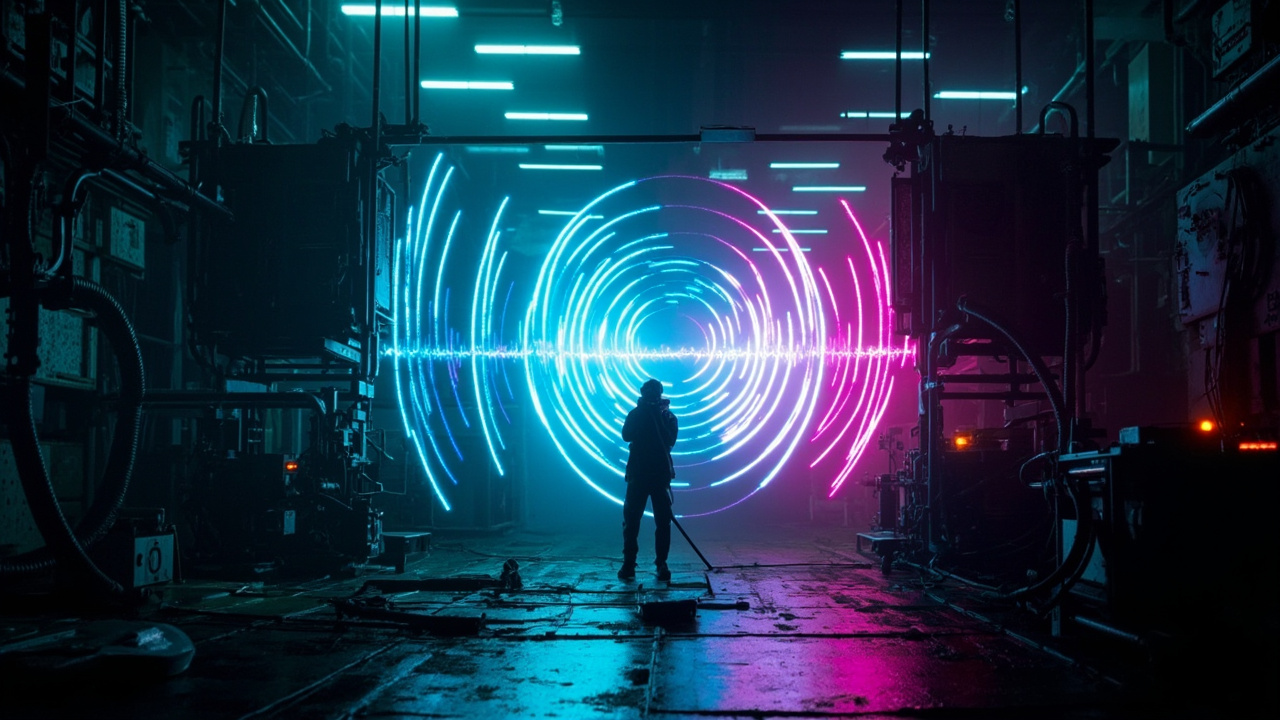
While the AI industry’s spotlight stays fixed on chatbots and video generators, a quieter branch of the field — one that decides whether robots and industrial systems can actually survive the real world — is making serious progress. This morning, Mitsubishi Electric announced the development of Task-Aware Unified Source Separation, or TUSS: a single AI model that can pick out individual sounds — a worker’s voice, a failing bearing, a passing forklift — from tangled, real-world audio, and hand each one cleanly to downstream AI systems. The company will demo it live at CEATEC 2026 in Chiba this October under the title “Ear of Physical AI.”
The problem: machines are deaf in noisy places
Humans perform source separation effortlessly. Standing on a factory floor, you can tune into one conversation while a compressor roars and music plays somewhere in the background — the famous “cocktail party effect.” Machines historically cannot. Traditional pipelines handle exactly one task: a model trained to isolate speech from noise cannot separate two overlapping speakers, and a model trained on musical instruments is useless for detecting anomalous machine sounds.
That rigidity has real consequences for “physical AI” — robots, inspection drones, voice-controlled shop-floor equipment, monitoring systems. Every new acoustic task historically meant designing, training, and deploying a brand-new separation model. A factory deploying voice control, anomaly detection, and situational-awareness monitoring would need three separate audio stacks, each brittle when acoustic conditions drift from the training data.
How TUSS works: prompts instead of separate models
TUSS sidesteps that entire approach. Instead of one model per task, it uses a variable number of learnable prompts to tell a single network what to listen for. Specify “two speakers” via prompts and it performs speech separation. Specify “speech plus background noise” and it performs speech enhancement. Specify “machine sound” and it performs environmental-sound extraction for anomaly detection. The model changes its separation behavior at inference time depending on which prompts it receives — no retraining, no separate deployments.
The research, led by Kohei Saijo and colleagues at Mitsubishi Electric Research Laboratories (MERL) in Cambridge, Massachusetts, was published at ICASSP 2025 (arXiv:2410.23987). The team frames the contribution with unusual honesty about a genuine technical contradiction: music source separation wants instruments split apart, while cinematic audio separation wants them grouped together. Prior unified models handled this tension poorly, because a single unconditional network can’t satisfy contradictory objectives. TUSS resolves it by making the task itself an input — the prompt vector selects which behavior the network expresses.
In their experiments, the single TUSS model successfully covered five major separation tasks: speech enhancement, speech separation, sound event separation, music source separation, and cinematic audio source separation. MERL has released the training and evaluation code openly on GitHub, so the claims are reproducible rather than marketing vapor.
Why it matters for physical AI
The announcement’s framing — “Ear of Physical AI” — is more than a slogan. Mitsubishi Electric’s core business is factory automation, elevators, HVAC, and infrastructure equipment, and the press release explicitly targets “acoustically complex environments such as manufacturing sites and public spaces.” The near-term integration path is straightforward:
- Anomaly detection: continuously extract a specific machine’s acoustic signature from a wall of factory noise; even subtle deviations become visible to a diagnostic model.
- Robust voice control: operators can command equipment by voice without walking to a quiet room first.
- Situational awareness: security and monitoring systems can track specific sound events — a person shouting, glass breaking, a motor stalling — amid unrelated clutter.
- Operational recordkeeping: clean, separated audio feeds transcription and logging systems with far higher accuracy than raw mixed recordings.
Each application alone is modest. Together they point at a common infrastructure layer: one audio model that every physical-AI system in a facility can query. That is the difference between a demo and a deployable platform.
The CEATEC demo will be the real test
Mitsubishi Electric says the CEATEC 2026 exhibit (Makuhari Messe, October 13–16) will run a live demonstration: microphones will capture mixed audio at the venue itself — machinery, musical instruments, multiple simultaneous speakers — and TUSS will separate prompt-specified sources in real time, piping the results into speech recognition and abnormal-sound diagnosis. Live venue audio is a notoriously unforgiving testbed; a model that holds up there is meaningfully closer to production than one evaluated on curated benchmarks.
Context: audio AI is quietly industrializing
TUSS sits inside a broader shift. For most of the past decade, source separation was an academic subfield measured on benchmark datasets. Now, as multimodal AI moves into physical environments — robots, vehicles, smart infrastructure — acoustic understanding has become a bottleneck technology. Industrial players with both research labs and deployment channels (MERL publishes at ICASSP while Mitsubishi Electric ships factory equipment) are unusually well positioned to close the lab-to-floor gap that pure-play AI labs often cannot.
The open questions remain the usual ones for physical-world AI: how gracefully performance degrades under acoustic conditions the prompts weren’t tuned for, how much compute the model needs at the edge, and whether a single prompt-conditioned model can match specialized models at the extremes. But the direction is right — fewer brittle single-purpose models, one flexible listener.
For an industry that has spent two years arguing about tokens and context windows, it is a useful reminder that the next hard problems in AI may be acoustic, embodied, and sitting on a factory floor.