"We Will Definitely Do a Humanoid": Sam Altman Confirms OpenAI Is Building Its Own Robot Body
In his cleatest hardware commitment yet, OpenAI's CEO confirmed on the Sources podcast that the company will build a humanoid robot of its own — putting the AI lab on a collision course with Tesla's Optimus, Figure, and its own former robotics partners.
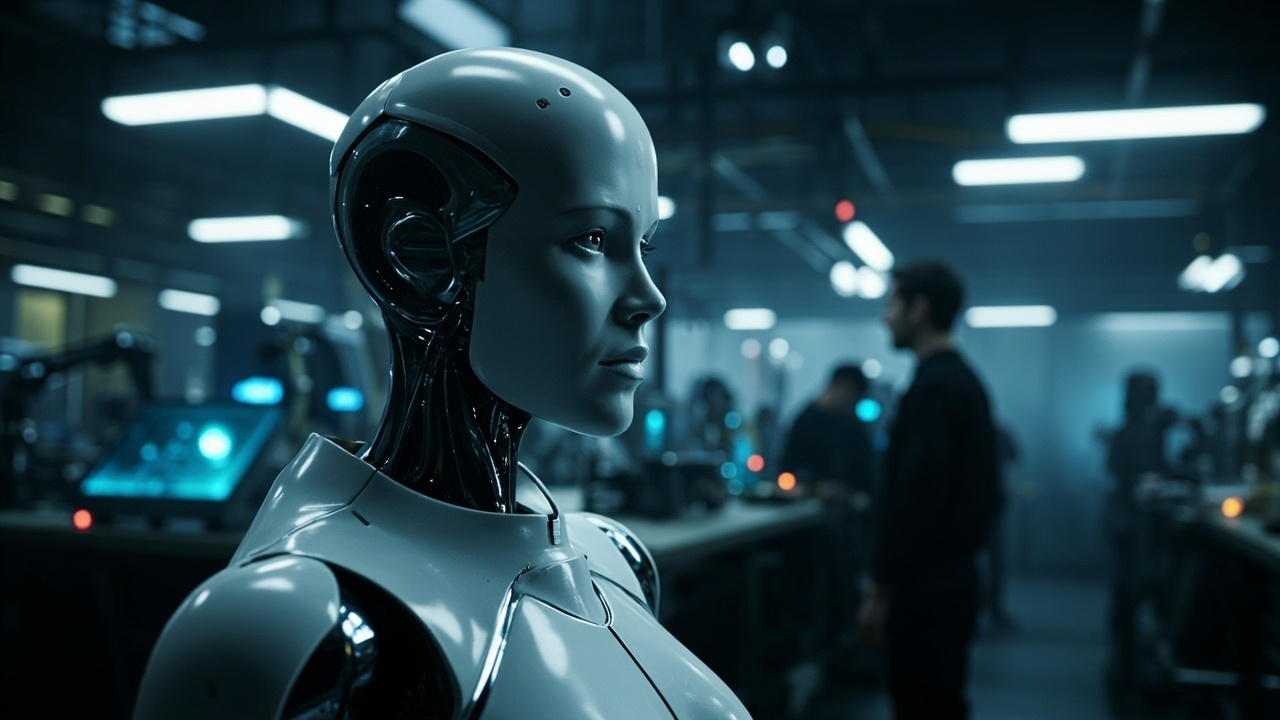
When Sam Altman was asked on the Sources podcast whether OpenAI’s revived robotics push meant a humanoid machine or specialized hardware for data centers, he did not hedge. “Both,” he said. “We will definitely do a humanoid. We will do other form factors as well.”
Those nine words, delivered in an interview recorded September 2 and first reported by Humanoids Daily and Forbes, settle a question that has hung over OpenAI since it formally launched an internal robotics division earlier this year. The most richly funded AI lab on the planet — the company that just trained GPT-6 Astra on more than 100,000 GPUs — is not going to be only a brain supplier for other people’s robots. It is going to build the bodies too.
The confirmation is brief, but its implications ripple across the entire robotics industry. Here is what Altman actually said, why OpenAI is doing this, and why the hardest manufacturing problem in tech may now belong to a company famous for shipping software.
What Altman actually committed to
Three things emerged from the interview, each more concrete than OpenAI has ever been about its hardware ambitions:
A humanoid is coming. Asked directly about form factor, Altman said “we will definitely do a humanoid” — the first time the CEO has used unambiguous language about OpenAI building a bipedal robot of its own. Until now, the company’s public posture was a robotics division, a stack of job postings, and a lot of speculation.
The world is built for people, so the robots should be shaped like them. Altman’s reasoning is the standard argument for humanoid kinematics, now endorsed at frontier-lab scale. “The world is very much designed for people,” he explained. “So if you think about like the ability to open a door and type on a computer and drive a piece of equipment and, you know, clean a kitchen and whatever else, we’ve kind of built this world for people, and I want to make sure that we keep building this world for people. So matching that form factor seems good.”
But not only humanoids. Altman was careful to note that OpenAI will also deploy purpose-built, non-anthropomorphic machines where the human form offers no advantage — specifically inside compute infrastructure. “There will of course be data center robots that have like different form factors,” he said. The near-term emphasis, he suggested, is industrial: building and maintaining data centers and manufacturing other machines, not domestic helpers.
On the consumer question — a robot in every home — he was more cautious but ultimately expansive: “I don’t think that’s the most important first thing to do… But someday. I think everyone should have a personal robot. Like I would love to have a personal robot that could like do the tasks that I don’t want to do.” (He also offered a one-word teaser on the long-rumored Jony Ive consumer device: “Soonish.”)
Crucially, Altman framed all the hardware as secondary to the intelligence that drives it: “I think all of that is less important than really figuring out like the brain that makes the robot work.”
The road that led here
OpenAI’s robotics history is a story of retreat and return. The company dissolved its original robotics team in 2021, later explained as a data problem: OpenAI could not get enough real-world physical interaction data to train on. In the interim, it invested in others — Figure’s $675 million round in early 2024, and an early stake in Norwegian-American humanoid maker 1X Technologies.
The pivot back to hardware came in stages through 2026. An internal robotics division was formalized under VP of Research Aditya Ramesh, following the high-profile departure of hardware lead Caitlin Kalinowski, who left for Anthropic and was replaced by Benjamin Bolte. On May 31, Altman announced an open hiring drive for “OpenAI Robotics,” seeking full-stack hardware, operations, systems, control, and machine learning engineers “to help us program and manufacture” robots.
The job postings told the real story. OpenAI’s careers page has listed a Technical Program Manager for Actuators ($207K–$285K), an Actuator Gear Design Engineer to develop “custom gears and gear stages for advanced robotic systems,” and an Operations Program Manager for Robotics Data Acquisition to run “data collection facilities.” This is not a lab exploring simulation research — it is a company standing up electromechanical manufacturing and physical data pipelines.
The partnerships, meanwhile, frayed. Figure CEO Brett Adcock has said he effectively had to “fire” OpenAI from their collaboration, citing the lab’s insufficient commitment to testing on physical embodiments — and, implicitly, its growing internal hardware aspirations. Figure has since built its own end-to-end foundation models. 1X is now the subject of SoftBank talks for a majority stake at a $6 billion valuation, talks that followed reports OpenAI had explored acquiring 1X outright before opting to build in-house.
Why this changes the competitive landscape
For years, the robotics ecosystem has organized around a clean division of labor: AI labs supply brains, manufacturers supply bodies. NVIDIA’s GR00T is a reference design meant to run on partners’ hardware. Google DeepMind’s Gemini Robotics 2, shipped July 30, runs on Apptronik, Boston Dynamics, and Franka platforms. Skild AI raised $1.4 billion in January at a $14 billion-plus valuation on the promise of an “omni-bodied” brain that can control robots it has never trained on. Physical Intelligence is running a similar play with π0.7.
Altman’s confirmation breaks that model. When the best brain supplier also builds bodies, the partnership pitch gets much harder — why buy intelligence from a company competing with you at the system level? As Forbes’ John Koetsier put it, OpenAI now becomes a shot across the bow of hundreds of robot companies that were buying or partnering for at least some of their physical AI.
The direct collision course is with Tesla’s Optimus, Figure, and Boston Dynamics — and with Chinese players like Unitree and XPeng’s IRON unit that dominate the manufacturing side. Agile Robots CEO Zhaopeng Chen has predicted humanoid robotics could grow to ten times the size of today’s automotive industry, and Elon Musk told G20 leaders there could be a billion robots operating on the planet within a decade. Altman has now publicly aligned OpenAI with that thesis.
The hard part: bodies are brutal
The counter-argument is manufacturing, and Musk is its best witness. Tesla began producing Optimus at its Fremont facility around August on converted Model S/X lines, five years after the program was announced — and no customer units have shipped. Musk conceded in January that no Optimus robots were doing useful work inside Tesla’s own factories, that Tesla missed its target of shipping roughly 10,000 units in 2025, and on the most recent earnings call he called Optimus “the hardest product to scale manufacturing that we’ve ever made,” requiring an entirely new supply chain.
The economics are equally unforgiving. McKinsey data cited in the Forbes analysis shows actuators account for 40–60% of a humanoid’s bill-of-materials cost, with harmonic drives and precision roller screws facing severe supplier concentration. China controls roughly 69% of rare-earth mining and about 90% of magnet processing; OpenMind estimates that building advanced robots without Chinese suppliers would cost about $131,000 against a $46,000 BOM. A company that must navigate US–China technology tensions while building its first physical supply chain inherits every one of those constraints at once.
There is also a research-driven reason the bodies matter to OpenAI specifically. OpenAI killed its robotics program in 2021 because it could not get enough data — and building and operating your own robots is the most direct route to exactly the physical interaction data that VLA (vision-language-action) models need. Toyota Research Institute CEO Gill Pratt has argued that only half the brain is solved — the fast, reflexive pattern-matching half — and that the field risks a trough of disillusionment without breakthroughs in reasoning and world models. Owning the fleet is owning the data flywheel.
What to watch
No timeline was given for OpenAI’s humanoid, and Altman’s own framing suggests compute-infrastructure robots come first. The observable signals to track: expansion of the actuator and data-acquisition job postings into actual fabrication facilities; any public debut of OpenAI-designed hardware in a data center context; the fate of the SoftBank–1X talks now that OpenAI is definitively a competitor rather than an acquirer; and whether Figure, Apptronik, or Boston Dynamics rebalance their AI partnerships in response.
Five years after walking away from robotics because the data was too scarce, the company that now runs the largest training clusters on Earth has decided the best way to get physical-world data is to build the physical world’s machines itself. Whether that bet beats the partnership model — or repeats Tesla’s half-decade of manufacturing pain with less hardware experience — will be one of the defining industrial stories of the AI era.
Sources
- [1] https://www.forbes.com/sites/johnkoetsier/2026/09/03/openai-is-making-a-humanoid-robot-everyone-should-have-one/
- [2] https://www.humanoidsdaily.com/news/sam-altman-confirms-openai-will-definitely-do-a-humanoid
- [3] https://openai.com/careers/technical-program-manager-actuators-san-francisco/
- [4] https://glitchwire.com/news/openai-builds-out-robotics-division-with-hardware-first-hiring-push/