No Brush, No Cloth, No Cross-Contamination: Hivebotics Raises $6M to Mass-Produce the Abluo Restroom Robot
Singapore's Hivebotics closed a $6M Series A led by Vertex Ventures to move its Abluo full-restroom cleaning robot from 20+ pilot sites into volume production, betting that contactless steam, an articulated arm, and auditable cleaning can fix a job with 200-400% annual turnover.
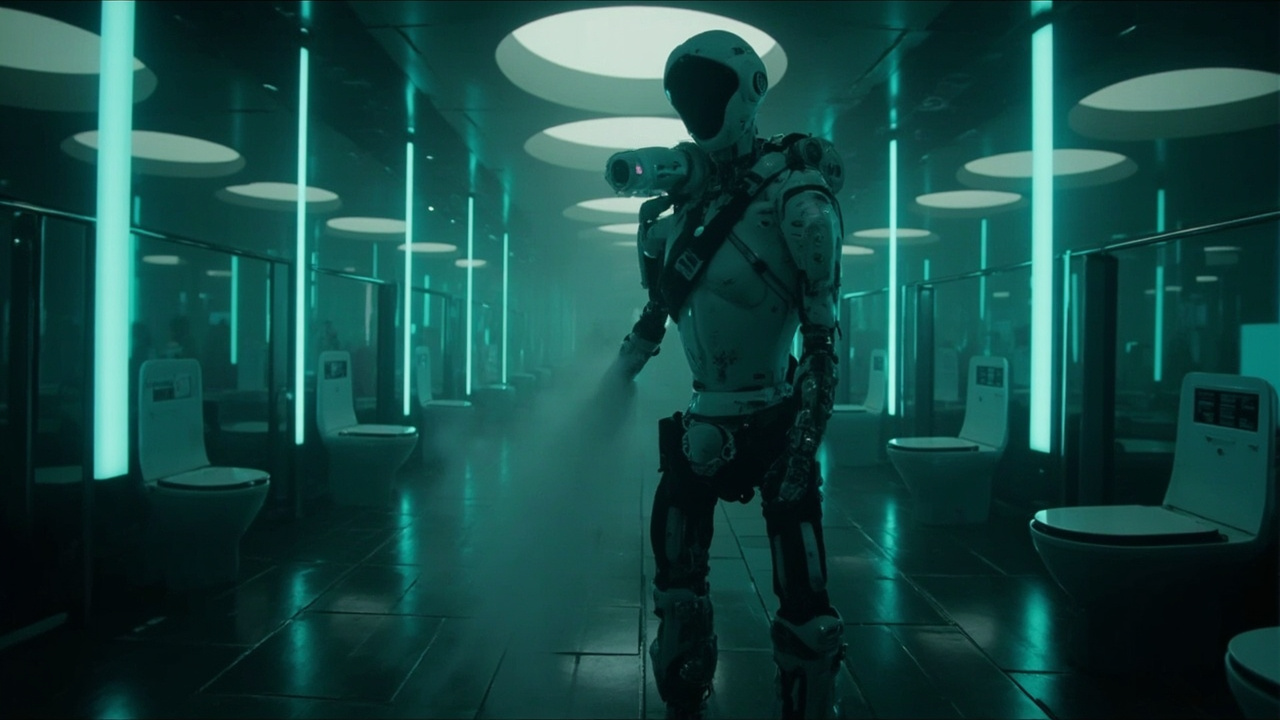
Cleaning robots have conquered the floor. Warehouses, malls, and airport terminals increasingly hum with autonomous scrubbers that trace efficient lanes across open tile. But the hardest, dirtiest, most-staff-starved room in any building — the restroom — has stubbornly resisted automation, because a restroom is not a floor plan. It is a gauntlet of cramped cubicles, protruding fixtures, wet surfaces, and contamination boundaries that no floor-only robot can cross.
Singapore-based Hivebotics just raised US$6 million to prove that gauntlet can be automated. The Series A, announced September 4 and led by Vertex Ventures Southeast Asia & India, with participation from Fareast Land Development (Farglory Group) and Rigel — a major Asian manufacturer of eco-friendly smart restroom products — will take the company’s Abluo robot from pilot deployments into volume production, expand its distributor network across four core markets, and fund further development of HiveIntelligence, the proprietary physical-AI layer that plans, monitors, and validates every cleaning job.
What Abluo Actually Does
Abluo is a mobile robot with an articulated arm that cleans a commercial restroom end to end — toilets, urinals, sinks, and floors — rather than the floor alone. That distinction is the entire company thesis. Existing cleaning robots are differential-drive platforms with a pad or brush underneath; Abluo is a mobile manipulator that reaches under toilet rims and around fixtures the way a human arm does.
The cleaning method is deliberately contactless. Instead of brushes or cloths — which carry cross-contamination risk as they travel between cubicles — Abluo combines high-pressure steam, a targeted chemical jet, vacuum extraction, and a blow-drying stage. Nothing that touched one toilet touches the next. In a post-pandemic hygiene environment where restroom audits increasingly test ATP residue on fixtures, “cleaned without contact” is both a marketing line and a compliance argument.
The perception stack matches the hardware ambition. Onboard vision identifies each fixture in the room, and a proprietary AI pipeline generates the cleaning route in real time — the robot does not follow a pre-mapped script but re-plans around an out-of-service stall or a bag left on the floor. Every job ends with a scored before-and-after check, which means cleaning outcomes can be audited rather than assumed. For facilities managers whose contracts hinge on hygiene KPIs, that audit trail may matter more than the cleaning itself.
The Mark 2 spec sheet fleshes out the picture: roughly 40 minutes per full cleaning cycle, three hours of battery runtime, a 6-DOF arm, and claimed labor reduction of 60–70% per restroom. The earlier Mark 1 platform was rated at 225 kg fully loaded and six hours of continuous operation.
From Pilots to Production
The commercial evidence behind the raise is a year of sustained field use. Abluo has logged nearly 10,000 operating hours over 12 months across more than 20 sites in Asia, Europe, the Middle East, and North America — including hospitals, airport terminals, and shopping malls. Those are the three venue types where restroom traffic, hygiene requirements, and labor costs intersect most painfully.
The company frames the economics in plain terms: Abluo replaces around 30 minutes of manual work per cycle with a five-minute human inspection. That is not full labor elimination — a human still verifies — but it converts one of facilities management’s most undesirable jobs into a supervisory one. CEO and co-founder Rishab Patwari argues the trajectory points further: “Within three years, teams of robots will do most of the repetitive, labour-intensive work of running a facility. We started with restrooms because they are the hardest: wet, cramped, and full of moving parts. Solve that, and the rest of the building follows. The timing is right. Labour is scarce, physical AI is breaking through, and hardware is getting cheap. Robots are no longer productivity tools. They are essential services.”
Why Investors Bite on a Toilet Robot
Vertex’s investment thesis, articulated by Executive Director Chan Yip Pang, is unusually specific: “Restroom cleaning is one of the few labour markets where demand is non-discretionary and supply keeps tightening. In Hivebotics’ key markets, the cleaning workforce is ageing and wage floors are rising, so operators need a way to hold hygiene standards without adding headcount they cannot find.”
The numbers back the framing. Soft facilities management — cleaning, security, catering, and related services — was estimated at US$770 billion globally in 2024 and is projected to reach US$1.23 trillion by 2033, according to Grand View Research. Restroom cleaning is its most labor-intensive line, and the hardest to staff: Kimberly-Clark has reported janitorial turnover of 200 to 400 percent annually. A job that must be done daily, that almost no one wants, and whose workforce churns multiple times per year is precisely the shape of problem automation is supposed to solve — non-discretionary demand meeting structurally scarce supply.
The participation of two strategic investors sharpens the go-to-market. Farglory Group is a major Taiwanese developer with vast property portfolios across Asia; Rigel manufactures smart restroom hardware and can accelerate the integration path into fixtures and washroom systems. Neither is a typical financial backer — both buy outcomes that Abluo produces.
The Physical-AI Layer Is the Moat Candidate
Hardware alone rarely sustains a robotics company; the durable asset here is HiveIntelligence, the software layer that plans each cleaning route, monitors execution, and validates results with scored before-and-after checks. Every deployed robot becomes a data collector for real-world restroom layouts, failure modes, and hygiene outcomes across four continents. If that flywheel compounds, Hivebotics’ route-planning and audit stack becomes harder to replicate than the arm itself — the same pattern that made navigation software the long-term value in warehouse robotics.
There is competition, notably from Chinese players pushing low-cost cleaning robots into Southeast Asia, and from incumbents like Kärcher — whose former Singapore head, Vincent Sim, notably joined Hivebotics as Chief Sales Officer in 2025, a signal worth reading either as talent flight toward the new thing or as validation of the market’s size. Founded in 2021 out of the National University of Singapore by Rishab Patwari and Nguyen Tuan Dung, the company remains early: $6 million is a modest war chest for hardware-in-production, and volume manufacturing of mobile manipulators is a capital-hungry discipline.
But the wedge is well-chosen. Restroom cleaning is the worst job in the building, the turnover statistics prove the labor market is broken, and the audit requirement gives buyers a reason beyond cost savings. If teams of robots really will run facilities within three years, the hardest room is a defensible place to start.
Sources
- [1] https://www.vertexventures.sg/news/hivebotics-raises-us-6-million-series-a-led-by-vertex-ventures-southeast-asia-india-to-automate-facilities-management-using-robots-starting-with-restroom-cleaning/
- [2] https://technode.global/2026/09/04/singapores-hivebotics-raises-6m-led-by-vertex-to-scale-restroom-cleaning-robots/
- [3] https://www.businesstimes.com.sg/companies-markets/robotics-startup-hivebotics-raises-us6-million-series-round-led-vertex-ventures
- [4] https://e27.co/hivebotics-nets-us6m-to-take-restroom-cleaning-robot-abluo-into-volume-production-20260904/
- [5] https://hivebotics.tech/abluemarkii