85% of Scans Still Booked by Fax: Inside Scan.com's $220M Bid to Wire Up US Medical Imaging
Scan.com raised $220M ($90M Series C equity led by Noteus Partners plus $130M in debt) to build a national API that uses AI to match every imaging referral to the right scanner by availability, price, and subspecialty.
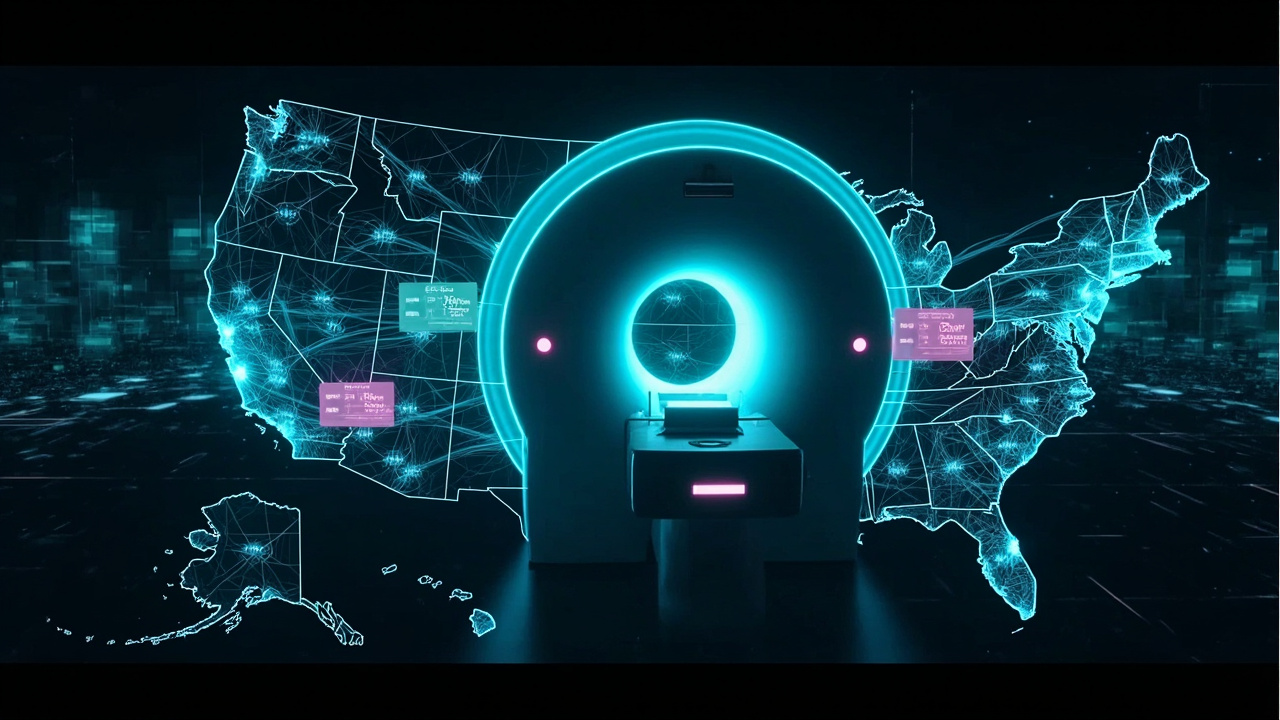
The most striking number in Scan.com’s Series C announcement is not the $220 million the company just raised. It is the 85% — the share of medical imaging appointments in the United States that, in 2026, are still booked by fax or phone. In a healthcare system that runs roughly 600 million imaging scans a year, the routing layer between a doctor’s referral and the MRI machine that actually performs the scan remains, for the most part, analog.
That is the gap Scan.com is betting $220 million on closing. The Atlanta-based company, already the UK’s largest medical imaging network, announced this week that it has closed a combined equity-and-debt financing: a $90 million Series C equity round led by London’s Noteus Partners, with participation from Aviva, Concord Health Partners, YZR Capital, and Oxford Capital, plus $130 million in debt facilities from VerisFi Capital and Atempo Growth earmarked for acquisitions and working capital. The round closed on August 31 and was made public in early September.
What Scan.com actually does
Strip away the funding language and Scan.com is an infrastructure play: a single national API that connects employers, health plans, digital health apps, third-party administrators, and workers’ compensation systems to imaging capacity across the United States. Referrals flow in through the API; scans come out the other side, booked at a quality-checked center, typically within days rather than weeks, at a price the patient can see before scheduling.
The company’s core claim is that the problem in US imaging is not a shortage of machines. It is that nothing connects the patient to the right machine at the right time. Scan.com’s own data illustrates the dysfunction: the same MRI can cost a few hundred dollars at one imaging center and several thousand at another a few miles away, with price a poor guide to quality. Some centers are booked out for weeks while scanners nearby sit idle — and the marketing and administrative cost of filling empty slots gets passed on to patients anyway.
The AI layer sits on top of this matching problem. Every referral that enters the platform is evaluated against live availability, negotiated price, and clinical subspecialty across the network. Scheduling and paperwork are handled automatically, and each completed report is routed — again by AI — to a radiologist who sub-specializes in the relevant area. Results are typically returned within 48 hours. A human team of “care guides” stays with the patient throughout the process, which the company frames as a deliberate design choice: the AI removes administrative work, not human contact.
The Quest-and-Labcorp analogy
CEO Charlie Bullock’s framing in the announcement is the clearest guide to the ambition. Diagnostics labs in the US consolidated decades ago into national infrastructure — Quest Diagnostics and Labcorp — but imaging never got its equivalent. “The US runs around 600 million medical imaging scans a year, and there is still no national infrastructure behind them,” he said. “Labs got that decades ago… Imaging never did, and that is what we have built.”
The technical differentiator, per the company, is that Scan.com integrates live and two-way with independent imaging centers’ own scheduling systems and electronic medical records, rather than relying on the static provider directories that similar companies use. That is what makes real-time matching on availability and price possible, and it is also the moat: each new center added to the network makes the routing intelligence better, and each routed patient generates data that deepens it. Noteus Partners’ investment thesis leans explicitly on this compounding — “an advantage that only continues to deepen with scale and AI.”
Traction and trajectory
The round follows a year in which Scan.com says its revenue doubled, surpassing a $165 million annualized run rate. More than 900,000 patients have accessed care through its network globally. Founded in the UK, the company expanded into the US in 2023 and says it now has operations live nationwide. The financing will fund further expansion of its US provider network and continued investment in the API and what the company calls its “agentic AI infrastructure” — the systems that route patients, schedule scans, and return diagnostic results.
The market context explains why investors wrote a nine-figure check. The US medical imaging market is valued at over $100 billion, one of the largest segments of American healthcare, and it is under simultaneous pressure from a national shortage of radiologists and technologists, employer and payer frustration with hospital pricing, and a patient population that increasingly expects to see a price before booking. Workers’ compensation systems, which bear both the cost of delayed imaging and the long claim durations that follow, are a particularly acute customer segment — Scan.com pitches days-not-weeks imaging as a direct lever on claim duration and total spend.
What to watch
Two open questions will determine whether this becomes national infrastructure or another well-funded middleman. The first is depth: a routing API is only as good as its network, and “operations live nationwide” can mean anything from dense coastal coverage to a thin national footprint. The $130 million debt facility for M&A suggests the company expects to buy density rather than only build it. The second is the AI claim itself. Matching on availability and price is a solved logistics problem; routing reports to the right subspecialist is harder; and the true test of “agentic” infrastructure is whether it can hold up inside regulated clinical workflows without the human care guides becoming the actual bottleneck.
Either way, the fax machine’s share of that 85% is now, officially, a funded target.
Sources
- [1] https://scan.com/media/press-releases/scan-com-series-c-2026
- [2] https://www.mobihealthnews.com/news/scancom-secures-220m-us-medical-imaging-expansion
- [3] https://radiologybusiness.com/topics/healthcare-management/healthcare-economics/radiology-appointment-booking-platform-scancom-raises-220m
- [4] https://www.fiercehealthcare.com/finance/scancom-raises-220m-build-largest-medical-imaging-network-us