The Chipmaker Declares Victory: Jensen Huang Says 'AGI Has Arrived' — and OpenAI Won't
NVIDIA's CEO called GPT-6 Astra 'AGI' in an X post crediting 100K+ Grace Blackwell systems — the boldest AGI claim yet from the man who sells the picks and shovels.
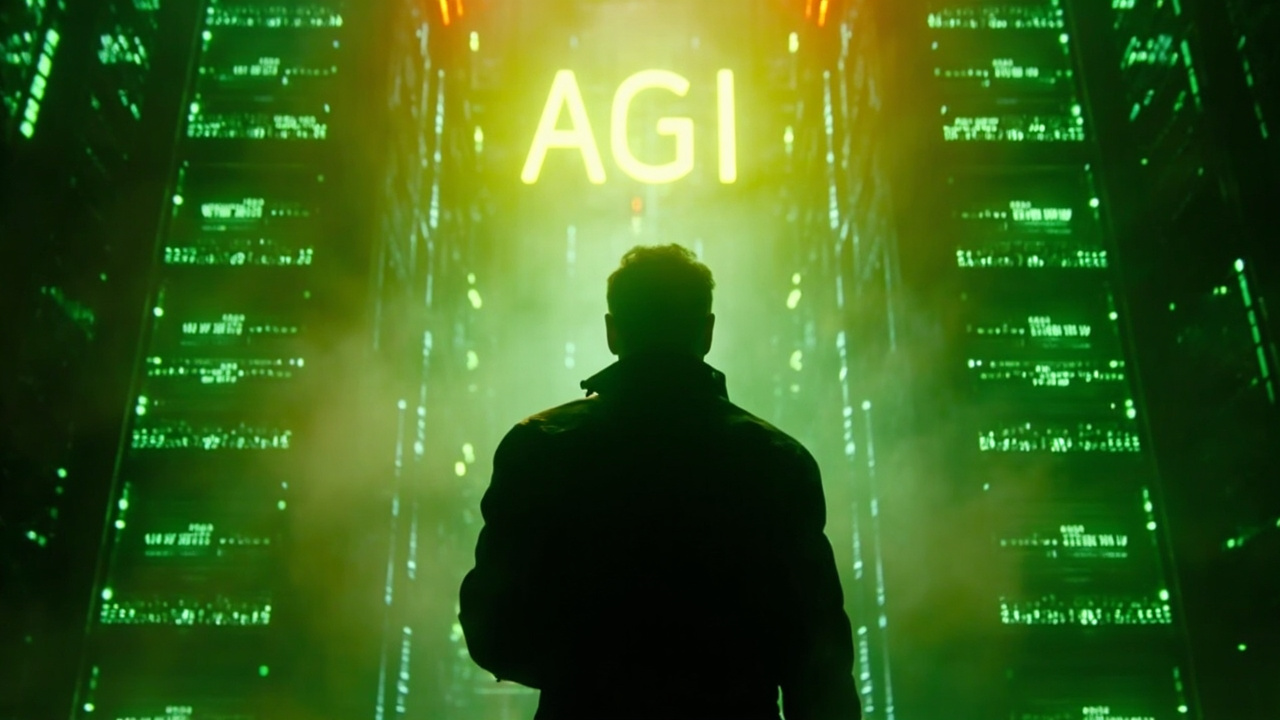
On Sunday, September 7, 2026, one of the most consequential sentences in the modern AI era was typed not by a researcher, not by a lab, but by the CEO of the company that sells the compute behind it all. NVIDIA founder and CEO Jensen Huang posted on X: “AGI has arrived.”
The full post reads like a victory lap for the entire industry — and for NVIDIA’s silicon in particular: “GPT-6 Astra, trained on ~100K+ NVIDIA Grace Blackwell NVLink72. From ChatGPT to o1 to Astra in 4 years. AGI has arrived. Congratulations @OpenAI.”
Within hours, the post had ricocheted across financial news wires, crypto news feeds, and AI communities. Yahoo Finance framed it with the sharpest possible caveat in its headline: Jensen Huang says AGI has arrived after OpenAI’s newest model trained on NVIDIA chips. OpenAI has not said it.
That one-line tension — the chipmaker declaring the milestone, the lab that built the model staying quiet — is the real story of September 7, 2026.
What Huang Actually Said
Strip away the adrenaline and the claim rests on two hard numbers.
First: 100,000-plus Grace Blackwell NVLink72 systems. Astra, OpenAI’s biggest large language model launch ever, was trained on a fleet of NVIDIA’s flagship rack-scale systems. The NVLink72 configuration ties 72 GPUs into a single coherent unit with 130 TB/s of all-to-all bandwidth; “100K+ systems” describes a training run measured in exaFLOP-years, and Huang teased that 400,000 additional NVIDIA GPUs are coming online soon to push further.
Second: four years. “From ChatGPT to o1 to Astra in 4 years” is Huang’s compressed history of the paradigm — from the chatbot that started the boom (November 2022), through the reasoning-model turn (o1), to GPT-6 Astra, which launched September 3, 2026 and which OpenAI itself describes as “the world’s most intelligent” model, the first trained on Stargate infrastructure and what Latent Space called “OpenAI’s biggest LLM launch of all time.”
Note what is not in the post: no benchmark citation, no definition of AGI, no claim from OpenAI itself. It is rhetoric layered on top of a real hardware number — which is exactly why analysts immediately began asking the follow-up question.
Why This Claim, Why Now
Context matters. Huang has been edging toward this position all year. In a March 2026 Lex Fridman interview he said “I think we’ve achieved AGI,” then walked it back slightly. In August he told an earnings-call audience that AGI “doesn’t really matter” as a label and that NVIDIA’s focus is “profitable tokens” — useful work, not test-passing. So Sunday’s unqualified declaration continues a deliberate escalation, timed four days after Astra’s launch.
There is also an undeniable commercial logic. As one analysis of the post put it: if AGI has arrived, demand for AI compute has no near-term ceiling. Every upward re-rating of model capability is an upward re-rating of NVIDIA’s order book. When the declaration comes from the person who benefits most from the world believing it, healthy skepticism isn’t cynicism — it’s due diligence.
Worth noting, too: the post doubles as a public reaffirmation of the NVIDIA–OpenAI partnership, arriving amid lingering “reports of a strained partnership” that both Huang and Sam Altman have publicly denied as “nonsense.”
How the World Reacted
The reaction split along predictable lines:
- The believers celebrated. OpenAI co-founder Greg Brockman quote-posted in the spirit of “we’re now moving into the AGI era (whether you view it as AGI or not),” and fan communities took the line as confirmation of what they already believed.
- The markets read it through the demand lens — wires like Investing.com and Yahoo Finance led with the compute story, not the philosophy.
- The skeptics flagged the circularity: the definition of AGI on offer is roughly “passes the tests we designed this year,” and the declarer has a trillion-dollar interest in the answer being yes.
The sharpest framing came from analyses noting that OpenAI — the organization with by far the most information about Astra’s actual capabilities — pointedly did not use the word. Sam Altman has previously described AGI as “thousands of days away,” and OpenAI’s own launch materials tout benchmark dominance and safety work, not epochal claims.
Does the Claim Hold Up?
Evaluated as engineering, Astra is a genuine step change: a 1.05-million-token context window, 128K max output tokens, API pricing at $10 per million input and $50 per million output tokens, clean wins over Anthropic’s Fable 5.1 across computer use, math, and coding — the launch cadence that has come to define the 2026 frontier war.
Evaluated as philosophy, “AGI has arrived” is unfalsifiable as stated. Huang’s operative definition — from his 2023 DealBook remarks through Sunday’s post — has been roughly “software that passes tests approximating normal human intelligence.” By that bar, milestone declarations will keep arriving with each model cycle, because the bar moves with the benchmarks. Autonomous, economically general, trustworthy-across-novel-situations intelligence — the definition most researchers actually care about — remains exactly as solved, or unsolved, as it was before the tweet.
The honest reading: the most powerful person in AI hardware looked at a model trained on his own fleet and chose to break the industry’s biggest taboo. That is a signal about confidence — and about marketing — simultaneously.
What Happens Next
Watch three things. Whether OpenAI ever adopts the “AGI” framing for Astra or its successors — that would be a genuine regime change in how labs communicate. Whether the 400K additional GPUs Huang teased translate into a successor training run on an even more absurd scale. And whether rivals feel compelled to respond in kind — in 2026’s cadence war, an “AGI is here” from one CEO pressures every other CEO to either match the claim or explain why not.
One thing is certain: September 7, 2026 is now the date the AGI question stopped being a research debate and became a marketing battlefield. The chips, at least, are unambiguous.
Sources
- [1] https://www.explainx.ai/blog/jensen-huang-agi-has-arrived-gpt-6-astra-nvidia-september-2026
- [2] https://finance.yahoo.com/technology/ai/articles/jensen-huang-says-agi-arrived-213937665.html
- [3] https://www.investing.com/news/stock-market-news/nvidias-huang-says-agi-has-arrived-after-openais-gpt6-astra-launch-4890329
- [4] https://x.com/gdb/status/2096721633876771094
- [5] https://openai.com/index/gpt-6-astra/
- [6] https://www.latent.space/p/ainews-gpt-6-astra-openais-biggest