No Teleop, No Script: Unitree's UnifoLM-X2-1.0 Drives Fully Autonomous Humanoid Combat With a Real-Time World Model
Unitree claims UnifoLM-X2-1.0 is the first real-time world-model system to control fully autonomous humanoid combat — no teleoperation, no choreography. Inside the claim, the WMA-0 lineage, and what's still unproven.
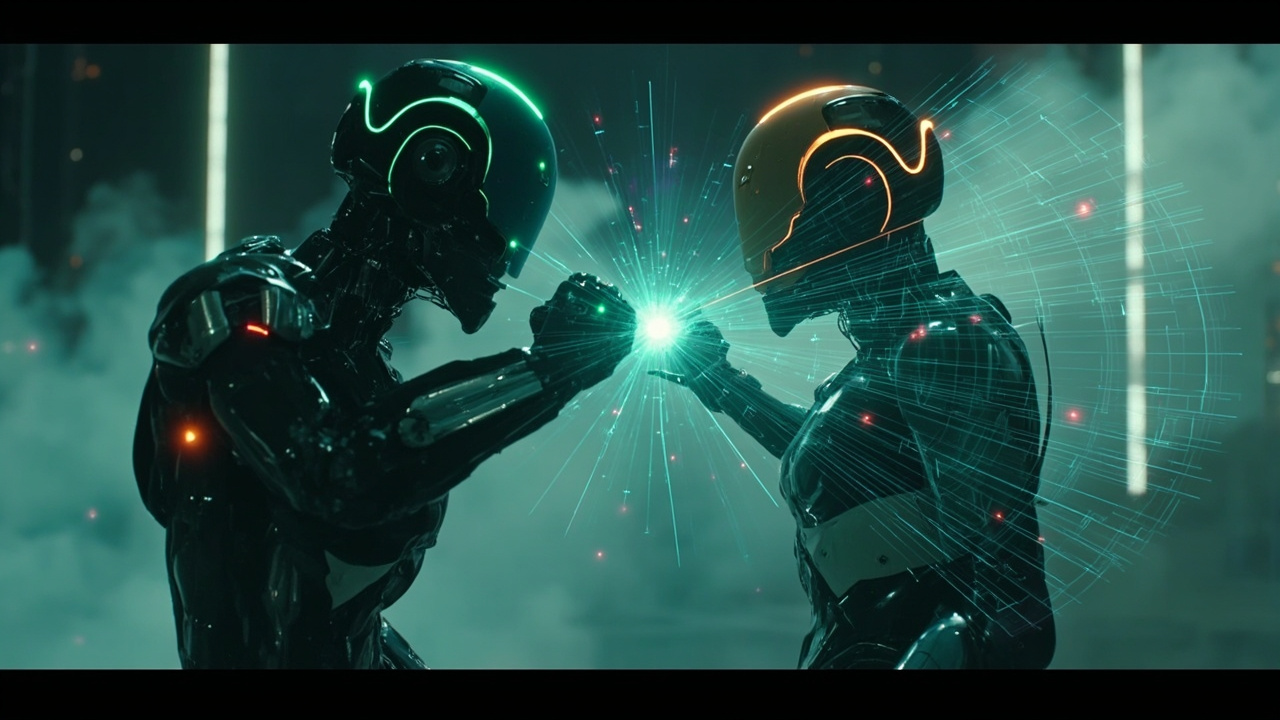
On September 7, Unitree Robotics released UnifoLM-X2-1.0, a system the company describes as the first real-time, world-model-driven platform for fully autonomous humanoid robot combat — no human operator behind a remote console, no scripted choreography, no pre-planned motion sequences. If the claim holds up, it marks a meaningful boundary crossing for embodied AI: a machine that doesn’t just execute learned skills, but continuously predicts what happens next in the physical world and plans against it, in real time, against an adversary that is trying to do the same.
The framing is deliberately provocative. Combat is not where most robotics companies are competing — the money is in warehouses, factories, and demos of folding laundry. But as a stress test of autonomy, a sparring match is close to the worst case, and that is exactly why the announcement is worth taking seriously even before the details arrive.
What a world model actually does here
A world model, in this context, is a neural network that internally simulates the consequences of actions. Given the current visual state of the scene and a candidate action, it predicts how objects will move, how forces will interact, and how the robot’s own body will respond. Instead of reacting to what already happened — the classical control loop — the robot acts on a prediction of what is about to happen.
Unitree frames the X2-1.0 release around four bottlenecks it says previous world-action foundation models failed to break through:
- Instant planning — generating viable actions fast enough to matter in a dynamic exchange.
- Decision-making against a moving, adversarial opponent that responds to your moves.
- Dynamic interactive execution — surviving high-force contact events like punches and kicks without falling over or freezing.
- Real-time prediction of future states, rather than reactive control after the fact.
In the demonstration video, a fleet of Unitree humanoids executes martial-arts routines, flips, and high-speed engagements. The company says the system predicts “the next few seconds of physics” and plans within that horizon.
The lineage: WMA-0, open-sourced a year ago
X2-1.0 did not appear from nothing. In September 2025, Unitree open-sourced UnifoLM-WMA-0, its first world-model-action architecture, spanning multiple robotic embodiments. The base model is still available on Hugging Face, with training code on GitHub — which matters, because it gives outsiders a concrete picture of the architectural DNA that X2-1.0 presumably inherits.
WMA-0 is a video-diffusion world model with an action head, trained on Open-X plus five Unitree datasets. It operates in two modes: a Decision-Making Mode that predicts information about future physical interactions to help a control policy generate actions, and a Simulation Mode that generates high-fidelity environmental feedback conditioned on robot actions. Training was two-stage — a video generation stage followed by action-conditioned fine-tuning.
X2-1.0 looks like the production-grade evolution of that line: the same idea of simulating the future before committing to an action, hardened for contact-rich, adversarial, latency-unforgiving scenarios.
Why combat is the honest benchmark
Warehouse pick-and-place is forgiving. Objects sit still, timing is loose, and a failed grasp costs a retry. A sparring opponent is the opposite on every axis: contact-rich, adversarial, and punishing of even tens of milliseconds of lag. If a world model can plan effectively inside that envelope, the same capability stack points at a long list of less cinematic but more commercial applications:
- Bimanual manipulation of moving or deformable objects, where the object’s state evolves during the motion.
- Human-robot collaboration on shared tasks, where the human moves unpredictably.
- Locomotion over shifting terrain or under external disturbance — the prediction problem is the same, the stakes differ.
- Teleoperation, where round-trip latency currently caps performance; a local world model that predicts through the lag effectively hides it.
There is also an architectural story underneath. Most humanoid stacks today are a patchwork: a learned locomotion policy at the bottom, a VLA or LLM planner on top, and hand-crafted safety layers glued in between. A single world model that predicts the next few seconds of physics and drives control directly would collapse that stack — fewer seams, fewer failure modes, one representation of the future. Whether X2-1.0 truly is that unification or a demo-shaped slice of it is the open question.
What’s missing — and it’s a lot
The skeptic’s ledger is non-trivial. There is no paper, no benchmark numbers, no inference latency figure, and no confirmation of whether X2-1.0 will be open-sourced like its predecessor. The combat footage is impressive, but there is no way to tell from a video how much is cherry-picked, how the model handles novel opponents or environments, what the failure modes look like, or how much compute it takes to run these predictions at control frequency on the robot itself. The gap between “world’s first” in a press cycle and “reproducible in a lab” is exactly where robotics announcements usually go to die.
The right posture is conditional belief: the lineage is real, the prior work is inspectable, and the demo is consistent with the claimed capability — but the evidence is a video and a claim.
The company behind the claim
Unitree is carrying real momentum into this release. Founded in 2016 by Wang Xingxing in Hangzhou, the company started with quadruped robots before moving into humanoids, and has emphasized vertical integration — designing and manufacturing core components in-house — as its cost weapon. The G1 humanoid sells for roughly $16,000–$18,000, a fraction of Western competitors’ pricing.
As of July 2026, Unitree had shipped more than 18,000 humanoid units and was profitable. Its August 2026 listing on the Shanghai STAR Market raised approximately $905 million in an oversubscribed IPO, with Wang signaling that substantial portions of the proceeds will fund AI model development. X2-1.0 is the first high-profile output of that spending priority — and a signal that Unitree intends to compete on models, not just hardware margins.
What to watch
For anyone building on humanoid platforms, the decisive question is whether X2-1.0, or a distilled variant of it, lands on Hugging Face next to WMA-0 and Unitree’s existing VLA models. The moment the weights are downloadable, this stops being a marketing video and becomes something the community can fine-tune, benchmark, and break. Watch also for third-party replications of the autonomous-combat claim, latency disclosures, and whether the two-mode WMA-0 architecture survives into the new system.
Until then, UnifoLM-X2-1.0 is best read as a thesis statement with excellent production values: that the path to useful humanoids runs through predicting the future, not reacting to the past — and that the first company to industrialize that idea may be the one already selling 18,000 robots.
Sources
- [1] https://alphasignal.ai/news/unitree-s-unifolm-x2-1-0-lets-humanoid-robots-fight-with-no-human-control
- [2] https://cryptobriefing.com/unitree-world-model-humanoid-robot/
- [3] https://www.kucoin.com/news/flash/unitree-unveils-world-s-first-autonomous-humanoid-robot-powered-by-real-time-world-model
- [4] https://x.com/UnitreeRobotics/status/2096932273602048258
- [5] https://github.com/unitreerobotics/unifolm-world-model-action
- [6] https://huggingface.co/unitreerobotics/UnifoLM-WMA-0-Base