Google's €13 Billion Finland Bet: The Largest Single Investment in Its European History Buys Nuclear-Powered AI
Google will pour at least €13 billion into Finnish AI infrastructure through 2027-2028 and sign a 22-year nuclear PPA with Fortum that keeps the Loviisa plant — 10% of Finland's electricity — online beyond 2030.
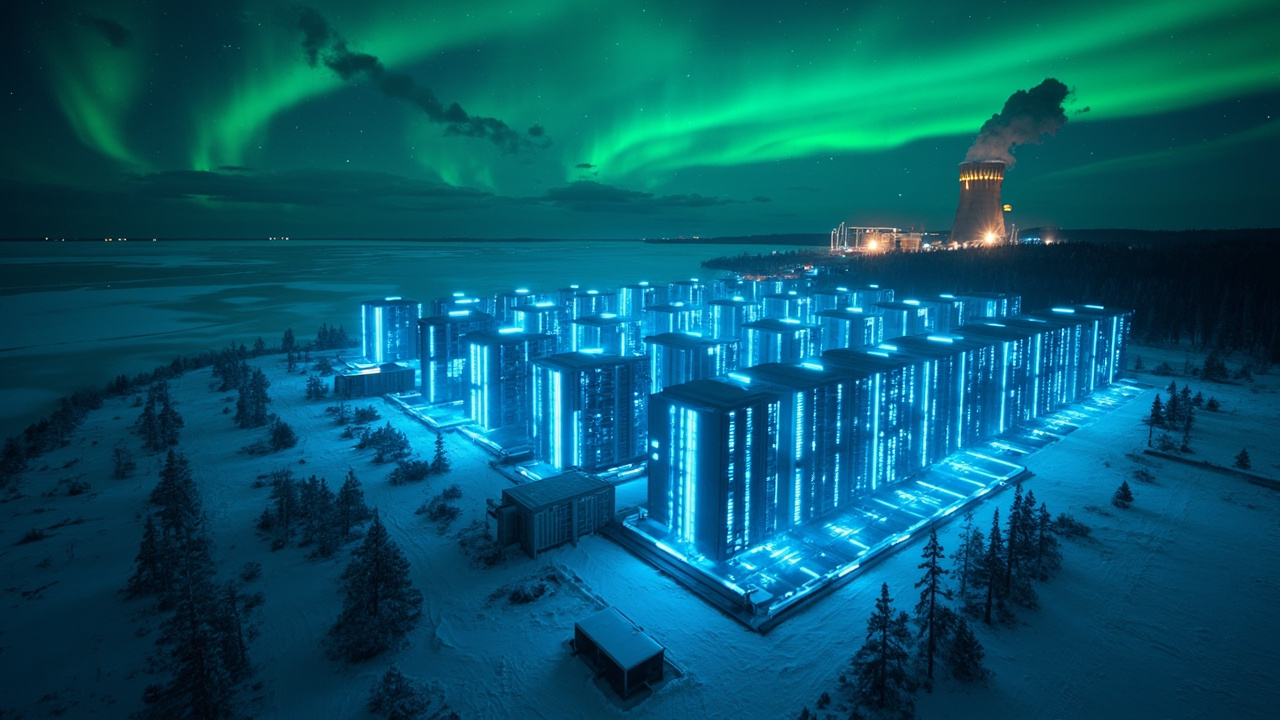
The race to power artificial intelligence has entered a new phase: the era of hyperscalers underwriting national energy assets. On September 9, 2026, Google announced it will invest at least €13 billion ($15.1 billion) in digital infrastructure in Finland over the next two years (2027–2028) — the company’s largest single investment in its European history — while simultaneously signing a 22-year nuclear power purchase agreement with Finnish utility Fortum that effectively keeps a nuclear power plant alive.
The announcement, made jointly from Hamina, Kajaani, Muhos, and Vaala, bundles together data center construction, grid partnerships, wind and battery projects, and a nature-restoration program. But the headline number conceals the most strategically interesting part of the deal: for the first time at this scale, a tech company is acting as the anchor tenant for a nuclear lifetime extension.
What’s in the €13 billion
Google’s investment covers data centers and supporting infrastructure across four Finnish municipalities: Hamina on the southern coast, where Google bought a former paper mill in 2009 and converted it into its first Finnish data center, and Kajaani, Muhos, and Vaala in the country’s north. The buildout includes three new data centers plus an expansion of the existing Hamina campus.
The economics for Finland are substantial. During the 2027–2028 construction phase, Google estimates the initiative will contribute an annual average of €3.6 billion to Finland’s GDP and support more than 37,000 jobs nationwide — roughly 16,000 of them in construction, generating €911 million in average annual labor income in that sector. Once operational, the facilities are projected to support 7,000 jobs annually, with wages averaging 24% above Finland’s median.
This is a meaningful macro injection for a country of 5.6 million people still navigating the aftermath of Finland’s early-2020s recession and the loss of Nokia-era hardware glory. Reuters reported that Google expects the initiative to contribute an annual average of $4.2 billion to Finnish GDP during the buildout.
The nuclear deal that anchors everything
The most consequential element of the announcement is the 22-year power purchase agreement with Fortum, Finland’s majority-state-owned energy company. The PPA covers the lifetime-extension period of the Loviisa nuclear power plant, which today employs around 580 people and supplies roughly 10% of Finland’s electricity.
The mechanics matter. Loviisa’s two Soviet-era VVER reactors have operating licenses running to 2050, but Fortum has an ongoing €1 billion lifetime-extension investment program — including a turbine-island modernization already underway — required to keep the plant running past 2030. According to Fortum’s stock exchange release, approximately 80% of the projects and €700 million of that capital expenditure still lacked final investment decisions. Google’s PPA provides exactly the long-term revenue certainty needed to commit to 100% of the lifetime extension.
In other words: without Google’s contract, one of Finland’s two nuclear plants would likely have gone dark after 2030. With it, a 10% slice of the national electricity supply is secured through mid-century.
The PPA ramps up in stages: it begins in 2028 with smaller capacity, then reaches 50% of Loviisa’s capacity for 2030–2049. For Fortum, the deal is expected to lift the group’s comparable return on net assets (RONA) by approximately 1.4 percentage points over time — meaningful progress toward its 14% long-term target, from 11.0% LTM at the end of Q2 2026.
The agreement also enables a further 10 MW power uprate of the plant on top of an already-planned 38 MW uprate expected to go live in 2028. Beyond the PPA, the companies signed a memorandum of understanding to explore new nuclear reactors at the Loviisa site, new renewable and flexibility capacity, and energy portfolio management services.
Why a hyperscaler is now a nuclear offtaker
Google framed the deal as a “blueprint for responsible integration of AI into European energy systems,” and the structure reflects genuine grid strategy rather than greenwashing. Three design choices stand out.
First, the geography. In partnership with transmission system operator Fingrid and Business Finland, Google deliberately sited the new data centers in Finland’s north rather than the south — close to existing grid infrastructure and carbon-free energy sources. That reduces the need for new grid investment and, per Google, helps lower system costs across Finland and the Nordics. The AI-era siting calculus inverts the old logic of building near population centers: power proximity now trumps latency for training workloads.
Second, the cooling and heat loop. Google’s Hamina campus pioneered seawater-based cooling and offsite heat recovery that covers roughly 80% of the annual heat needs of Hamina’s district heating network — waste heat warming Finnish homes. The company says heat-recovery readiness is now embedded in the design of all its new Finnish sites, a model directly relevant to other cold-climate data center builds.
Third, the flexibility stack. Google announced additional onshore wind PPAs with Valorem and Suomen Hyötytuuli bringing its total new-to-the-grid onshore wind capacity in Finland to 629 MW, plus a 94 MW battery system near Kajaani expected online in late 2027 to help balance the grid during cold, windless Nordic winter periods. The company is also working to let its wind portfolio participate in Fingrid’s ancillary markets.
The community and nature package
Unusually for an infrastructure announcement, roughly as much ink was spent on ecology as on megawatts. Google will fund ecological restoration of former forestry lands adjacent to its sites — native forest regeneration, peatland and wetland conservation, wildlife corridors — plus public saunas, fishing piers, and year-round recreational trails. A €31 million community fund over four years supports local education and economic growth in the four municipalities, with €10 million earmarked for research and innovation. Municipal energy programs will bring solar and heat pumps to low-income households and upgrade backup power for emergency and health services.
Since 2023, Google’s Hamina operations have drawn on an ecosystem of more than 600 Finnish suppliers including DNA, Elisa, and Nokia. The Hamina site anchors one of Google’s 43 cloud regions, serving customers like Nokia, Elisa, and the City of Hamina itself.
The bigger picture
The Finland deal lands amid an unprecedented global capex surge by AI hyperscalers, and it sharpens three trends worth watching.
Energy is now the binding constraint on AI scaling. Microsoft has bet on the Three Mile Island restart; Amazon and Meta have chased nuclear PPAs of their own; OpenAI has backed gas turbines and fusion moonshots. Google’s move is distinctive in tying a data center expansion directly to an existing plant’s lifetime extension — a faster, cheaper path to firm carbon-free power than new-build nuclear, and one that turns a decommissioning risk into a grid asset.
Europe is competing for AI infrastructure on its own terms. Finland offers what AI builders now crave most: cool climate, cheap and stable nuclear-heavy electricity, deep grid competence, and EU jurisdiction for customers with data-residency needs. Google calling this its largest European investment signals that the “sovereign AI” wave is translating into concrete hyperscaler commitments on the continent — echoing the likes of Cerebras’ recent Mikkeli supercomputer site elsewhere in Finland.
Offtake agreements are becoming industrial policy. A single corporate PPA is here doing work that would once have required government guarantees: keeping 580 skilled nuclear jobs alive, stabilizing electricity prices in the south of the country, and potentially catalyzing new reactors at Loviisa through the MoU. Expect regulators and utilities across Europe to study the Fortum–Google structure closely — it is a template for how private AI demand can be marshaled toward public grid resilience, and equally a reminder of how dependent the AI buildout has become on deals struck decades into the future.
For Finland, €13 billion over two years is a generational bet that the country’s quiet advantages — clean power, cold air, and engineering depth — are exactly what the AI economy will pay a premium for. For Google, it locks in energy and capacity at the moment when both are the scarcest commodities in technology.
Sources
- [1] https://www.googlecloudpresscorner.com/2026-09-09-Google-Deepens-Commitment-to-Finland-with-Two-Year-EUR13-Billion-investment-in-AI-Infrastructure
- [2] https://www.fortum.com/media/2026/09/inside-information-fortum-and-google-partner-drive-sustainable-growth-finland-sign-nuclear-power-purchase-agreement
- [3] https://www.reuters.com/business/media-telecom/google-invest-15-billion-ai-infrastructure-finland-2026-09-09/
- [4] https://www.wsj.com/business/google-to-invest-15-billion-in-data-centers-and-infrastructure-in-finland-335c5ee2