From Simulating the World to Acting in It: HiDream's O1-Embodied Tops RoboColiseum's Hardest Leaderboard
HiDream.ai launches HiDream-O1-Embodied, an embodied world model that ranks No. 1 on RoboColiseum's Robustness leaderboard (0.692) and pairs a 100x generative data flywheel with Noitom motion capture.
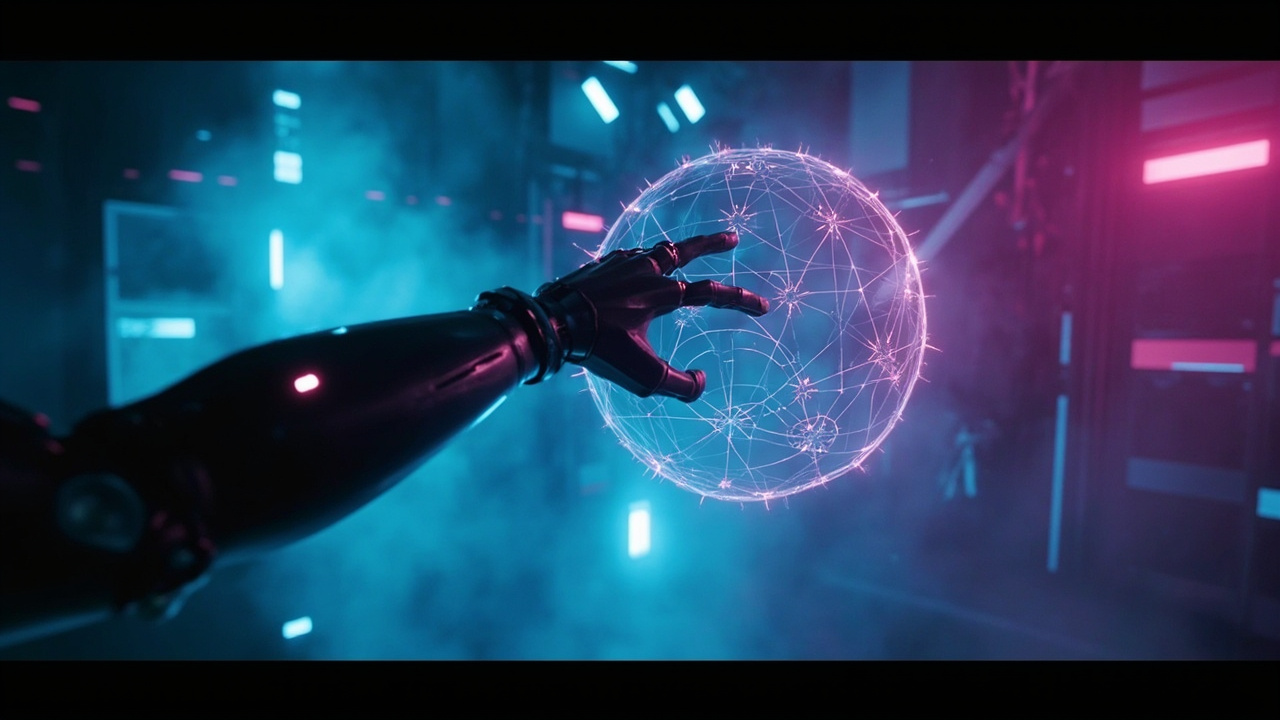
Just weeks after releasing HiDream-O1-World, its interactive video world model that claimed the top spot on WBench’s Navi sub-leaderboard with a score of 80.9, Beijing-based HiDream.ai has taken the next, harder step: the company today launched HiDream-O1-Embodied, an embodied world model built to carry AI out of digital simulation and into physical interaction with the real world.
The launch is more than another checkpoint on a corporate roadmap. It is a concrete demonstration of how the “world model” thesis — the idea that the next generation of foundation models must internalize physics, causality, and action rather than just text and pixels — is being operationalized by one of China’s most ambitious AI labs, and how the hardest bottleneck in embodied AI is being attacked not with more parameters but with a fundamentally different approach to data.
Why Robustness Is the Leaderboard That Matters
Alongside the release, HiDream-O1-Embodied made its public debut on RoboColiseum, a standardized simulation benchmark for embodied intelligence models, and immediately ranked No. 1 on its Robustness leaderboard with an average score of 0.692.
RoboColiseum is not a toy benchmark. The platform evaluates models across four dimensions — instruction following, spatial understanding, robustness, and general-purpose manipulation — through four capability leaderboards and 78 high-fidelity simulation tasks designed to closely approximate real-robot performance. It is open to universities, research institutions, and model developers worldwide, and it has attracted dozens of leading models from China and abroad since entering internal testing.
Among the four dimensions, Robustness is widely regarded as the most challenging — and the most predictive of real-world value. Rather than testing models in the “greenhouse” of idealized lab conditions, the Robustness track deliberately varies backgrounds, lighting, materials, robot initial states, camera positions, and image quality, while also introducing diverse paraphrases of instructions. It measures exactly what breaks most robot deployments: how gracefully a system degrades when the world refuses to cooperate.
A score of 0.692 at the top of that leaderboard means HiDream-O1-Embodied maintained stable task execution under precisely the kinds of disturbance — occlusion, lighting shifts, camera miscalibration, noisy instructions — that cause single-view, keyword-matching robots to fail outright.
Three Execution-Level Advances
The robustness result rests on concrete architectural commitments at the execution level, which HiDream describes across three core capabilities.
Language understanding beyond keyword matching. Traditional robots interpret instructions as keyword lookup: “Bring me the cup” works, but “Get me a cup” or “Hand me the cup” may silently fail. HiDream-O1-Embodied instead covers an equivalent instruction space spanning diverse verbs, sentence structures, and expressions, focusing on the underlying intent rather than the literal wording. However an instruction is phrased, the model identifies what the user actually means.
Multi-view visual collaboration. In the physical world, a robot’s visual input is rarely ideal: camera positions shift, calibration drifts over time, and individual feeds get obstructed. Rather than relying on a single fixed perspective, O1-Embodied integrates multiple viewpoints so that different visual channels complement one another. When one feed becomes inaccurate or temporarily unavailable, the others carry the scene understanding and execution continues. The design goal is explicit: transform “a single failure causes the entire system to fail” into “local limitations do not prevent the system from operating as a whole.”
Fault tolerance trained into the model. Most models are trained on “perfect” data — clear images, complete frames, standardized viewpoints — a regime the real world almost never provides. HiDream-O1-Embodied proactively injects a wide range of non-ideal conditions during training, repeatedly exposing the model to incomplete, noisy, and unstable information until reliable decisions from limited visual cues become the default behavior. The model is deliberately not optimized for peak performance under ideal conditions, but for stable execution in complex, dynamic environments.
The 100x Data Flywheel
The most strategically interesting part of the announcement is not the leaderboard score but the data paradigm behind it. High-quality embodied data remains one of the scarcest and most decisive resources in the field — robot demonstration data is expensive to collect, slow to scale, and narrow in coverage. HiDream’s answer is a “real-world foundation + generative augmentation” production paradigm in which the model actively participates in creating the data it needs to improve.
The flagship example is a collaboration with Noitom, the motion-capture specialist. Starting from Noitom’s high-precision human motion-capture data as the real-world foundation, HiDream uses its native omni-modal generation capabilities to achieve 100x-scale data augmentation: from a single real-world motion sample, the model generates physically consistent video variations by altering backgrounds, lighting conditions, object forms, and scene configurations — producing a large, diverse training set while preserving underlying physical constraints.
The mechanism is elegantly self-referential: the model acts as both student and teacher, generating targeted training samples aimed at the specific capabilities it needs to improve next. This creates a growth flywheel in which data and models continuously reinforce one another — a compounding loop that is very difficult for competitors relying on linear human data collection to match.
A World Model Matrix Taking Shape
HiDream’s CTO Ting Yao frames the release in terms of three core capabilities a complete world model foundation requires: omni-modal representation, causal reasoning, and physical-world modeling — all centered on the ability to express, understand, and generate within the real world. “From the beginning, HiDream.ai’s native omni-modal world model architecture was designed to support unified representations across modalities, including action,” Yao said. “The release of HiDream-O1-Embodied marks a critical milestone in our technology roadmap, as we move from simulating the world to enabling AI to operate in the real world.”
The sequencing of the product line tells the story. HiDream-O1-Image — the open-source, natively unified image generation model built on a Pixel-level Unified Transformer — addressed generation. HiDream-O1-World, launched less than a month ago, addressed understanding and reasoning about space, time, motion, and object relationships in digital environments, topping WBench’s Navi sub-leaderboard at 80.9. HiDream-O1-Embodied now addresses operation and execution in physical environments. Founder and CEO Dr. Tao Mei has argued that the next generation of foundation model competition lies not in improving individual modalities but in moving from single-modal to multimodal intelligence and ultimately to natively unified omni-modal intelligence — and the company is visibly assembling that unified stack piece by piece.
What It Means
The competitive implications cut in two directions. For the embodied-AI field, the RoboColiseum Robustness result sets a new public reference point for what “deployable” means: it shifts the evaluation conversation from success rates in curated environments to stability under adversarial real-world variance, which is the metric that actually gates commercial deployment in warehouses, homes, and hospitals.
For the broader foundation-model race, HiDream’s data flywheel is the deeper signal. If a lab can amplify scarce real-world capture data by 100x through generative augmentation while preserving physical consistency, then the traditional moat of “we collected more robot data than you” erodes, and the new moat becomes the quality and native multimodality of the generative model itself. That is a bet that favors companies with strong generative foundations — and it explains why HiDream, which made its name in open-source image generation, is now pushing aggressively into embodiment.
The gap between simulation leaderboards and physical reality remains real — 0.692 on RoboColiseum is a simulation score, not a warehouse trial. But with O1-Embodied, HiDream has demonstrated that the world-model architecture it has been building across image, video, 3D, and now action is not a slide-deck vision but a shipping system with a measurable, top-ranked robustness profile. The move from simulating the world to operating in it has begun in earnest.
Sources
- [1] https://asianews.network/hidream-ai-launches-hidream-o1-embodied-extending-its-native-omni-modal-world-model-strategy-into-physical-interaction/
- [2] https://www.malaysiaworldnews.com/hidream-ai-launches-hidream-o1-embodied-extending-its-native-omni-modal-world-model-strategy-into-physical-interaction/
- [3] https://www.newspressnow.com/news/national_news/business/hidream-ai-launches-hidream-o1-embodied-extending-its-native-omni-modal-world-model-strategy-into/article_d542d65c-ebde-5807-9ccd-e98c097d2e75.html
- [4] https://hidream.ai/