India's First Lights-Out Factory Lab: TCS Builds a Fully Robotic Battery Line in Pune to Sell the Factory of the Future
TCS has opened India's first lights-out factory lab at Sahyadri Park in Pune — a fully robotic battery pack assembly line wrapped in digital twins, vision AI and sensor-to-cloud intelligence, built to de-risk AI-first manufacturing for clients.
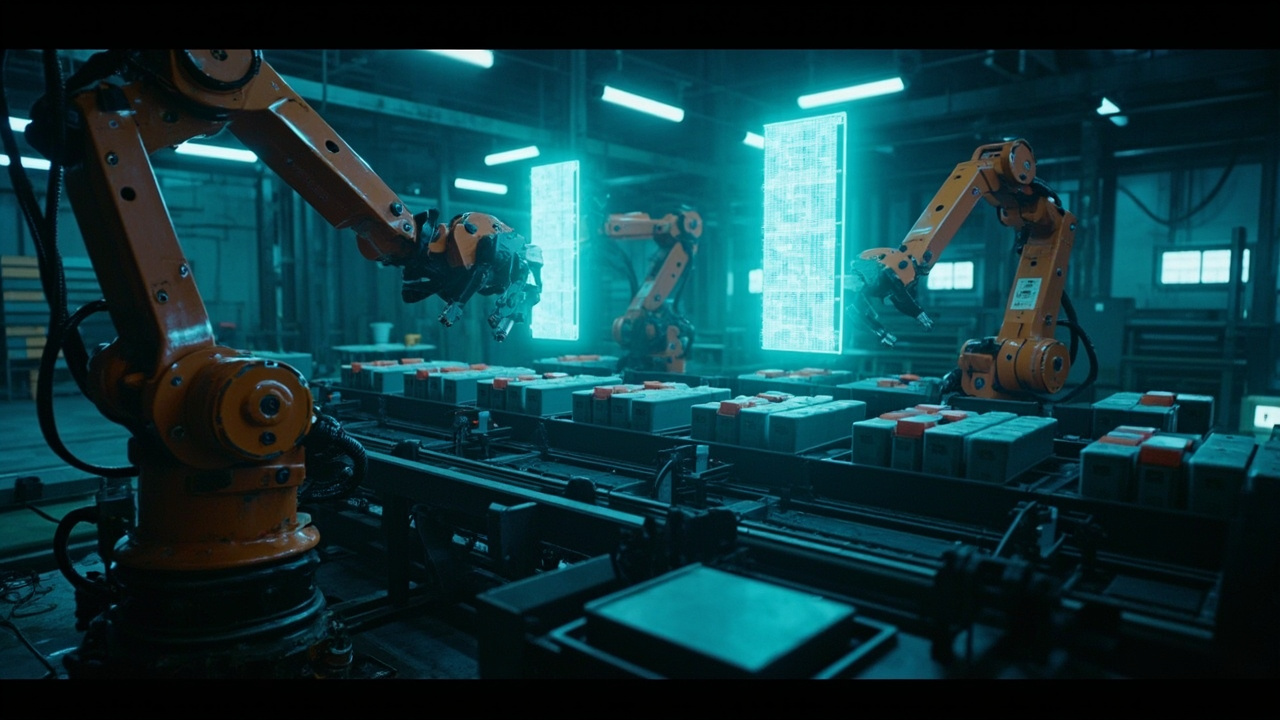
On September 9, 2026, Tata Consultancy Services formally launched the TCS Industrial Autonomy & Engineering Lab — Lights-Out Factory at its Sahyadri Park campus in Pune, and in doing so claimed a national first: India’s first lab built to demonstrate the principles of lights-out manufacturing, anchored by a fully robotic battery pack assembly line.
The announcement is modest in scale — this is a demonstration lab, not a production plant — but it is strategically loud. The facility exists to answer the question that has stalled industrial AI for a decade: how do you translate Industry 4.0, AI and robotics concepts into operating models that survive contact with a real factory floor?
What a lights-out factory actually is
The term “lights-out manufacturing” predates the current AI boom by decades — the idea being a facility so automated that it could run with the lights off, no humans on the floor. FANSSI… the concept traces back to FANUC’s famously automated machine-tool factories in Japan, where robots have built other robots with minimal supervision since the early 1980s.
What has changed is the accessibility of the ingredients. A lights-out line in 2026 is not just programmable logic controllers and fixed automation. At the Pune lab, TCS layers together:
- A fully robotic battery pack assembly line with multiple stages of production, operating as a live set-up rather than a mock-up
- Digital twins that mirror the physical line so scenarios can be simulated before — or while — they run on real hardware
- Vision AI for automated quality inspection along the line
- Factory control systems and real-time operational intelligence, feeding sensor-to-cloud data pipelines that make the line observable end to end
- Human-machine collaboration scenarios for the stages where people remain in the loop
The battery pack choice is deliberate. Battery assembly is hot, repetitive, precision-sensitive work — exactly the profile where autonomous systems outperform manual labor, and exactly the capability India’s electronics and EV manufacturing ambitions depend on.
The Human+AI Service Autonomy Model
According to TCS, the Pune lab will simulate how self-optimising factories can automate operations using what the company calls the TCS Human+AI Service Autonomy Model. The framing matters: TCS is not pitching full human replacement, but a staged autonomy model in which AI systems progressively absorb operations while humans supervise, intervene and collaborate.
That staged framing is also the commercial pitch. The lab gives manufacturers a controlled setting to explore industrial scenarios, assess their suitability for production environments, and — in TCS’s words — reduce deployment risk. For plant operators who have watched pilot after pilot die in the gap between proof-of-concept and production, “validate before you deploy” is the actual product being sold.
The lab’s stated use-case list reads like a checklist of where industrial AI actually earns its keep today: predictive maintenance, automated quality inspection, real-time process optimisation, human-machine collaboration, and autonomous factory operations.
The NVIDIA lineage
The Pune facility is the second act of a strategy TCS opened earlier this year. In 2026, the company launched the TCS Industrial Autonomy & Engineering Lab Powered by NVIDIA in Bengaluru, dedicated to accelerating “physical AI” innovation for industrial and mobility applications — the wave of AI that acts in the physical world rather than chatting about it.
The Bengaluru lab is the research-and-platform play; Pune is the proof. By standing up a live, multi-stage robotic line, TCS converts the physical-AI story from slideware into something a manufacturing client can walk through, prod, and benchmark against their own lines. The two labs together let TCS sell an integrated journey: model the factory digitally, validate the autonomy stack on a real line, then scale to the client’s plant.
Why an IT services giant is building factories
TCS is India’s largest IT services firm, and its move into industrial autonomy is a mirror of where the money is moving. Generic software services are being commoditised by the same AI models TCS deploys for clients; the growth frontier is outcome-based, domain-heavy work where the provider owns a measurable physical result.
The Pune lab also positions TCS in India’s manufacturing moment. With New Delhi pushing electronics manufacturing, EV supply chains and defence indigenisation, the bottleneck is increasingly not capital but validated automation know-how. A domestic lights-out reference line — staffed by an integrator with TCS’s client reach — shortens the path for Indian manufacturers who want autonomy without betting their own factory on an unproven stack.
Context from adjacent coverage this week underscores the pull: at its Global Technology Explorers Conference, JD Cloud announced plans for a 100,000-GPU domestic cluster partly targeting embodied-AI workloads, and hiDream’s O1-Embodied topped embodied benchmarks. The physical-AI stack — chips, models, integration — is being assembled globally, and India’s integrators want to own the deployment layer.
The realistic read
Some caution is warranted. A demonstration lab with a robotic battery line is a far cry from a true production lights-out plant — the hardest problems in manufacturing autonomy (long-tail defects, changeovers, unscheduled downtime, safety certification) only fully appear at production scale and volume. TCS’s own emphasis on “reducing deployment risk” is an admission that this gap is the core problem customers face.
Nor is TCS alone. Siemens, Rockwell, Honeywell and a wave of robotics-first startups are all selling AI-first factory transformation, and Japan’s Algomatic Dynamics just raised ¥5 billion to push multi-finger robotic hands. What TCS brings is scale of client access — and the Pune lab is best understood as a sales acceleration instrument as much as a research one.
Still, firsts matter. India’s manufacturing sector has historically under-automated relative to peers; a credible domestic showcase for autonomous production lines, tied to an NVIDIA-powered platform and a repeatable autonomy model, is a real signal that the country’s largest integrator sees industrial AI as its next decade of business — not a side quest.
For manufacturers, the pitch distils to one line: come to Pune, watch the line run itself, and leave with a validated blueprint instead of a leap of faith.
Sources
Sources
- [1] https://www.tcs.com/who-we-are/newsroom/press-release/tcs-launches-indias-first-lights-out-factory-lab-advance-ai-first-manufacturing
- [2] https://telecom.economictimes.indiatimes.com/amp/news/enterprise-services/tcs-launches-lights-out-factory-lab-in-pune-to-drive-ai-enabled-manufacturing/133961136
- [3] https://www.business-standard.com/markets/capital-market-news/tcs-launches-india-s-maiden-lights-out-factory-lab-at-pune-126090900447_1.html
- [4] https://www.moneycontrol.com/news/business/companies/tcs-launches-india-s-first-ai-powered-lights-out-factory-in-pune-14025990.html