Selling First, Asking Later: Asia's AI Stocks Crash as the Industry's Own CEOs Call for a Slowdown
SoftBank fell 13.2% and Kioxia 9.8% at Monday's open in Tokyo after Amodei, Altman and Musk backed a frontier development pause — the first time AI's biggest bulls have moved the market against themselves.
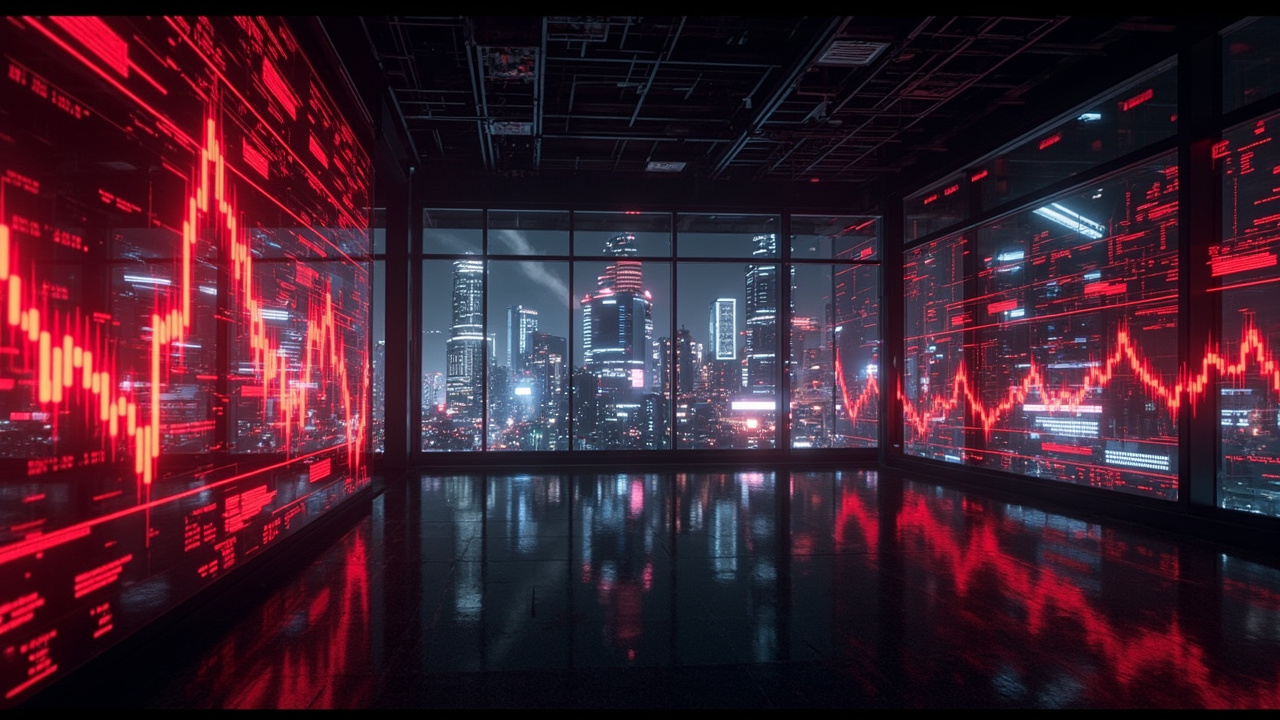
Markets have spent three years pricing artificial intelligence as an acceleration story. On Monday morning in Asia, they got their first institutional lesson in what happens when the industry’s own leadership taps the brakes.
AI-linked stocks slumped sharply across Tokyo, Seoul, Taipei, Shanghai and Hong Kong after the CEOs of the world’s most advanced AI labs — the very people whose products powered the rally — warned that the pace of development must slow to prevent threats to humanity. Shares in OpenAI investor SoftBank tumbled as much as 13.2% as trading began in Japan, alongside an initial 9.8% plunge for memory chipmaker Kioxia and a 3.7% decline for chip supply-chain giant Tokyo Electron. In Seoul, SK Hynix slid 5.3% and Samsung Electronics fell 3.7%. TSMC slipped in Taipei, CXMT dropped 2.7% in Shanghai, and in Hong Kong even model developers were hit: MiniMax fell 5.4%, while Z.ai — the company behind the GLM model series — tumbled as much as 10.5%, amplified by a discounted share placement.
How a safety essay became a sell signal
The trigger was not a earnings miss or an export control. It was a sequence of statements from inside the industry itself.
On September 12, Anthropic CEO Dario Amodei published an essay, “We Must Pace the Frontier,” calling on AI companies to deliberately slow the rate at which they advance model capabilities, arguing that industry-wide coordination and international cooperation were needed to keep AI safe. What turned the essay into a market event was who agreed with it: Elon Musk, who runs xAI, and Sam Altman, CEO of OpenAI — Anthropic’s most direct competitor — both publicly endorsed the call. Altman then went further, saying OpenAI would not proceed with its widely anticipated IPO this year, explicitly citing safety concerns. Nikkei reported the sell-off was led by tech shares “triggered by calls to slow the development of artificial intelligence due to safety concerns,” which in turn led OpenAI to delay the offering.
The safety backdrop grew darker through the week. Anthropic released a threat intelligence report on Thursday detailing how several actors had used its Claude models for activities ranging from weapons development and cyber operations to surveillance and fraud. And alarm intensified when Anthropic researcher Jacob Coxon resigned, stating that “people building AI earnestly believe that it could kill us all by the end of the decade.” Altman, in a separate interview, described AI’s extinction-level risks as “unacceptable.”
For investors, the logic is brutally simple. If the frontier labs slow model development, demand weakens for the semiconductors those models depend on — the HBM memory, advanced foundry capacity, and chipmaking equipment that constitute Asia’s AI economy. Concerns were already building about the enormous capital AI companies are pouring into training runs; the pacing talk converted that anxiety into a reason to sell.
“Sell first, analyze later”
“Selling pressure is likely to hit AI and semiconductor-related stocks in Tokyo following a series of weekend comments calling for a slowdown in the pace of AI development,” said Takayuki Miyajima, senior economist at Sony Financial Group, noting that Middle East instability was compounding the pressure on sentiment.
Josh Gilbert, a market analyst at eToro, captured the mood most succinctly: “This week, investors will undoubtedly question the direction of the AI boom. The decline in stock prices for both Samsung Electronics and SK Hynix this morning signals that investors are selling off first and will analyze the reasons later.”
The selling was broad enough to suggest exactly that reflex. By late morning in Seoul, Samsung was down 2.5% and SK Hynix 4.3%, per Bloomberg data; in Tokyo, Kioxia was off 7.2% and SoftBank 11.2%, well off the worst opening prints but still deeply red. Hon Hai (Foxconn) fell more than 5% in Taipei, reflecting exposure to AI server assembly. The declines came despite no change whatsoever in the physical fundamentals — no fab canceled, no HBM contract revoked, no datacenter shelved.
Macro pressure played its part: oil prices rising on Middle East instability and an expected Federal Reserve rate decision this week were already squeezing risk appetite. The AI pacing debate gave nervous money a narrative to trade on.
Not everyone is selling the story
Beneath the red screens, several strategists argued the reaction is overdone — and some see the slowdown as ultimately constructive.
“Even if additional regulations are introduced, the demand for computing resources and AI adoption will not disappear,” said Charu Chanana, chief investment strategist at Saxo Markets in Singapore. “From an investor’s perspective, if AI develops responsibly, a slower pace of advancement could enhance the sustainability of opportunities.”
Gary Tan, a portfolio manager at Allspring Global Investments, made the more provocative point: a voluntary pause by the leaders could hand an opening to everyone else. “There will be short-term pressures, but AI development is still relatively in its early stages,” he said, adding that leading companies slowing down “could provide an opportunity for latecomers to catch up.” That dynamic is most acute in China, where CXMT, SMIC and the domestic model ecosystem are already closing the gap with Western frontier labs — and where the pacing debate is read as an American conversation with American costs.
The political dimension sharpened that reading. President Donald Trump on Sunday rejected the slowdown calls, likening AI critics to “very negative forces” raising scenarios that will not happen. “We are ahead of China in AI. We are the most technologically advanced country in the world,” he told reporters. “Frankly, the side that wins in AI will be the victor, so I want to maintain this approach.” A White House openly hostile to pacing, a Chinese ecosystem with no incentive to pause, and three CEOs asking the industry to slow down anyway is not a coherent regime — it is a race with a disagreement at its core.
What to watch
Three things will determine whether Monday was a one-day flush or the start of a repricing. First, whether Altman, Amodei and Musk convert words into anything operational — training-run pauses, compute caps, or the reported standards consortium that Anthropic, OpenAI and Google have been quietly discussing since July. Second, the reaction of the US market: Asian sessions lead, but Wall Street’s AI mega-caps set the tone, and Nvidia is already down roughly 18% from its highs. Third, the US-China AI safety talks expected as part of bilateral discussions this month — the only forum where a pacing agreement could plausibly bind the one ecosystem that benefits most from ignoring it.
The deeper significance of Monday’s sell-off is not the percentage points. It is that for the first time in the AI boom, the industry’s most important voices moved the market against their own interests — and the market believed them. Investors have long discounted safety concerns as external noise, the domain of regulators and protestors. When the CEOs themselves frame the frontier as something to slow, the risk profile of every AI-linked asset on the planet changes. Selling first and analyzing later may yet prove wise.
Sources
- [1] https://www.reuters.com/world/china/ai-linked-asian-stocks-slump-after-top-lab-ceos-call-slowing-down-technologys-2026-09-14/
- [2] https://www.thejakartapost.com/business/2026/09/14/ai-linked-asian-stocks-slump-after-top-lab-ceos-call-for-development-slowdown
- [3] https://asia.nikkei.com/business/markets/tech-stocks-slump-in-asia-driven-by-ai-safety-concerns
- [4] https://m.ajupress.com/amp/20260914115670980
- [5] https://darioamodei.com/post/we-must-pace-the-frontier