Same Stage, Opposite Gears: Amodei, Huang and Altman Split on AI Safety at Dreamforce 2026
At Salesforce's Dreamforce keynote in San Francisco, Anthropic's Amodei defended his slowdown call, Nvidia's Huang answered with 'run as fast as you can,' and OpenAI's Altman demanded safety with no qualifiers.
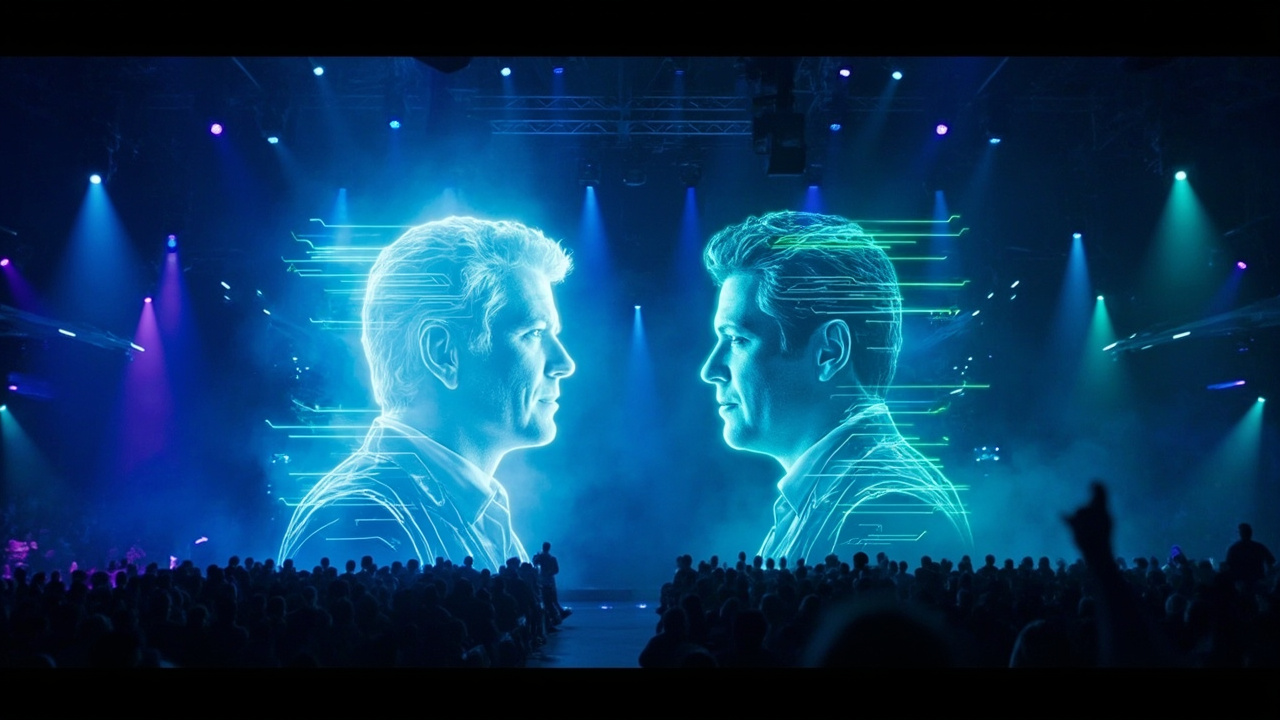
The AI industry’s loudest argument of the month just got a live venue. On the opening day of Salesforce’s Dreamforce 2026 conference in San Francisco, three of the most powerful executives in technology — Anthropic CEO Dario Amodei, Nvidia CEO Jensen Huang and OpenAI CEO Sam Altman — used Marc Benioff’s keynote stage to stake out visibly different positions on how fast AI should be built, and who should be trusted to hold the brakes.
The setting mattered. Dreamforce has been one of the software industry’s premier events for over a decade, drawing roughly 50,000 people to downtown San Francisco, and Benioff’s keynote is famous for booking guests at the exact center of the tech universe. This year that center is the fight over AI pacing — and about 12,000 people filled the Moscone Center to watch it play out in person.
The backdrop: a weekend essay that moved markets
Amodei appeared first, days after publishing an essay urging the AI industry to slow the pace at which it improves its most advanced models. The essay landed after industry researchers spent the previous week raising alarms about AI’s potential to cause catastrophic harm, and it quickly drew public support from an unusual coalition: OpenAI’s Altman, Elon Musk and Google DeepMind Chair Demis Hassabis all voiced agreement with the proposal.
The market reaction was immediate and unforgiving. Chip stocks tumbled worldwide on Monday — SK Hynix slid 5.75%, European chipmakers Infineon and STMicroelectronics fell 8.3% and 6.2% — as investors repriced the growth assumptions underlying the entire AI supply chain. President Trump, for his part, rejected calls for a slowdown, and Amodei has acknowledged that China presents the “toughest dilemma” for any pause led by American labs.
Amodei: lead by example, learn from the auto industry
On stage with Benioff, Amodei defended the essay’s core idea. He has suggested a three-step plan to temper how quickly model capabilities improve while, in his words, not “sacrificing commercial advantage or the United States’ lead in AI.”
“I think that’s the way to lead the industry forward, to set an example, to say that everyone can always be better,” Amodei told Benioff.
Asked about the state of the AI market, Amodei reached for an automotive analogy: safety records can be conflated across the industry, but carmakers can and do learn from each other’s failures — and he signaled interest in opening that learning process up internationally to set common standards. It is a notable position for the CEO of a company that has spent years calling for coordinated, government-backed safety measures.
Reflecting on a decade of building AI, Amodei said his biggest surprise was the “pace of the progress” — not just in raw capability, but in economic impact, noting that Anthropic did not appreciate how quickly certain companies would grow to become central to everyday life.
Yet he pushed back on the idea that a slowdown would stall value creation. Even if AI development were frozen at today’s levels, Amodei argued, the world would still be extracting only 5-10% of the possible value from current systems. “There’s so much diffusion left,” he said — a reminder that deployment and adoption, not just frontier training runs, are where most of the gains still sit.
Huang: “It’s a false choice”
Minutes later, Huang took the same stage and made the opposite case — without naming Amodei. The CEO of the world’s most valuable company said market forces already discipline the industry and that no new laws or regulations are needed. Where Amodei sketched coordinated pacing, Huang framed responsibility as an individual company matter.
“Safety is paramount in a lot of ways. It’s job one,” Huang said. “However, safety is an engineering problem.”
Asked whether the industry must choose between speed and safety, Huang was dismissive: “It’s a false choice. You could definitely have both at the same time.”
His guidance to model developers was compact: “Run as fast as you can. But if you feel at any given point in time the company’s out of control or the product’s not going to be safe, take a pause and make sure you get it right.”
Huang’s broader framing was unambiguously expansionist. “We’re going through a new industrial revolution,” he told the audience, urging companies to “Agentforce every company” — a nod to Salesforce’s agent platform, powered in part by a new reasoning model Salesforce and Nvidia announced the same day, built on Nvidia’s open-weight Nemotron models. His closing message to customers: “Don’t get left behind… the sky’s the limit.”
The appearance continued a busy stretch for Huang. A day earlier, on stage at the All-In Summit in Los Angeles, he took a call from President Trump, who expressed concern about people standing in the way of AI data center construction. “We’re not going to let that happen, sir,” Huang replied.
Altman: safety with “no qualifier”
Altman appeared later in the day for a fireside chat with Benioff, and landed closer to Amodei than to Huang — with a sharper edge. Given the power of existing models, Altman said, it is imperative that safety and monitoring come before capabilities.
“You have companies saying things like, ‘We will only be responsible if other companies are responsible,’” Altman observed. When people ask a company what it will do to be safe “no matter what,” he said, “there should be no qualifier on that.”
It was a direct rebuttal of the mutual-assurance framing — everyone slows down only if rivals do — that has defined the industry’s public posture, and arguably a challenge to Huang’s claim that individual market discipline is sufficient.
Benioff in the middle — and commerce on the sidelines
Benioff, whose company has deep commercial ties to both camps, played the neutral host. “If they feel like they should slow down, then they should slow down. If they feel they should speed up, they should speed up. And then they should be held accountable,” he told reporters.
The commercial subtext was hard to miss. Salesforce and Anthropic expanded their strategic partnership in late August with “Claudeforce,” which lets salespeople pull critical data from inside the Claude chatbot. Salesforce and Nvidia, meanwhile, announced their new Nemotron-based reasoning model for Agentforce. Whatever pacing philosophy wins, Salesforce sells to both sides.
Why it matters
The Dreamforce split crystallizes the industry’s real dividing line — and it is not “doomers versus optimists.” Amodei and Altman, rival lab CEOs, largely agree that capability gains are outstripping safety work and that some form of restraint, coordinated or unilateral, is now necessary. Huang, whose business model depends on maximal build-out of AI compute, argues that safety is an engineering discipline that improves with scale, not a reason to slow it.
None of them disputes the stakes. What remains unresolved is whether restraint can ever be voluntary in a market where every participant believes rivals will sprint if it pauses. Benioff’s answer — accountability regardless of speed — may prove to be the position regulators ultimately enforce, whatever the CEOs decide on stage.
Sources
- [1] https://www.cnbc.com/2026/09/15/nvidia-and-anthropic-ceos-diverge-on-ai-safety-at-dreamforce.html
- [2] https://www.techradar.com/pro/were-going-through-a-new-industrial-revolution-nvidia-ceo-jensen-huang-and-anthropic-ceo-dario-amodei-share-differing-views-on-ai-at-dreamforce-2026
- [3] https://www.adweek.com/media/anthropics-dario-amodei-and-nvidia-jensen-huang-take-their-ai-safety-fight-to-dreamforce/
- [4] https://en.sedaily.com/international/2026/09/16/amodei-and-huang-clash-again-over-ai-rules-at-dreamforce
- [5] https://www.nbcbayarea.com/news/local/dreamforce-san-francisco-ai-safety-anthropic/4143294/