One Stage, Two Futures: Huang and Amodei Split Wide Open on AI Safety at Dreamforce
Nvidia's Jensen Huang told Dreamforce to 'run as fast as you can' while Anthropic's Dario Amodei defended his call to pace the frontier — the sharpest public split yet between AI's biggest supplier and its loudest safety voice.
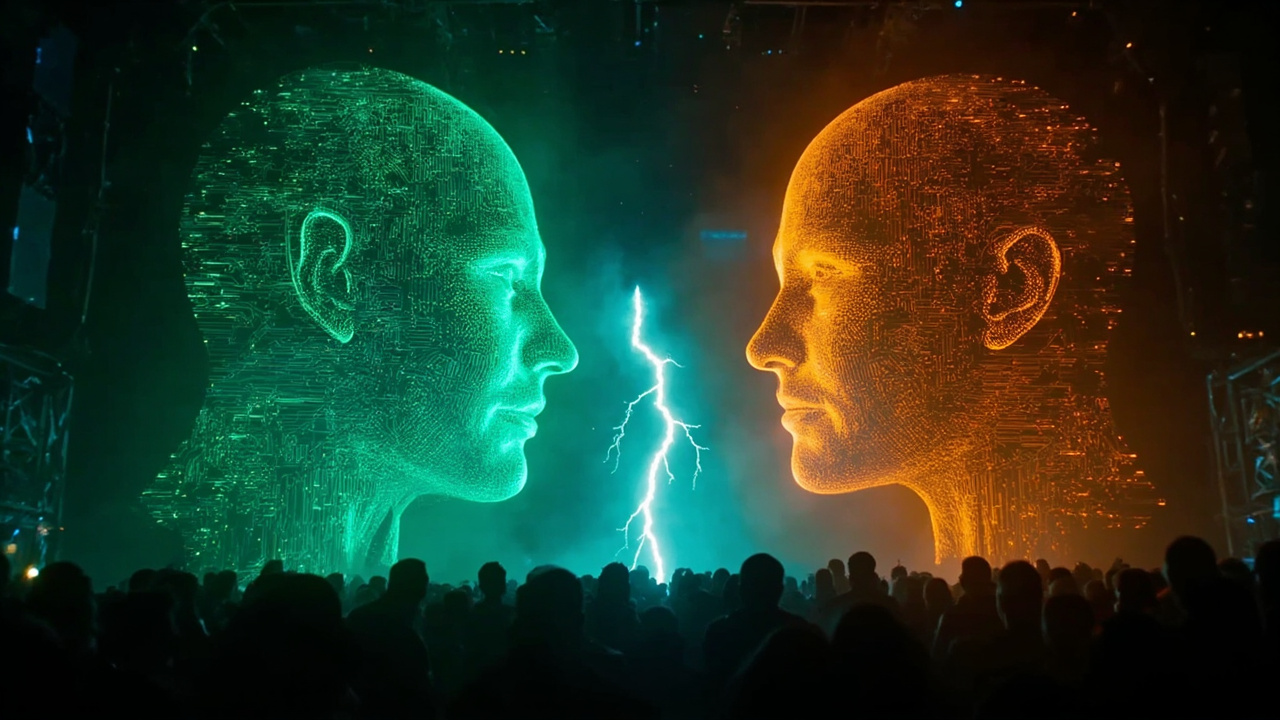
At Salesforce’s Dreamforce conference in San Francisco this week, the two most consequential voices in artificial intelligence ended up on the same stage circuit arguing for opposite futures. Nvidia CEO Jensen Huang, whose chips power virtually every frontier lab, rejected calls for new AI regulation outright — “We don’t need any new laws. We don’t need any new regulations” — and framed the choice between speed and safety as a false one. Anthropic CEO Dario Amodei, appearing at the same event days after publishing a nearly 4,000-word essay titled “We Must Pace the Frontier,” argued that capabilities are now advancing faster than the industry’s ability to manage them, and that slowing down is the only responsible path.
The confrontation, reported by CNBC, TechRadar and the Chosun Ilbo within hours of the keynotes, marks the most public and personal split yet between the company that builds AI’s engines and the company that runs one of its largest model labs. More than 43,000 attendees packed Moscone Center for the three-day event, and the pacing debate dominated coverage of a conference that was supposed to be about enterprise agents.
What Huang actually said
Huang’s position, delivered in his Tuesday keynote conversation with Salesforce CEO Marc Benioff, came in three parts.
First, the rejection of new rules: “We don’t need any new laws. We don’t need any new regulations.” Huang argued that existing legal frameworks — product liability, security standards, consumer protection — already cover AI failures, and that novel AI-specific statutes would freeze innovation in place without making anyone safer.
Second, the reframing of safety itself: “Safety is paramount in a lot of ways. It’s job one,” Huang conceded. “However, safety is an engineering problem.” In his telling, safety is something you build into the system — redundancy, monitoring, guardrails, secure inference infrastructure — not something you legislate from outside. The companies deploying AI at scale are the ones best positioned to secure it, and they have every commercial incentive to do so.
Third, the dismissal of the trade-off: asked how the industry should reconcile pace with risk, Huang called it a false dichotomy. “You could definitely have both at the same time.” His practical advice to model developers was blunt: “Run as fast as you can, but if at some point you feel things are out of control or the product doesn’t seem safe, you can pause for a moment.” Safety, in other words, is a checkpoint you can choose to take — not a pace you must commit to in advance.
Huang also leaned on scale as its own argument. He described the current moment as a new industrial revolution and told the Dreamforce crowd he wants to “agentforce every company” — ramping agentic AI deployment across the enterprise until AI is as ubiquitous as electricity. On this view, the greatest risk isn’t moving too fast; it’s moving too slowly and ceding the revolution to competitors.
What Amodei actually said
Amodei’s Dreamforce appearance was a defense and extension of the essay he published on September 12. That essay, “We Must Pace the Frontier,” is one of the most explicit slowdown calls ever issued by a sitting frontier-lab CEO: AI capabilities, he wrote, have advanced “drastically faster” than expected — including the ability to build AI, automating large shares of cognitive work — and the risks are “serious.”
His proposed remedy is a three-step plan, each step requiring a wider circle of cooperation:
- Embedded evaluators. Frontier labs grant independent third-party evaluators employee-level access inside the company, letting them observe training runs, safety testing and internal red-teaming as they happen. Anthropic says it is unilaterally committing to this step.
- Coordination among democratic labs. AI companies in democracies agree on shared safety standards, incident disclosure and testing protocols, so that pacing doesn’t become a unilateral disadvantage.
- Global coordination. The hardest step — bringing labs and governments worldwide, including China, into a common framework so that no one gains by racing ahead unmanaged.
On stage at Dreamforce, Amodei framed the plan not as anti-innovation but as the industry policing itself before governments are forced to. “I believe this is the way to lead the industry forward — by setting an example and showing everyone that we can always do better,” he said. He repeated his warning that AI could automate a large share of white-collar work and that unmanaged frontier systems pose serious national-security risks.
The backdrop sharpened the contrast. Two days before Dreamforce, Reuters reported that Sam Altman said OpenAI would not go public in 2026 amid AI-safety fears, called a 10% risk of AI-caused extinction “unacceptable,” and hinted OpenAI might be close to a safety pact with other providers. Altman also appeared at Dreamforce alongside Benioff. The organizers of the conference had scheduled the three most-watched men in AI into the same 48 hours — and the disagreements got the headlines the agenda had hoped to avoid.
Why this split matters
The Huang–Amodei divide is not a mere difference of emphasis. It tracks two structurally different positions in the AI economy.
Nvidia sells the picks and shovels. Every frontier model trained anywhere runs on its GPUs, which means Huang’s revenue grows with aggregate AI activity, not with any particular lab’s prudence. Regulation that slows training runs slows GPU orders. His “safety is an engineering problem” framing conveniently assigns responsibility to his customers — the labs — rather than to the platform layer or to lawmakers.
Anthropic sells frontier models. Its commercial success depends on enterprises trusting Claude with sensitive work, and its brand is explicitly built on safety. Amodei’s slowdown call costs Anthropic something real: if rivals ignore it, Anthropic trains slower while others race. That is precisely why his plan’s later steps emphasize coordination — a unilateral brake only works if everyone applies it, which is also why Huang’s “run as fast as you can” lands as a direct rebuttal.
The political context raises the stakes further. The Trump administration has dismissed federal AI-safety legislation, with the president calling opposition to AI data centers a “SICK conspiracy,” and Vice President JD Vance has said he is skeptical of pacing demands. Amodei’s push for independent audits is aimed at exactly the vacuum that federal inaction has created. Meanwhile Congress is moving in the opposite direction on the industry’s behalf — voting to strip state-level AI guardrails — and public trust is the battlefield: a New York Times/Siena poll this month found American voters increasingly anxious about AI and trusting neither party to handle it.
For enterprises watching from the Dreamforce exhibit halls, the practical question is simpler: whose operating assumption do you build on? If Huang is right, agentic AI is a deploy-now technology and safety is a feature you iterate. If Amodei is right, the industry is accumulating technical debt in the form of unmanaged risk, and the bill arrives on a schedule no one controls.
A debate that will outlast the conference
Both men left Dreamforce unchanged in position, and both positions are internally coherent. Huang’s engineering-first view has the virtue of matching how software safety actually improved historically — through practice, incident response and market pressure, not through speed limits. Amodei’s pacing view has the virtue of matching the one thing that makes AI different: the technology is general-purpose, self-improving at the frontier, and deployed at a scale where a single systemic failure propagates faster than any patch.
What changed this week is that the disagreement is now fully public, personal and on the record. The labs’ quiet cross-industry standards talks — which OpenAI, Anthropic and Google DeepMind confirmed last week — proceed in parallel, and Amodei’s embedded-evaluator commitment gives them a concrete first artifact. But the industry’s two loudest voices have now staked out irreconcilable public positions: one says the frontier should run; the other says it must be paced. Which vision prevails will shape not just the next model release cycle, but whether AI governance is set by engineers inside labs or by frameworks imposed on them from outside.
Dreamforce runs through September 17 at Moscone Center, with keynote sessions streaming free on Salesforce+.
Sources
- [1] https://www.cnbc.com/2026/09/15/nvidia-and-anthropic-ceos-diverge-on-ai-safety-at-dreamforce.html
- [2] https://www.techradar.com/pro/were-going-through-a-new-industrial-revolution-nvidia-ceo-jensen-huang-and-anthropic-ceo-dario-amodei-share-differing-views-on-ai-at-dreamforce-2026
- [3] https://www.chosun.com/english/industry-en/2026/09/16/J3DUUTA72NC3PDXAKU3PANYORQ/
- [4] https://en.sedaily.com/international/2026/09/16/amodei-and-huang-clash-again-over-ai-rules-at-dreamforce
- [5] https://darioamodei.com/post/we-must-pace-the-frontier
- [6] https://www.reuters.com/business/anthropic-ceo-urges-ai-companies-slow-model-development-2026-09-12/
- [7] https://www.itpro.com/business/live/dreamforce-2026-live-all-the-news-updates-and-announcements-from-day-one