Refinery Ghosts, Server Farms: Philly's 'No Data Centers' Campaign Kicks Off in Grays Ferry
A 100-person rally at Philadelphia City Hall launched a moratorium push against AI data centers, led by residents of Grays Ferry — the neighborhood that lived beside the East Coast's largest oil refinery for a century.
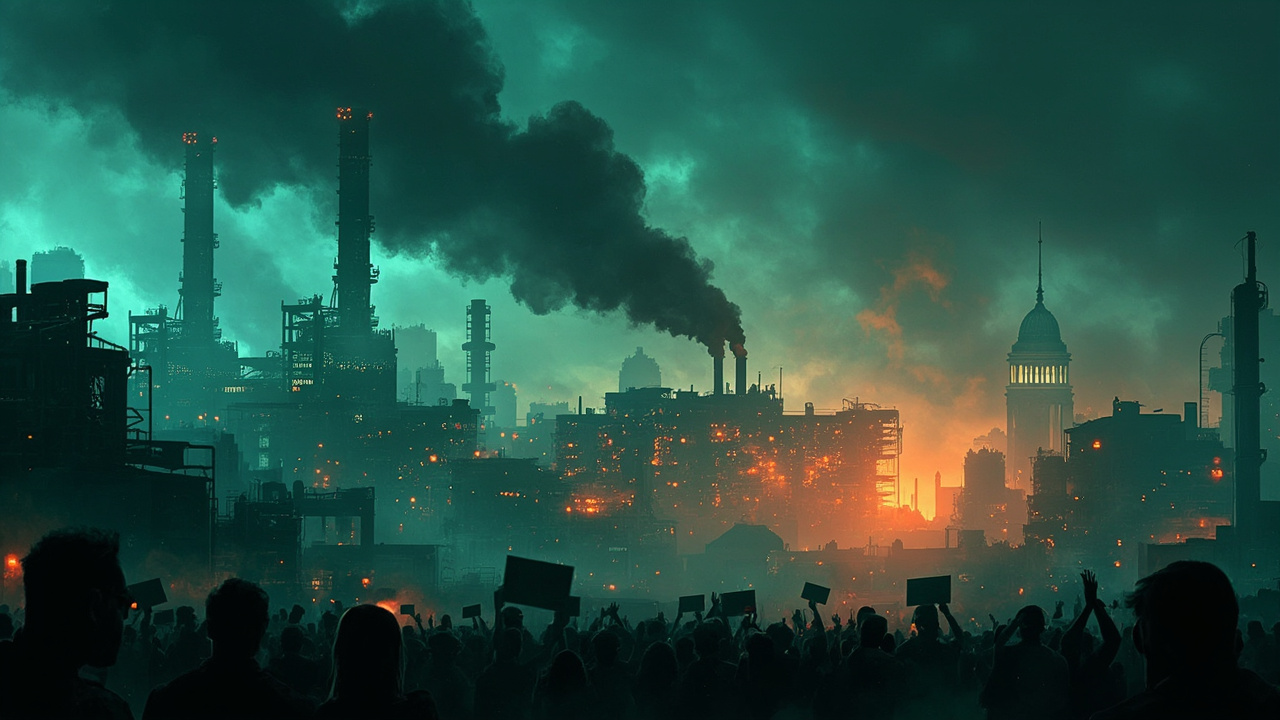
The national fight over where to build America’s AI infrastructure has arrived in Philadelphia — and the people leading the resistance know exactly what it means to live next door to heavy industry.
On Monday, more than 100 residents gathered on the steps of City Hall to launch “No Data Centers in Philly,” a campaign demanding that the City Council declare a moratorium on data center development. The rally was organized by a coalition that includes Philly Thrive, an environmental justice group born in Grays Ferry, the Southwest Philadelphia neighborhood that spent roughly a century in the shadow of the Philadelphia Energy Solutions oil refinery — once the largest on the East Coast, processing up to 335,000 barrels of crude oil per day until an explosion and bankruptcy shut it down in 2019.
A neighborhood that already paid the price
For the campaign’s organizers, data center opposition is not an abstract debate about energy grids or GPU supply chains. It is personal.
Shawmar Pitts, managing co-director of Philly Thrive and a lifelong Grays Ferry resident, told TechCrunch that he didn’t connect his community’s chronic health problems to the refinery until he encountered the group tabling in his neighborhood in 2018. “I read the information they had on the table about how living near the refinery affects you, and I’m looking at all the sicknesses on this paper, and I’m like, ‘My mother has this, my sister has that, my next-door neighbor suffers from this’ — every house, someone has something on that list,” he said.
Philly Thrive board president Sonya Sanders was blunter. Her husband, a fellow Grays Ferry resident, died of a rare bone cancer in 2020. He didn’t smoke or drink, and she attributes his illness to refinery emissions. “In my eyes, they killed him,” she said at the rally. “The pollution killed him. I believe he would be here today if he wasn’t silently murdered, because it was the pursuit of profit that killed him.”
That history is precisely why Philadelphia has become the newest flashpoint in the national data center backlash. City officials have identified two potential sites for AI data centers — one in Northeast Philadelphia, the other in Grays Ferry itself — though no formal construction proposals exist yet. The specter of a hyperscale facility landing on land whose previous industrial occupant poisoned its neighbors for generations has galvanized a community that feels it has seen this movie before.
“We don’t want data centers,” Sanders said. “We don’t want the pollution, we don’t want the noise, and we know they’re not going to bring us more jobs.”
The energy math behind the fear
A data center is not an oil refinery, and even opponents concede the direct air-quality impact would be far smaller than 335,000 barrels of crude per day. But the scale of the AI buildout is forcing some sobering projections.
According to BloombergNEF, U.S. data centers are on track to consume more natural gas by 2035 than Germany and Japan combined — a projection the firm nearly doubled in the span of nine months. Burning one cubic foot of natural gas releases the equivalent of about 60 grams of CO2, and additional data center demand is expected to generate an extra 1 million metric tons of greenhouse gas pollution every day, roughly 12% of present-day U.S. emissions. Harvard researchers estimated back in 2021 that fossil fuel air pollution already contributes to one in five deaths worldwide.
The local concerns are more immediate than climate math. Clean Air Council attorney Annie Fox warned at the rally that a typical data center planned in Pennsylvania includes hundreds of diesel engines nominally reserved for emergencies — but the grid operator has already said operators may need to run them during heat waves rather than draw from an overstressed electrical grid. “We can expect that to get more frequent… Fossil fuel-hungry data centers will worsen climate change, making those heatwaves more frequent and severe,” she said.
Residents also cite water consumption, noise, light pollution, and the surveillance implications of massive computing complexes in residential neighborhoods. “I’m worried about surveillance and the fact that they’re going to have access to information they have no business knowing, and I’m concerned that they’re going to be using water and electricity that takes away from the people and the neighborhoods who need it,” attendee Donna Greenberg told TechCrunch.
A movement with a growing win record
Philadelphia’s campaigners are pushing on a door that is already opening elsewhere. In New York, Governor Kathy Hochul signed Executive Order No. 62 on July 14, the nation’s first statewide moratorium on new hyperscale data centers — a one-year pause on permits for facilities expected to draw 50 megawatts or more, while regulators study the impacts. “Progress shouldn’t arrive with a higher utility bill, deleted water supply, or noise pollution,” Hochul said. “These data centers can only be built, should only be built in places that want them.”
At the city level, moratoriums have been approved in Denver, Indianapolis, Asheville, Charlotte, and Reno — typically framed as temporary pauses so officials can study water, power, and land-use impacts before approving projects. Pennsylvania’s Governor Josh Shapiro signed his own executive order in August imposing unusually strict permitting guardrails on AI data center development, pulling the facilities out of fast-track approval and banning developer NDAs.
The pattern is consistent: polling has repeatedly shown that a majority of Americans oppose data center construction in their own area, even as the AI industry races to secure gigawatts of capacity. During the first quarter of this year alone, roughly $130 billion worth of data center projects were blocked or delayed by local opposition, according to CNBC.
What comes next
For now, there is no actual data center proposal on Philadelphia’s table — a fact that critics of the campaign are quick to note, arguing the city is fighting projects that don’t exist. But organizers say that’s the point: they want the moratorium in place before developers gain momentum, not after. Pennsylvania has been actively courting AI infrastructure investment, and Philadelphia’s two identified sites make the city a plausible target as the statewide pipeline grows.
The Grays Ferry site carries particular symbolic weight. The former refinery land has been undergoing remediation and redevelopment as the “Bellwether District,” and urban planners have spent years debating what kind of industry — if any — the neighborhood should accept next. Many residents and planners strongly oppose handing the land to another power- and water-hungry incumbent, even a cleaner one.
“I just think that our community standing up and fighting back is tremendous,” Pitts said. “It takes a lot of effort and a lot of people.”
The question now facing Philadelphia’s City Council is the same one facing scores of American cities: whether the AI boom’s promise of jobs and tax revenue can overcome the memory of the last industrial era’s bill — a bill that communities like Grays Ferry are still paying, in cancer rates and chronic illness, long after the refinery went dark.
Sources
- [1] https://techcrunch.com/2026/09/15/the-ai-data-center-boom-is-colliding-with-cities-scarred-by-big-industry/
- [2] https://whyy.org/articles/philadelphia-protest-data-centers-city-hall/
- [3] https://www.inquirer.com/politics/philadelphia/data-center-moratorium-philadelphia-ai-20260914.html
- [4] https://www.axios.com/local/philadelphia/2026/09/14/data-center-philadelphia-region-campaign-josh-shapiro-pennsylvania
- [5] https://www.governor.ny.gov/news/first-statewide-moratorium-new-hyperscale-data-centers-launched-governor-kathy-hochul