Trading Thirst for Toxins: The AI Boom's 'Forever Chemicals' Cooling Problem
ChemSec's survey of the world's 10 largest PFAS producers finds nearly all expanding output for AI data-center cooling and chipmaking — a tidal wave of 'forever chemicals' that never degrade, even as Fortune reports the industry is swapping water for fluorinated fluids to keep AI servers cool.
The AI industry spent two years defending itself against one environmental accusation: data centers drink too much water. Now, as operators race to answer that criticism, they are walking into another one — this time involving chemicals that never break down.
On September 18, 2026, Fortune reported that data centers are increasingly swapping water for “forever chemicals” to keep AI equipment cool. The reporting draws on a new survey by ChemSec, the Swedish chemicals watchdog, which found that most of the world’s ten biggest PFAS producers are expanding capacity — and that AI infrastructure is a leading reason why.
The chemistry of the problem
PFAS — per- and polyfluoroalkyl substances — are built around carbon-fluorine bonds, among the strongest in organic chemistry. That structure makes them nearly immune to heat, water, and corrosion, which is why they show up in nonstick pans, food packaging, stain-resistant fabrics, and firefighting foam. It is also why they are virtually indestructible in nature. They do not degrade; they accumulate — in air, soil, water, and up the food chain. Research links them to cancer, liver disease, kidney problems, high cholesterol, and birth defects. Scientists have warned that PFAS accumulation has already breached a planetary boundary, and National Health and Nutrition Examination Survey data has found the chemicals in the blood of 97% of Americans.
Unfortunately for everyone, the same heat resistance that makes PFAS dangerous makes them exceptionally good at one thing the AI industry desperately needs: absorbing heat.
Why AI is pulling demand
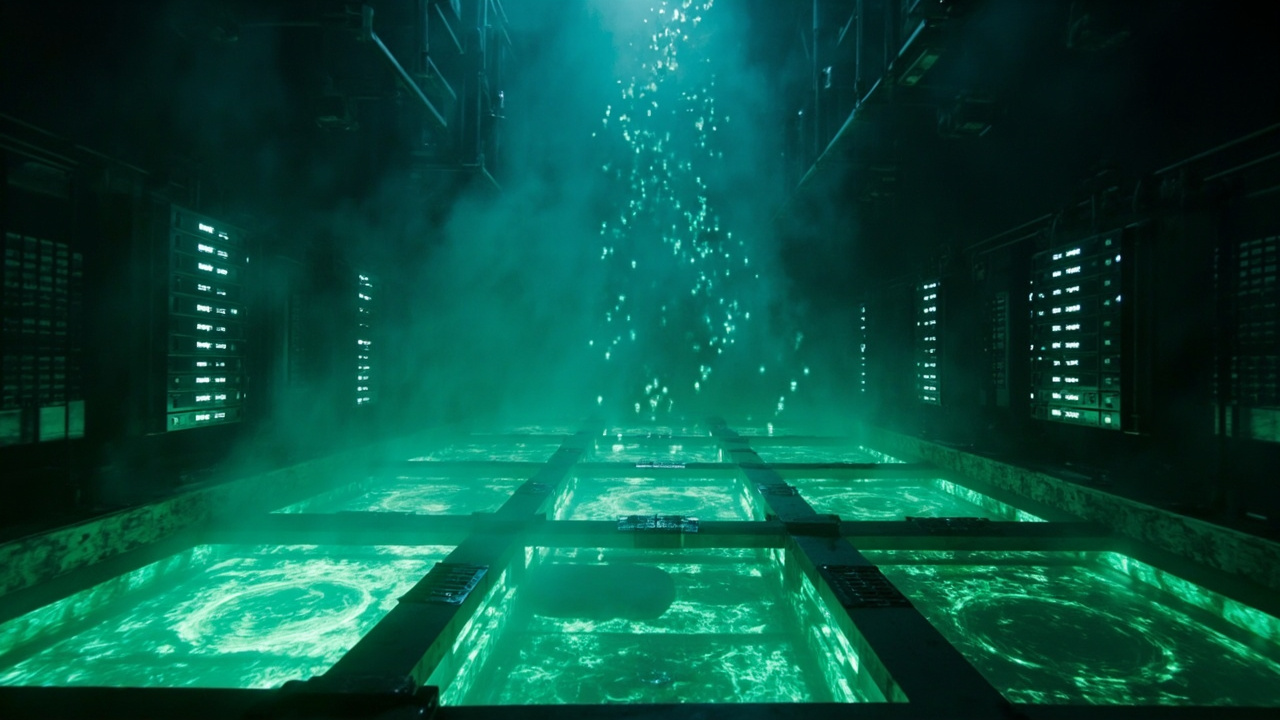
The demand comes from three directions at once. The first is data-center cooling. Newer cooling architectures — notably two-phase immersion cooling — submerge servers in a bath of dielectric fluid with a low boiling point. As the hardware heats up, the fluid boils, carrying heat away as vapor that rises to a water-cooled condensing coil, recondenses, and cycles back down. It is elegant, energy-efficient, and dramatically less thirsty than evaporative cooling towers. It also runs on fluorinated fluids that include PFAS.
The second is semiconductor manufacturing. PFAS are woven through the chip fabrication process — a recent Danske Bank investor note observed that in microchips these chemicals are “not merely peripheral additives; they are essential ingredients integrated into as many as 1,000 distinct steps at the nanometric level.” Every GPU that powers the AI boom passes through them.
The third is lithium-ion batteries, where PFAS coatings and binders are a parallel growth area.
Who is expanding, and by how much
ChemSec’s survey of the top ten producers found expansion plans across Europe, Asia, and North America, with companies explicitly framing investments around the “AI revolution”:
- Chemours (US) — produces or uses more PFAS substances than any other company on ChemSec’s SIN Producers list. ChemSec estimates between half and two-thirds of its $5.8 billion revenue comes from PFAS. The company is developing products specifically for data-center cooling and launched new refrigerants in August. Critics note Chemours was recently ordered to pay $450 million to settle a lawsuit over PFAS discharges.
- Daikin (Japan) — launching a dedicated “datacentre hub” and plans to triple PFAS capacity in response to semiconductor demand, while promising to “maintain and expand our top share in the industry.”
- Arkema (France) — expanding refrigerant production with a new $60 million (£44 million) unit in Kentucky that the company says “will enable us to follow the rapid expansion of datacenters’ cooling needs.”
- AGC (Japan), Dongyue (China), Gujarat Fluorochemicals (India), HaloPolymer (Russia), Orbia Fluor & Energy Materials (Mexico), Solstice (US), and Syensqo (Belgium) are all increasing output.
The outliers are instructive: Switzerland’s Archroma is pivoting to market PFAS-free alternatives, and BASF has committed to exiting PFAS production entirely by 2028.
ChemSec’s math on the broader picture is stark. The world’s biggest PFAS makers pulled in roughly $4 billion in profit in 2022, against an estimated $17.5 trillion per year in societal costs — healthcare, cleanup, contaminated water. As ChemSec executive director Anne-Sofie Bäckar put it: “These companies’ expansion plans show that unless governments and regulators insist on a rapid phaseout, we will face a new tidal wave of forever chemicals.”
The EPA fight over one molecule
The battleground is already concrete. In July 2026, seventeen environmental organizations petitioned the EPA to reject Chemours’ application to fast-track a new PFAS compound — Opteon 2P50 — for data-center cooling, arguing the company underestimated its health and climate risks and that toxicological evidence was insufficient.
“A hyperscale data center can contain hundreds of tanks, totaling tens of thousands of liters of dielectric fluid,” the letter warned. “If even a small fraction of the Opteon 2P50 used in a large data center leaks, it would result in a significant release of PFAS gases. And when cooling tanks need to be replaced, large amounts of Opteon 2P50 will be disposed or released, increasing the risk to the public and the environment.”
Chemours disputes this, telling The Guardian the systems operate as a closed loop with low emissions during operation. In France, 192 citizens and four environmental organizations have filed a lawsuit against Arkema and Daikin over PFAS contamination in the country’s “chemical valley.”
The catch-22 at the heart of AI’s footprint
The timing is awkward for the industry. Data-center construction is exploding — a 2026 BOMA study found data centers accounted for nearly 46% of US private construction last year, versus under 5% a decade ago, with spending rising from $1.8 billion in 2014 to $41.1 billion. Community backlash over water, power, noise, and tax abatements is intensifying, with polls showing majorities opposing new AI data centers.
PFAS-based cooling is, in part, an answer to the water criticism. Two-phase immersion and fluorinated refrigerants genuinely cut water consumption and can reduce energy overhead. But swapping a renewable resource that falls from the sky for synthetic chemicals that never degrade is not an unambiguous environmental win — it is a trade of a visible problem for a nearly invisible one.
That leaves the AI industry in a bind familiar to anyone who has watched infrastructure debates play out: every fix creates a new externality, and the entities best positioned to profit from the fix are the same ones carrying the liability. Danske Bank analysts called PFAS “the hidden risk of the AI boom,” flagging “escalating potential for multibillion-euro remediation and litigation liabilities.”
Regulators in Europe, the UK, and parts of the US are beginning to move on PFAS restrictions. How those rules treat data-center cooling fluids — and whether the AI buildout gets an exemption in the name of national competitiveness — may determine whether “forever chemicals” becomes the industry’s next long public reckoning.
Sources
- [1] https://fortune.com/2026/09/18/data-centers-ai-compute-pfas-forever-chemicals-water/
- [2] https://www.theguardian.com/environment/2026/sep/14/pfas-firms-tidal-wave-forever-chemicals-ai-industry-demand-datacentres
- [3] https://chemsec.org/reports/the-worlds-top-10-pfas-producers/
- [4] https://www.foodandwaterwatch.org/wp-content/uploads/2026/07/FSW_2607_DataCenterPFAS.pdf
- [5] https://www.eesi.org/articles/view/data-centers-are-contributing-to-pfas-forever-chemical-pollution