Nine Robots, One Brain: Faraday Future's 919 Event Puts a $9,990 Humanoid and a $129,900 Flagship on Sale
At its annual 919 launch, Faraday Future put nine new EAI robot configurations on sale — from a $9,990 educational humanoid to a $137,900 industrial quadruped — completing its 'One-Brain Multi-Form' Robot World 2.0.
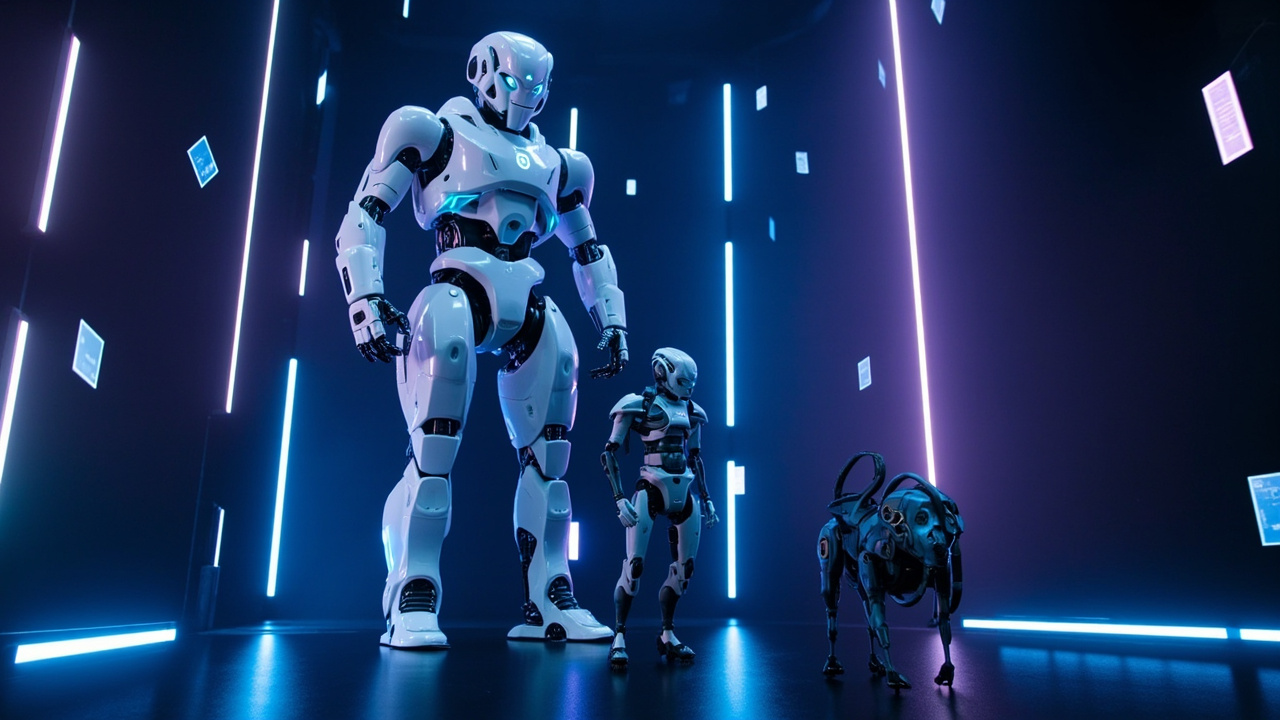
The most startling number from Faraday Future’s annual 919 launch event, held September 19 in Los Angeles, is not the $129,900 price of its flagship humanoid. It is $9,990 — the starting price of the FF Master Mini, which the company bills as North America’s first compact embodied-AI humanoid robot priced below $10,000 that combines programming education, open development, and sports competition. A sub-$10K biped is the kind of price point that moves humanoids from research-lab line items into school budgets, and it anchors a launch that saw nine new robot configurations go on sale across five models, alongside four industry solutions for education, research, security, and inspection.
With the launch, the California-based company says its “One-Brain Multi-Form Multi-Capability” FF EAI Robot World has been upgraded to Version 2.0 — a portfolio it claims now spans three robot forms (humanoid, quadruped, and mobile manipulator), five product series (Futurist, Master, Aegis, Navi, and Faber), 11 models, and 24 products. That would make it, by FF’s own accounting, the U.S. robotics company with the most complete range of robot forms, the broadest size coverage, and the largest number of robot models.
The flagship: All-New Futurist
At the top of the new stack sits the FF All-New Futurist, a full-size professional humanoid positioned as an “All-in-One Professional Expert.” The core spec sheet: 51 active degrees of freedom, rising to 71 with an advanced dexterous-hand upgrade; a 1,152-watt-hour dual-battery system good for roughly eight hours of operation under standard working conditions, with autonomous charging; and, on the Ultra variant, an NVIDIA Jetson Thor compute module delivering 700 TOPS. FF says that compute, combined with vision-language-action models, world models, and task planning, lets the robot move beyond executing individual commands to completing entire tasks. Target use cases include university research, embodied-AI development, enterprise services, sports competition, and industrial applications.
Pricing is tiered to match. The All-New Futurist Standard comes in at $89,900, including a Skills Package the company values at $10,000. The Ultra is $129,900 with a $15,000 Skills Package. That positions the Futurist meaningfully below the seven-figure asks that frontier humanoids from the biggest names have floated for general-purpose research platforms, while remaining a serious capital purchase for any university lab.
The education play: Master Mini
The Master Mini line may matter more to FF’s long-term story. Three configurations — Master Mini, Master Mini Pro, and Master Mini Ultra — are aimed at education, sports, and robotics competition, what FF calls an all-rounder “from classroom to competition.” The robot stands roughly 95 centimeters tall, weighs about 19.5 kilograms, and scales compute across its variants at 48, 117, and 200 TOPS respectively. Open motion, perception, and application interfaces support programming education, open development, entertainment performances, and robot soccer. Pricing runs $9,990 for the base model (with a $1,000 Skills Package), $12,990 for the Pro, and $17,990 for the Ultra.
The strategic logic is the EAI Data Factory: every classroom and competition unit is a data-collection node. The K-12 Education Solution announced at the event builds a full pipeline on top — a three-tier curriculum in Blockly, Python, and ROS, a supporting competition system, grade-specific courses, teacher training, and device management — with modular packaging for private schools, public districts, and training institutions. The Research Solution mirrors this for universities, led by the All-New Futurist, with a unified SDK, ROS interfaces, simulation and digital twins, and support for Sim-to-Real and swarm-intelligence research within one tool chain.
The industrial dogs: Aegis Hyper, Mega, and Classic Ultra-W
The quadruped line covers the industrial end. FX Aegis Hyper is a large industrial-grade machine for extreme environments, heavy-duty tasks, and high-risk autonomous operations, with support for professional payloads including thermal imaging, gas detection, 3D scanning, and communications relay equipment. It starts at $137,900, including a $15,000 Skills Package — the most expensive item in the launch.
FX Aegis Mega, available in two configurations, is a mid-sized wheel-legged robot with a maximum payload of 50 kilograms. It can continuously climb 25-centimeter stairs, clear single obstacles up to 80 centimeters, and its hot-swappable dual batteries deliver at least five hours of unloaded runtime. Both configurations are $74,990, including an $8,000 Skills Package.
The FX Aegis Classic Ultra-W is the lightweight option: an approximately 22-kilogram wheel-legged robot for security and companionship, combining wheeled mobility with legged obstacle-clearing, low-noise operation, and open development support for secondary development, simulation training, and multi-robot coordination. It is priced at $12,990 with a $3,000 Skills Package.
One brain, four cores, and a sales network
Founder and Global CEO YT Jia framed the strategy as ecosystem over form factor: “FF is not building a single robot form that attempts to do everything, we are building a robotics ecosystem in which a generalized and adaptable EAI Brain supports multiple robot forms.” He tied the approach to Stanford professor Fei-Fei Li’s view that multiple robot forms will coexist within one ecosystem, with diverse forms generating real-world data that feeds EAI Brain training, Skills development, and device iteration.
Commercially, FF says it operates a “Light on Four, Heavy on Four” model — staying light on capital, assets, marketing, and sales while focusing on product strength, AI, real-world utility, and users. Based on Q2 financial results, the company puts the average contribution margin on its robotics products at roughly 30 percent. Sales run through a “6+1” network: six routes to market (B2B, FF Par, e-commerce, marcom and video sales, community, and Mcube), plus RoboShare, a robot-sharing and rental platform operated by AIxC, an FF majority-owned subsidiary that has signed an MOU with U.S. rental platform Hifivebot. All nine new products are available for sale and delivery now through FF.com, Amazon, and RobotShop.
Context and caveats
The 919 event is the biggest single step yet in FF’s pivot from electric vehicles — the company’s troubled origin — to what it now calls Physical AI. The Robot Report noted in May that FF had secured $25 million to ship 1,500 robots by year’s end, having shipped just 68 robots between February and April. Scaling from dozens to thousands of units, while managing a going-concern warning and heavy reliance on Chinese OEM manufacturing (a risk factor FF itself flags, including the possibility of federal import bans), is the gap between this launch’s ambition and its delivery.
Still, the price ladder on display — $9,990 to $137,900, spanning classroom bipeds to industrial quadrupeds, all sharing one software ecosystem — sketches a plausible volume strategy that most humanoid startups, focused on single flagship machines, have not attempted. Whether the flywheel spins depends on execution FF has yet to prove. But as a statement of where consumer-adjacent robotics pricing is heading at the end of 2026, the 919 launch is one of the clearest data points yet.
Sources
- [1] https://investors.ff.com/faraday-future-to-unveil-nine-new-ai-powered-robots-and-four-industry-solutions-at-its-annual-919-launch-event-completing-its-one-brain-multi-form-multi-capability-robot-world-2-0/
- [2] https://www.stockwatch.com/News/Item/U-b20260919657129-U!FFAI-20260919/U/FFAI
- [3] https://www.therobotreport.com/faraday-future-obtains-25m-ship-1500-robots-years-end/