A $249 Board Picked the Target: Inside Scaleout's Fully Autonomous Drone Strike for NATO's ALMA Program
A Swedish startup inside NATO's DIANA accelerator ran a complete autonomous kill chain on a Nvidia Jetson Orin Nano: detect, rank, fly, strike — no human input beyond a start button, zero external comms, 30 ms latency, mission done in under 320 seconds.
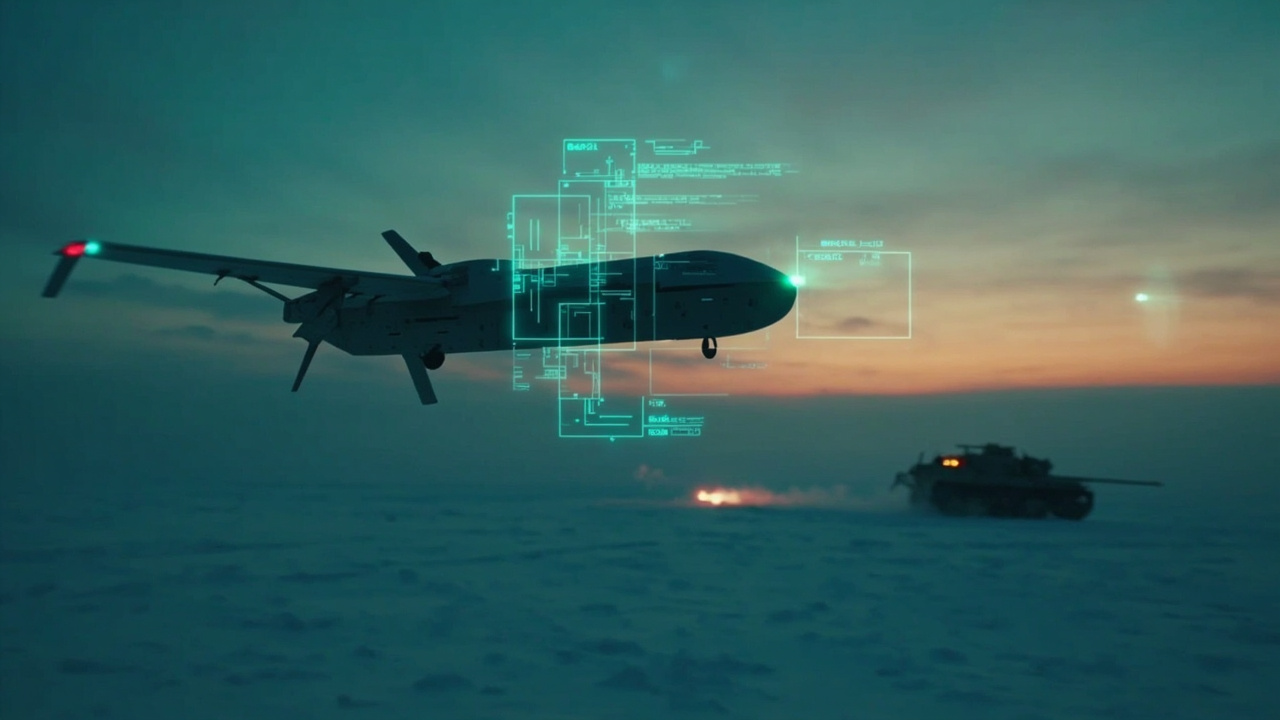
Over a Swedish test range in January, a drone spotted four objects moving through the snow, ranked one of them — an armored engineering vehicle — as the target worth hitting, flew itself to it, and dropped an explosive on it. A human had set the mission parameters. No human picked that vehicle. No human flew that stretch. And for the entire engagement, the aircraft sent nothing back to any server, because it could not: the whole point was to prove it didn’t need to.
The story broke into the mainstream this week when Ars Technica’s Jeremy Hsu profiled Scaleout Systems, the Swedish AI startup behind the onboard intelligence, and Tom’s Hardware followed with the hardware details. The demonstration took place during BAE Systems Bofors’ Winter Demo 2026 event in Karlskoga, Sweden — three days, roughly twenty startups, and a panel featuring Swedish defence minister Pål Jonson — as part of ALMA, the Affordable Loitering Modular Ammunition project that BAE Bofors leads.
Who Scaleout Is and Why It Exists
Scaleout Systems is an Uppsala University spin-off founded in 2018 by researchers Andreas Hellander and Salman Toor. Its original business was unglamorous and civilian: training and deploying machine-learning models directly on the hardware inside commercial trucks and vehicles. The full-scale Russian invasion of Ukraine in 2022 changed the calculus. “With the war in Ukraine and a shifting world, we realized that this technology can be very important to operationalize edge data and sensor data for machine learning to make sure that NATO allies have found that strategic advantage,” Hellander told Ars Technica.
The company’s defining choice is that it does not use frontier models. There is no GPT-class system, no giant multimodal backbone calling home to a data center. Scaleout trains small computer-vision models sized for what a drone or a forward-deployed workstation can physically carry — “from small embedded devices to quite powerful edge workstations,” in Hellander’s words. In the February arctic test, the object detector was YOLOv8 Nano, running on a Nvidia Jetson Orin Nano — a development board that sells for $249.
That constraint is the strategy. Modern battlefields are saturated with electronic warfare; jamming routinely severs the communication link that remotely-piloted drones depend on. An aircraft that “goes stupid” the instant its link drops is an aircraft already lost. Ukraine reached this conclusion from the bottom up, bolting onboard AI onto cheap FPV kamikaze drones. Scaleout is chasing the same problem with a formal architecture and a NATO badge.
The January Mission, Number by Number
Scaleout’s own materials describe the ALMA Winter Demo flight plainly: the drone autonomously “detected, identified and geolocated all potential spotted threats with the use of AI,” with “all data handled by dedicated onboard computing, allowing the system to perform in real-time without any external processing.”
The specifics reported this week fill in the picture. Beyond an initial button press, manual input was optional; a designated pilot remained on hand purely as a failsafe controller. The mission ran under human-set parameters — engage an armored engineering vehicle being the priority class — and required roughly 200 seconds of reconnaissance, with the full mission completing in under 320 seconds. In the arctic follow-up at BTC Karlskoga, flown at −18 °C in snow on an Airolit S1 airframe, the system sustained about 30 frames per second at roughly 20 m/s with target latency of 30 ms or less — and about 30 ms sustained in the field. Ranging worked without a depth sensor by combining a pinhole camera model with known object dimensions.
An operator could have taken control at any moment. Nobody needed to.
The Learning Loop Is the Real Story
A drone that picks its own target is, by now, an established genre — DroneXL notes the New York Times investigation into Eric Schmidt’s AI attack drones in Ukraine, where autonomous terminal guidance landed above a 70 percent hit rate but a human still designated targets first. The genuinely new part is what Scaleout demonstrated in June at a Swedish Air Force base in Uppsala, where the military already licenses the company’s main platform.
The setup: two ground nodes under a cloud-hosted control plane. ALPHA was a forward-deployed node at the air base with a stable link; BRAVO was a lab node in Uppsala whose connection was first degraded, then cut entirely. BRAVO kept running inference and active learning at full frame rate while offline, logging detections locally, then backfilled everything on reconnect — in priority order: heartbeat, critical alerts, drift, model updates.
This is federated learning, the architecture Scaleout has been building since before the pivot: devices train locally and share model updates rather than raw sensor footage, so reconnaissance data never leaves the hardware that captured it. Headquarters nodes aggregate updates from multiple units, retrain, and push improved models back to the edge whenever a link opens. The failure it targets is model drift — a detector trained on desert imagery performs badly over a city, and a war does not pause while someone retrains it in a data center. “If we can release several new versions of this model that — during the course of a single day or certainly an operation — keep learning and keep improving,” Hellander told Ars, “that is the sustainable advantage.”
The company packages this as Scaleout Edge plus a “Tactical Computer Vision Network,” developed under project FEDAIR (Federated Aerial Intelligence for Recon) inside NATO’s Defence Innovation Accelerator for the North Atlantic — DIANA — which selected Scaleout in February 2025 alongside five other Swedish companies and provided €100,000 in development funding, training, and test-range access. Hellander frames the endpoint as alliance-wide: “In principle, you can unlock collaboration between NATO member states.”
A drone that strikes autonomously is a fixed capability. A network of drones that keeps getting smarter while jammed, and syncs its improvements when the link returns, is a compounding one.
The Governance Gap
None of this exists in a regulatory vacuum — it exists slightly ahead of one. States party to the Convention on Certain Conventional Weapons agreed a non-binding autonomy text in Geneva on September 5, after the United States and Russia pushed late changes and Washington sought flexibility on human-judgment language. Reuters reported that the US position had hardened over the previous six months toward guidelines over a binding treaty. Stop Killer Robots’ Nicole van Rooijen said three years of work had been “substantially diluted in the last hours.” The CCW’s Seventh Review Conference in November decides whether actual treaty negotiations begin — and the agreed text has not been published.
The US has a domestic rule, DoD Directive 3000.09, requiring that autonomous weapon systems let commanders exercise “appropriate levels of human judgment over the use of force.” But that directive governs American programs. It has nothing to say about a Swedish demonstration. Tom’s Hardware put the sharpest point on the whole affair: in the February test, autonomous target selection ran on a board hobbyists can buy.
DroneXL’s reporting also flags the question neither Scaleout nor BAE has answered in public: where does operator veto live once the link is gone? The entire design premise is that the link will be gone. Whether an abort command can still reach an aircraft in that state is precisely what the November Geneva text will be judged on. And there is a sobering precedent for what happens when this class of capability escapes the test range: forensic teams have tied a Russian Molniya drone carrying an Nvidia Jetson Orin module to a July 6 strike on a Zaporizhzhia gas station that killed three civilians — the first documented case of its kind.
What Comes Next
Scaleout’s demonstrations, license, and DIANA funding all come before any official NATO procurement order or combat deployment. Whether BAE Systems Bofors moves ALMA from demonstration to production remains open. But the direction of travel is unmistakable: European militaries are committing serious money to unmanned systems — Sweden has pledged $440 million, and in Germany, Helsing and Stark took €600 million in loitering-munition contracts away from Rheinmetall. The war in Ukraine has already normalized onboard AI on cheap kamikaze drones; the federated-learning layer that Scaleout adds turns attrition hardware into a self-improving swarm.
The uncomfortable summary: the same edge-AI economics that put a capable vision model on a $249 developer board for robot hobbyists also puts autonomous target selection on a loitering munition. The January flight over Karlskoga was a demo with a pilot standing by. The November meeting in Geneva will decide what rules exist when nobody is.
Sources
- [1] https://arstechnica.com/ai/2026/09/nato-backed-startup-adapts-ai-for-autonomous-drone-recon-and-attack-missions/
- [2] https://www.tomshardware.com/tech-industry/drones/autonomous-strike-drone-uses-nvidia-jetson-orin-nano-to-independently-pick-and-bomb-targets-swedish-startups-attack-drones-run-small-ai-model-require-no-human-input-and-zero-external-comms
- [3] https://dronexl.co/2026/09/18/nato-scaleout-alma-autonomous-drone-target/
- [4] https://aiweekly.co/alerts/swedish-ai-startup-scaleout-runs-autonomous-kill-chain-drone-on-jetson-orin