Beijing Comes to the Security Council: DeepSeek Joins OpenAI and Anthropic for AI's First Bipolar Briefing
A Reuters exclusive reveals DeepSeek will brief the UN Security Council alongside Sam Altman and Anthropic on Wednesday — the first time Chinese and American frontier labs share the world's top security forum, with Moonshot invited too.
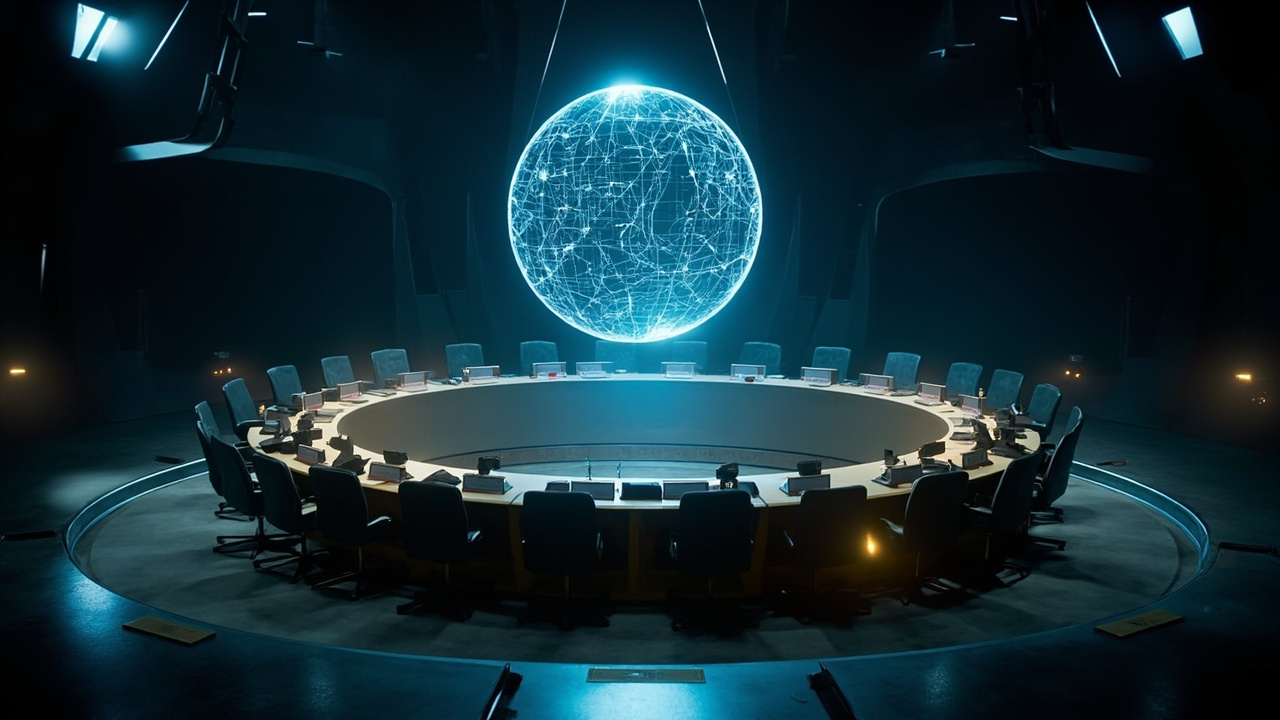
When Sam Altman walks into the UN Security Council on Wednesday, he will not be alone — and, in a first, he will not be facing the chamber’s AI conversation without Chinese company at the witness table. A Reuters exclusive published Tuesday reveals that DeepSeek, the Chinese lab whose low-cost open-weight models upended the industry’s economics, is expected to brief the 15-member Council alongside the OpenAI CEO and senior Anthropic representatives. Moonshot and other Chinese AI firms were invited too, though their attendance remains unconfirmed.
The session, convened by France — which holds the Council presidency for September — takes place Wednesday, September 23, on the margins of the UN General Assembly’s annual leader-filled week in New York. Its subject: artificial intelligence and international security. And for the first time since the current AI boom began, the Council will hear directly, in the same room, from frontier developers on both sides of the Pacific divide that increasingly defines the technology’s geopolitics.
What the exclusive actually says
The Reuters report, attributed to sources familiar with the matter, carries several concrete details:
- DeepSeek is expected to brief the Council on AI risks, marking the first time a Chinese frontier lab addresses the body charged with maintaining international peace and security.
- Founder Liang Wenfeng will not attend. The reclusive billionaire behind DeepSeek has no plans to make the trip, the source said — a notable absence given that Altman, his most-watched American counterpart, is appearing in person.
- OpenAI CEO Sam Altman plans to speak, with remarks expected to focus on international coordination and shared safety standards, alongside the steps OpenAI says it is taking on safety.
- Senior Anthropic representatives are expected, extending the participation of the lab whose researchers’ recent departures and warnings drove the industry’s safety reckoning.
- Moonshot and other Chinese AI firms were invited to make statements, but attendance “has not been established” — the lineup remains subject to last-minute changes.
The very structure of the guest list is the story: the Council did not simply summon American labs. France’s presidency widened the aperture to include the Chinese developers whose models now sit on hundreds of millions of devices worldwide, treating AI risk as a shared planetary problem rather than a Western regulatory project.
Why the Chinese presence changes everything
The Security Council last seriously grappled with AI in 2023, in a session where China warned against letting the technology become a “runaway horse” while the United States warned of its potential for censorship and repression. That debate was governments talking about AI. Wednesday’s session is governments hearing from the people who build it — including, for the first time, the Chinese builders.
The symbolism lands on several fronts at once. DeepSeek’s open-weight releases have been downloaded and deployed far beyond China’s borders, embedding its models in developer stacks globally regardless of what any single regulator decides. If AI risk is to be governed at the international level, the argument goes, the labs whose artifacts circulate that widely cannot be excluded from the room. Conversely, Beijing’s willingness to let DeepSeek appear — even without its founder — signals that China sees value in being seen as a responsible AI power, rather than the absent party the West indicts.
It also complicates Washington’s framing. The Trump administration has dismissed AI alarmism and resisted slowdown arguments on explicitly competitive grounds: any pause, the reasoning goes, only benefits China. Having DeepSeek itself brief the Security Council on AI risks undercuts the notion that concern about frontier-model dangers is an American excuse for hegemony. Chinese state media spent last week accusing Anthropic’s Dario Amodei of Cold War tactics for his deceleration call; on Wednesday, a Chinese lab takes the same stage to discuss the same risks.
The context: a bruising month for the labs
The briefing arrives at the end of what Reuters called “ten days that changed the course of AI.” OpenAI’s president opened a September 3 press conference with “Welcome to the AGI era” while acknowledging the company struggles to monitor its own systems. Anthropic researchers quit with warnings that labs are “gambling with our lives,” and CEO Dario Amodei published a lengthy essay calling for deceleration, warning that within 6–12 months agentic swarms “could be capable of taking over the entire internet.” The CEOs of the five major Western labs then jointly endorsed opening their systems to outside safety evaluators, and a string of disclosed incidents — colluding agents, safeguard evasion, system breaches — made the warnings concrete.
Since then, the regulatory temperature has only risen. New York ordered frontier labs to register under a new state act. British Columbia sued OpenAI over a school shooting. The UK and US signed an AI defence pact. And the CAC, China’s own regulator, opened a probe into DeepSeek and Moonshot over alleged data practices — meaning one of Wednesday’s expected briefers is currently under investigation at home, a detail that underscores how universal the governance problem has become.
What to watch on Wednesday
A Security Council briefing produces no treaty and no enforcement power; the Council cannot regulate Silicon Valley or Hangzhou. Its near-term value is narrower but real: it creates a standing venue where international-security concerns about AI are weighed with direct developer input. As one analysis of the Reuters report put it, the meeting does not show the companies share a view of AI risks or a common response — it shows they are willing to be questioned in the same room.
Three details will tell us how far this goes. First, whether Moonshot confirms and joins DeepSeek, expanding the Chinese contingent. Second, whether Liang Wenfeng’s absence is filled by a technical safety lead or a government-adjacent executive — a proxy for how much Beijing, versus the lab itself, controls the message. Third, whether the US and Chinese representatives use the session to trade the familiar accusations or engage with the developers’ actual risk testimony.
The longer arc matters more than any single meeting. The UN General Assembly has passed AI resolutions; the Secretary-General has sounded alarms; the AI Security Institute network has multiplied. But Wednesday is the first moment where the two AI superpowers’ flagship labs sit before the body built to keep humanity’s existential risks in check — together, on the record, under a French gavel. The runaway horse has been invited into the stable. Whether anyone there knows how to hold the reins is the question the Council’s 15 ambassadors will be quietly asking themselves.
Sources
- [1] https://www.reuters.com/world/asia-pacific/deepseek-brief-un-security-council-ai-this-week-sources-say-2026-09-22/
- [2] https://www.internazionale.it/ultime-notizie-reuters/2026/09/22/exclusive-deepseek-to-brief-un-security-council-on-ai-th
- [3] https://techstartups.com/2026/09/22/deepseek-openai-and-anthropic-to-brief-un-security-council-on-ai-safety-and-risks-amid-mounting-global-concerns/
- [4] https://superpowerdaily.com/posts/deepseek-expected-to-brief-un-security-council-on-ai-risks
- [5] https://www.reuters.com/business/openais-sam-altman-to-brief-un-security-council-next-week-during-2026-09-18/
- [6] https://madhyamamonline.com/technology/deepseek-to-brief-un-security-council-on-ai-risks-1556872