400,000 Robots and ¥1 Trillion a Year: Inside Toyota's Physical AI Bet
Toyota told investors that factory automation from 2028 could require roughly 400,000 robots and ¥1 trillion ($6.4B) in annual spending — the largest physical AI roadmap any automaker has put on the table.
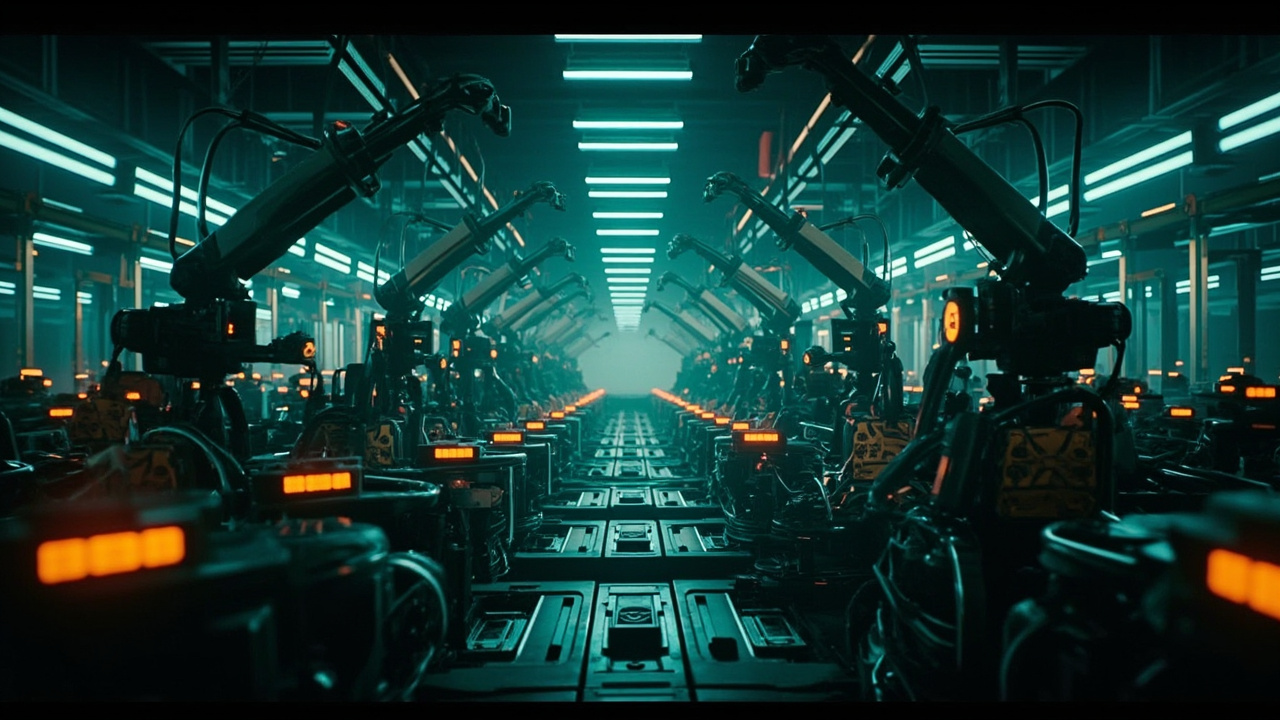
When the world’s largest automaker puts a number on robotics, the industry listens. Toyota Motor told investors earlier this month that modernizing its factories with what it calls physical AI could require around 400,000 robots and annual spending of about ¥1 trillion (roughly $6.4 billion) starting from 2028, according to reporting by Reuters published September 18 and amplified across the trade press this week.
It is the largest physical AI roadmap any automaker has publicly put on the table — and it arrives at a moment when humanoid robots have moved from conference demos to boardroom budget lines.
What Toyota actually said
The numbers come from an investor briefing, so precision matters. Toyota estimates — it has not committed — that factory automation across its own plants, group companies, and major suppliers could require approximately 400,000 robots from 2028 onward, with annual investment in the neighborhood of ¥1 trillion. The company has not said whether the full investment will proceed, nor how many years spending at that level would continue.
The 400,000 figure is deliberately broad. It includes:
- Replacement equipment for existing machines reaching end-of-life, not just net-new deployments
- Humanoid and non-humanoid systems alike — industrial arms, mobile logistics robots, and future collaborative platforms
- The extended enterprise: Toyota’s own factories plus group companies and major suppliers, which is why the number towers over official industrial-robot statistics
For context, the International Federation of Robotics (IFR) counted about 450,500 industrial robots in operation across all of Japan in 2024, with roughly 44,500 installed during that year. Japan’s entire automotive industry installed about 13,000 industrial robots in 2024 — an 11% jump and the best year since 2020. Toyota’s single-company estimate approaches the size of Japan’s total installed base, precisely because it counts replacements, multiple robot types, and the supplier ecosystem in one bucket.
Physical AI, defined by the company using the term
Toyota uses “physical AI” to describe technology that lets robots perceive their surroundings through sensors, learn or optimize their actions according to the situation, and operate autonomously. That definition separates the effort from classical factory automation, where machines repeat pre-programmed motions and any deviation stops the line.
The company’s Frontier Research Center frames the mission around labor shortages and skill transfer — capturing the tacit knowledge of aging master technicians before it retires with them. Technologies from Toyota’s long-running Human Support Robot programme now feed directly into production hardware.
Three concrete systems illustrate where this is going:
- Kamigo Plant piston line. A piston assembly line that began operating with robots in January 2025 has moved from three human operators to full automation, per Toyota’s 2025 integrated report. Notably, the road there was not linear: Toyota first introduced robots on selected sub-lines in 2008, hit maintenance-skills shortages when engine production moved overseas, and reverted some processes to manual work — while workers built jigs that doubled or tripled efficiency. That accumulated manufacturing knowledge later powered the newer automated line.
- KumiPro parts-picking robot. Already operating on production lines at Toyota Motor East Japan, KumiPro uses cameras to identify and handle loosely positioned components — eliminating the need for parts to be precisely pre-positioned, a huge cost in classical automation. Toyota has also demonstrated force-feedback control that compensates for camera-recognition errors while inserting components into narrow spaces.
- ELEY (Embodied Learning robot for Enhanced Yield). A two-armed, human-like robot on an omnidirectional mobile base, built for tasks involving physical contact with objects and surroundings. It is designed to cope with external forces when it encounters an object at an unexpected position — the difference between a demo robot and one that survives a real factory floor.
Toyota acknowledges open problems: long-duration reliability, repeatability in reaching precise positions, and the data infrastructure required for robot learning. Its plan is to test ELEY in near-production conditions, feeding both successful and failed attempts back as training data.
Sim2Real at industrial scale
On the research side, Toyota trains humanoid robots with reinforcement learning in simulated environments, running thousands of simulated robot instances in parallel before transferring learned behavior to physical machines. The stubborn obstacle is the Sim2Real gap: movements that work in simulation don’t always transfer, because sensor readings, floor friction, and actuator behavior differ from the digital twin. Toyota’s researchers deliberately inject variations in those conditions during training and pull data from physical robots to close the gap.
The Toyota Research Institute (TRI) also continues its work with Boston Dynamics on AI control systems for the Atlas humanoid. In 2025 the partners demonstrated Atlas completing a sequence of walking, lifting, sorting, and packing tasks using a single Large Behavior Model, with new robot skills added through human demonstrations — a “foundation model for motion” approach that mirrors what large language models did for text.
The competitive frame: Hyundai is coming too
Toyota is not alone in attaching a date to humanoid factory labor. Hyundai Motor Group — which bought controlling stakes in Boston Dynamics in 2021 — plans to introduce Atlas at its Metaplant America in Savannah, Georgia from 2028, initially for parts sequencing, expanding into component assembly from 2030. Hyundai has further set a target of establishing annual production capacity for as many as 30,000 robots by 2028.
That both giants chose 2028 as the pivot year is no coincidence. It aligns with when NVIDIA, Toyota’s simulation partner via Omniverse and Isaac Sim, expects physical AI deployments to move from pilots to production fleets.
Why it matters
Three implications are worth watching:
- A demand signal for the whole robotics stack. If Toyota’s estimate is even half right, it implies a multi-year procurement wave for robot arms, mobile platforms, sensors, and — critically — the AI software layer that orchestrates them. Suppliers from NVIDIA to a new generation of foundation-model robotics startups are positioning for it.
- Labor arithmetic finally has a number attached. The ¥1 trillion figure turns “robots will address labor shortages” from a talking point into a budget line. The Kamigo case also shows the realistic path: automation succeeded only after decades of accumulating manual-process knowledge, not instead of it.
- The Sim2Real gap is the real bottleneck. Toyota’s candor about reliability, repeatability, and learning-data infrastructure is a useful corrective to humanoid hype. The company that solves transfer from simulation to messy physical reality — at scale, over years of duty cycles — wins the physical AI era, and Toyota is spending like it intends to be that company.
The caveat bears repeating: this is an estimate shared with investors, not a signed purchase order. But when the world’s biggest automaker sketches a 400,000-robot horizon, the rest of the industry — and its investors — have to price it in.
Sources
- [1] https://www.reuters.com/business/autos-transportation/toyota-estimates-factory-automation-could-cost-64-billion-per-year-2028-2026-09-18/
- [2] https://www.artificialintelligence-news.com/news/toyota-physical-ai-factory-robotics/
- [3] https://finance.yahoo.com/technology/articles/toyota-estimates-6-4-billion-221528069.html
- [4] https://www.thenewstribune.com/news/business/article317314559.html