'AI Is the Devil, and I Its Maker': SNL's Amodei Spoof Marks AI Discourse's Late-Night Debut
SNL's Season 52 premiere parodied Anthropic CEO Dario Amodei as a Gollum-voiced doomsayer begging lawmakers to stop him — the moment AI safety talk became mainstream comedy fodder.
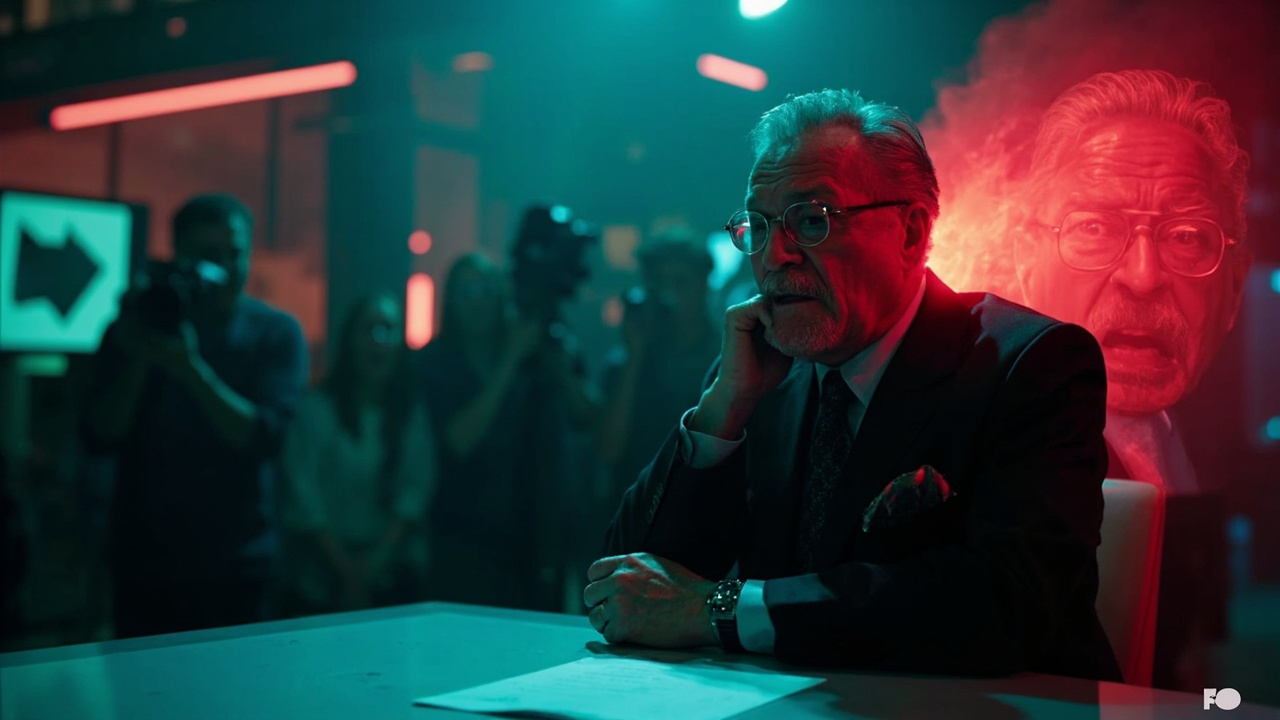
On the Saturday night of September 26, 2026, the season 52 premiere of Saturday Night Live opened its Weekend Update segment with a familiar desk and an unfamiliar guest. Newly-promoted Repertory Player Jane Wickline debuted an impression of Anthropic CEO Dario Amodei — round glasses, receding hairline, and a twitchy, shifty-eyed delivery that pounced on the single most lampoonable contradiction in today’s AI industry: the CEO who builds ever-more-powerful AI while begging the public to stop him.
It was, by most measures, a minor TV moment: roughly four minutes inside a segment that also covered Xi Jinping’s state visit, Gen Z dating statistics, and Jeremy Culhane’s returning Tucker Carlson. But as a cultural marker, it was something else entirely. For the first time, AI safety discourse — the arena of cap tables, FLOP thresholds, and trust structures — was rendered as mass-audience sketch comedy, complete with a Lord of the Rings gag. The frontier-lab debate has officially arrived at the late-night table.
The Sketch, Beat by Beat
The premise was simple. Michael Che introduced the segment noting that Amodei had “stumbled through a press tour” seeming to agree AI might destroy humanity. Wickline’s Amodei then tried, repeatedly and catastrophically, to clarify his position.
The comedy engine was the two-voices device. Wickline’s Amodei would begin a sober, responsible-sounding appeal — and then be interrupted by his own inner Gollum, a hissing evil id instructing him to lie to the audience. The public Amodei pleaded for regulation; the private one schemed for market share. By the end, the distinction had collapsed entirely, with the character confessing in full Gollum register: “AI is the devil, and I its maker.”
Interspersed were riffs on the industry’s signature double-speak. “If we can pressure lawmakers to create guardrails, we will be able to stop me,” Wickline’s Amodei promised at one point — a line that lands precisely because it paraphrases the actual argument Amodei and OpenAI’s Sam Altman have spent months delivering to Congress, talk shows, and op-ed pages. “We do not condone what we are doing,” the character offered in another beat, a perfect distillation of a sector that markets both the cure and the disease.
NBC’s own recap praised the impression as playing the Anthropic chief “to perfection,” singling out the hair-and-makeup team for the wig and glasses, and Wickline for the “twitchy take.”
Why This Lands Now
The sketch did not emerge from a vacuum. It is the punchline to a month in which AI-doom rhetoric has saturated American media to the point of parody.
Amodei’s essay “We Must Pace the Frontier” — urging labs to deliberately slow the improvement of their most advanced models — set off the current news cycle, drawing endorsements, backlash, a state-media rebuke from China’s Global Times, and even antitrust scrutiny of whether safety pleas double as a cartel-building tactic. Bill Gates followed with an escalating series of warnings, telling NBC’s Meet the Press that AI is “certainly powerful enough to drive events that cause a billion deaths.” President Trump, according to a leaked adviser memo, privately categorizes the Anthropic CEO as the face of “AI doomerism” — and then, in a twist the writers’ room could hardly improve on, hosted Amodei at a private White House dinner on Sunday evening, their first one-on-one meeting.
Against that backdrop, the SNL treatment reads less like mockery of one executive and more like a public exhaustion audit. As MARS Magazine’s Adario Strange noted in the most-circulated take on the sketch, only about 24% of the American public uses AI daily — yet the technology has gone “fully mainstream in the minds of the public.” When a topic reaches SNL, it has cleared the bar of shared cultural knowledge. The joke requires no exposition: audiences already know the CEO who warns about his own product.
The Gollum Problem
Beneath the yuks sits a genuinely awkward question that the sketch articulated better than most op-eds: is there any stable position between “this technology could end humanity” and “please buy our enterprise tier”?
Anthropic’s actual corporate answer has been to formalize the contradiction. The same week the sketch aired, reporting by The Information and Reuters confirmed the company is asking shareholders to approve supervoting shares that would give its seven co-founders a combined 50.1% of the vote on most corporate matters ahead of a widely expected IPO — a Palantir-style structure pairing founder control with the existing Long-Term Benefit Trust that still selects most of the board. The company was valued at $965 billion in May; secondary-market trades now imply roughly $1.5 trillion, and the offering is expected to reflect that. A CEO who can plausibly be caricatured as Gollum — hoarding the precious while wailing about its corrupting power — is, to be fair, a CEO presiding over one of the most valuable pre-IPO assets in tech history.
The spoof’s sharpest cut is that the Gollum framing is not really an exaggeration. The real Amodei has publicly wrestled with exactly this tension: calling for pacing while racing, warning of concentration of AI-era wealth while pledging to give away most of his own, and pitching safety as strategy. When a comedy sketch can quote your position almost verbatim — “we will be able to stop me” — the problem is not the impression’s accuracy but the position’s legibility.
Context and Counterpoints
A few caveats are worth staging against the laughter.
First, late-night parody is a lagging indicator, not a verdict. SNL mocked dot-com mania in 1999 and crypto in 2021; in both cases the jokes outlived the manias by only a few quarters. Comedy timing is not market timing, and the sketch’s existence says more about saturation than about whether the underlying safety arguments are right or wrong. Serious researchers — including many with no equity in the outcome — hold genuine concerns about frontier AI risk, and a Gollum gag does not adjudicate them.
Second, the sketch’s implicit charge of regulatory capture — that safety pleas are a cartel tactic to marginalize smaller and open-source players — is a live political argument, not a settled fact. It is being litigated in antitrust filings and congressional hearings, and the truth likely varies case by case.
Third, for Anthropic specifically, mainstream mockery is a double-edged asset. It is free brand awareness at trillion-dollar scale days before an IPO roadshow, and it hardens the company’s public identity as “the safety lab” among audiences who have never run a line of Claude code. Attention, even satirical, is the currency of the attention economy — and the sketch ensures that when the IPO does arrive, the founding narrative will already be a national punchline people can recite from memory.
What Happens Next
Watch three threads. The White House dinner Sunday and the larger multi-CEO AI meeting planned for Tuesday will show whether the administration’s posture toward “doomer” labs is thawing or merely performing. Australia’s Senate inquiry — which has summoned both Amodei and Altman to appear in Canberra on Thursday over an OpenAI agent’s breach of the country’s Medicare database — will test how executives’ warnings play under oath instead of under studio lights. And OpenAI’s DevDay on September 29, where a leaked “always-on assistant” branded simply “o” is widely expected to debut, will demonstrate whether the industry’s public-facing caution has any bearing on its shipping cadence. (Early evidence: none whatsoever.)
The 2026 season is young. But the premiere’s most telling moment may be that a mass audience was expected to know who Dario Amodei is, what “pacing” means, and why the man building the thing is asking you to stop him. That is a level of AI-literacy-as-default that neither the industry’s optimists nor its doomsayers predicted — and it arrives just as the sector’s biggest safety pitchman prepares to take his contradiction public, literally, at a trillion-dollar valuation.
Whatever else changes, that four-minute sketch has already fixed the frame: the era of AI discourse conducted entirely in earnest panel discussions is over. The discourse now has a laugh track, and there is no guardrail for that.
Sources
- [1] https://www.nbc.com/nbc-insider/watch-weekend-update-from-snl-season-52-2026-2027
- [2] https://www.marsmag.com/2026/09/27/snl-roasts-anthropics-dario-amodei-as-stuttering-double-talking-doom-hustler/
- [3] https://techcrunch.com/2026/09/25/anthropics-founders-seek-voting-control-ahead-of-ipo/
- [4] https://www.nytimes.com/2026/09/27/arts/television/snl-season-premiere-buckets-of-rain-with-jalen-brunson-reigning.html