One Senator, One Afternoon: The 417-3 Data Center Bill Dies by Unanimous Consent
Hours after the House passed the Ratepayer Protection Act 417-3, Sen. Martin Heinrich blocked it in the Senate as a 'half-measure' and offered his GRID Savings Act — now three competing bills meet a chamber that reconvenes Monday.
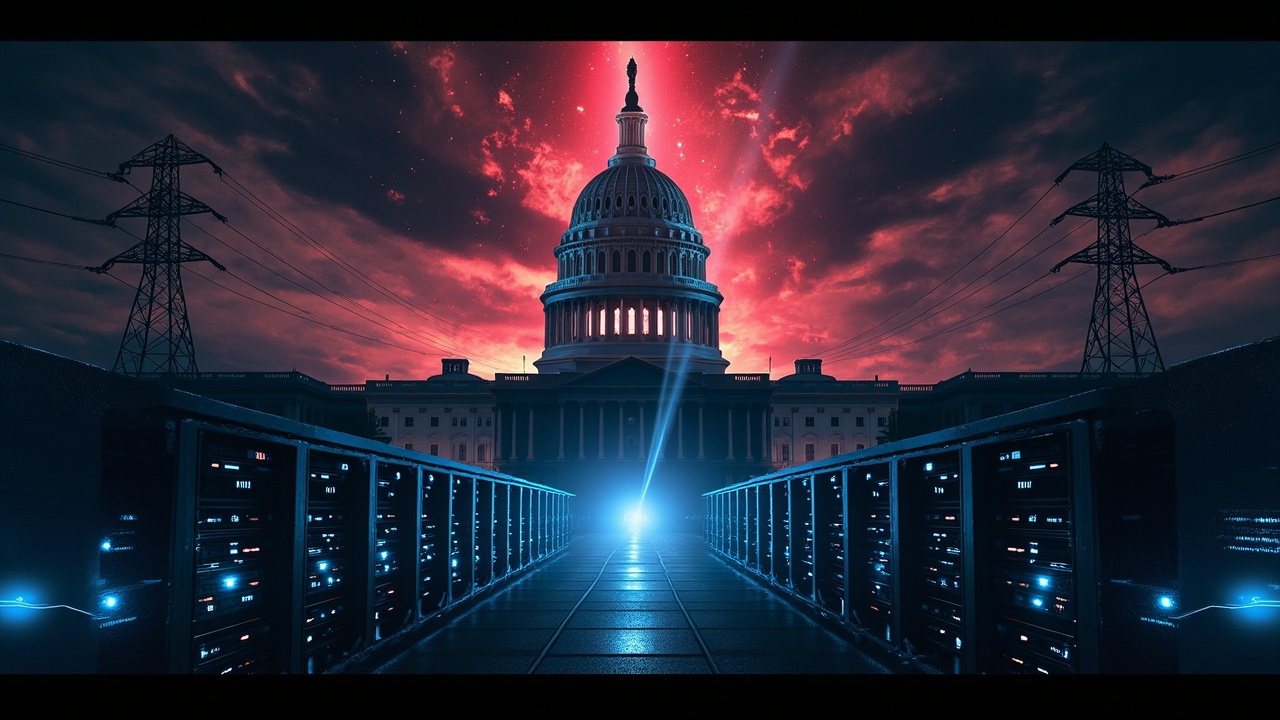
The most lopsided vote in recent AI-policy history met the least glamorous end imaginable. On Wednesday, September 16, the House passed the Ratepayer Protection Act 417 to 3 — the first data-center bill ever to clear a chamber of Congress, a near-unanimous answer to voter anger over AI infrastructure inflating electric bills. Roughly 24 hours later, in the Senate, a single Democrat from New Mexico said no. Because the chamber’s crowded pre-recess calendar left no time for regular floor process, the bill needed unanimous consent to move. Any one senator could stop it. One did.
Sen. Martin Heinrich, ranking member of the Energy and Natural Resources Committee, objected on Thursday, September 17, calling the House bill a “half-measure” that “does nothing to meaningfully address the rising costs of AI data center development.” His move denied both parties a bipartisan campaign-trail trophy less than seven weeks before the November midterms — and instantly spawned a three-way competition over who, exactly, will force hyperscalers to pay for the grid.
What was actually blocked
The Ratepayer Protection Act (H.R. 9340), sponsored by Rep. Gabe Evans (R-CO) and Rep. Kathy Castor (D-FL), is narrower than its headline suggests. It amends the Public Utility Regulatory Policies Act of 1978 to add a new consideration: state regulators would be asked to adopt standards ensuring that large-load customers — the June markup narrowed the definition to facilities whose demand is primarily IT infrastructure, data storage and computation — cover the costs of the network upgrades they necessitate, rather than socializing them across every household on the grid.
The operative word is “consider.” The bill codifies portions of the White House’s “Ratepayer Protection Pledge,” a voluntary March 2026 agreement signed by more than 300 utilities, cooperatives and hyperscalers, and pulls that logic into statute. It does not mandate any final regulation. Critics from both directions flagged this: too weak for Democrats who want firm federal requirements, too prescriptive for some state-utility constituencies who resent Washington defining cost allocation.
Heinrich’s objection was precise. The Senate version’s lead sponsor, Jon Husted (R-OH) — locked in a tough race against former Sen. Sherrod Brown, who has made Husted’s past data-center support a campaign issue — had sought fast-track passage by unanimous consent the day after the House vote. Under unanimous consent, there is no amendment process and no recorded vote. Heinrich used the moment to argue the bill’s voluntary architecture is a loophole: states can “consider” and then do nothing, while data-center demand keeps climbing transmission costs nationwide.
The counter-offer: a federal rule with teeth
Heinrich did not just block; he offered his alternative on the spot. His GRID Savings Act (S. 5199), introduced in August with bipartisan engineering, would require FERC — the Federal Energy Regulatory Commission — to promulgate a national rule governing how large loads interconnect to the interstate transmission system. Where the Ratepayer Protection Act asks states to consider cost allocation, the GRID Savings Act would give the federal commission direct jurisdiction over covered large-load interconnections and require that those users finance the grid upgrades they trigger, in exchange for reliable transmission service.
The bill would also formalize what FERC is already doing under pressure. In June, the commission issued six show-cause orders to the regional transmission organizations under its jurisdiction, directing them to justify or reform their tariffs for data centers and other large energy users — a process that traces back to a Department of Energy directive in October 2025. Heinrich’s bill would put that trajectory into statute, making the outcome independent of commission turnover.
It has company. Sen. Chris Van Hollen (D-MD) is pushing the Power for the People Act, which would prevent data-center costs from being passed through to households and small businesses, and Rep. Paul Tonko (D-NY) has a House companion. Van Hollen’s framing leans on capacity-auction data: data centers made up roughly 40 percent of the cost in PJM’s latest capacity auction, and data-center forecasts have driven close to half the growth in the past three auctions. The $156 billion question — his office counts at least that much across 48 publicly disclosed projects in 2025 alone — is who eats those network costs when the bill comes due.
Why the calendar was the real villain
The procedural collapse was almost overdetermined. The House passed H.R. 9340 under suspension of the rules on September 16, a path requiring two-thirds support that signaled overwhelming bipartisan backing. But the Senate’s September floor agenda was already saturated, and Majority Leader John Thune (R-SD) had said openly that pre-midterm passage would likely require unanimous consent — the same mechanism that lets a single senator impose a veto. When Heinrich objected, there was no fallback: no time for a cloture file-and-wait cycle, no committee pathway that could clear both chambers before the recess.
The Senate now reconvenes Monday, September 28, at 3:00 p.m., with no committee hearings scheduled that first day. What happens next is genuinely open. Republicans can re-attempt unanimous consent and dare Heinrich to hold the floor. Heinrich can seek a markup of the GRID Savings Act in Energy and Natural Resources, where he is ranking member. Or the competing bills can simply run out the clock into the midterms, with each party carrying its own version of “we tried to make Big Tech pay its electric bill” to voters.
The substrate under the fight
What makes the standoff more than inside baseball is the measurable public anger beneath it. A University of Massachusetts at Amherst survey in late August found 65 percent of respondents would oppose an AI data center in their local community — including 52 percent of Republicans, 71 percent of independents and 76 percent of Democrats. Local moratorium campaigns have proliferated from Philadelphia to rural Virginia as the buildout accelerates.
The economics driving that sentiment are structural. Anthropic alone signed an $11.6 billion, seven-year CPU-compute deal with Akamai last week, pushing its disclosed compute commitments past $500 billion in under a year. OpenAI’s roadmap contemplates hundreds of billions more. Every one of those training and inference clusters is also a multi-hundred-megawatt grid customer, and in most of the country the default tariff structure spreads the cost of serving them across every ratepayer on the wire.
The industry is not waiting for Congress. Nvidia, Google and Emerald AI launched the AI Energy Management Alliance to make data centers grid-flexible resources; Amazon signed an $8 billion backup-generation pact with Generac; labs are hunting smaller 20-30 MW deals near existing capacity. FERC’s show-cause docket proceeds regardless. The Senate fight is now about whether the rule comes from a statute or a regulator — and whether “consider” ever hardens into “must.”
For a blog tracking the AI buildout, the 417-3-to-blocked arc is the sharpest demonstration yet of how far public sentiment has outrun legislative machinery. The House spoke with one voice. The Senate couldn’t schedule the echo.
Sources
- [1] https://www.cnbc.com/2026/09/17/ai-data-center-utility-cost-senate.html
- [2] https://thehill.com/policy/energy-environment/6096398-heinrich-blocks-husted-data-center-bill/
- [3] https://www.politico.com/live-updates/2026/09/17/congress/data-center-bill-falls-amid-democratic-objection-01082461
- [4] https://www.heinrich.senate.gov/newsroom/press-releases/heinrich-offers-his-grid-savings-act-to-force-ai-data-centers-to-pay-for-grid-upgrades-highlights-how-husted-backed-bill-falls-short
- [5] https://www.politico.com/news/2026/09/18/senate-competing-data-center-bills-01083204
- [6] https://www.usatoday.com/story/news/politics/2026/09/18/senate-data-center-energy-bill-blocked/91823383007/