India's Second Shot at an Orbital Data Center: TakeMe2Space Books MOI-1A on a SpaceX Rideshare
Hyderabad's TakeMe2Space has signed 23 customers for MOI-1A, a sub-50 kg Nvidia Orin NX satellite flying on SpaceX's Transporter-18 rideshare — its comeback after losing its first spacecraft to India's PSLV-C62 failure.
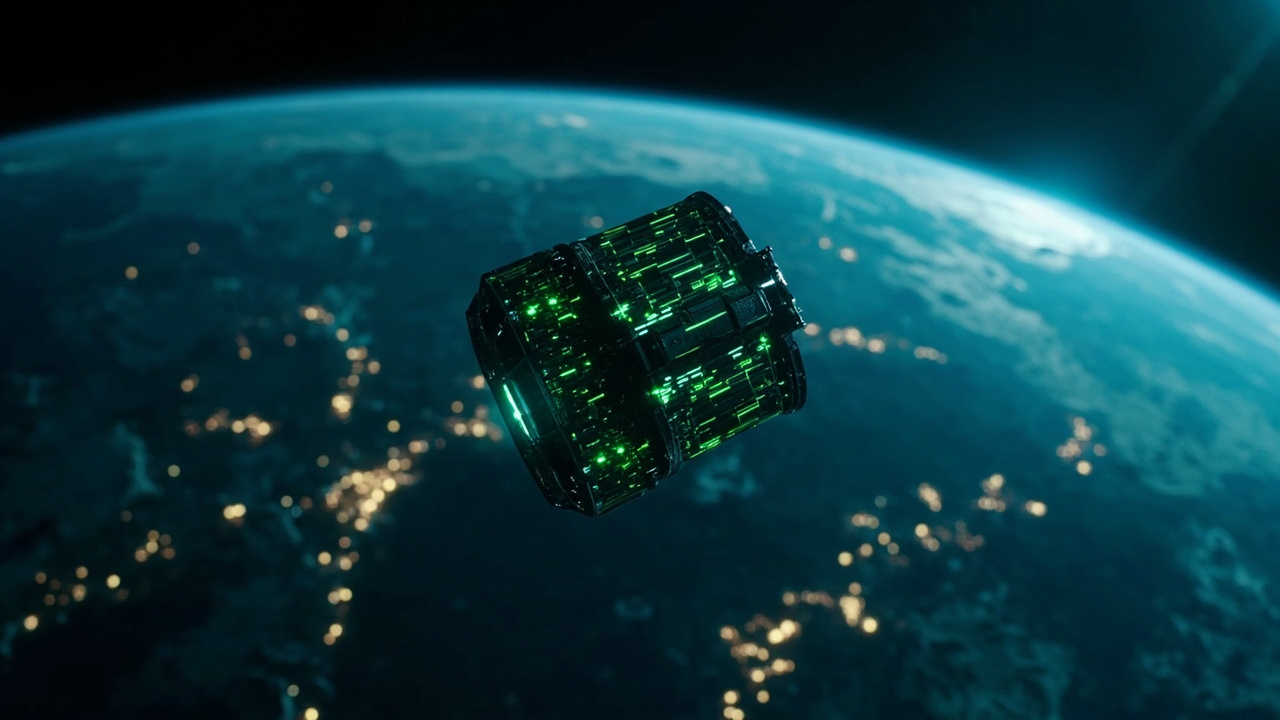
Nine months after an Indian rocket failure destroyed its first satellite, Hyderabad-based startup TakeMe2Space has booked its second ride — this time on an American one. The company said on Monday, September 28, that its MOI-1A orbital computing spacecraft will fly on SpaceX’s Transporter-18 rideshare mission, and that it has already signed 23 customers for compute capacity aboard the small satellite.
It is a quietly significant milestone for the nascent orbital data center industry. Not because of the hardware’s size — MOI-1A is a sub-50 kg spacecraft — but because of what it represents: the first commercial “compute node” from India reaching orbit, and a bet that processing data in space, close to where it is collected, can beat the traditional downlink-everything model on both latency and cost.
A Do-Over After PSLV-C62
TakeMe2Space’s maiden satellite, MOI-1, was lost on January 12, 2026, when ISRO’s PSLV-C62 rocket suffered a third-stage anomaly during ascent. The failure claimed all 16 payloads aboard, including satellites from three Hyderabad-based startups — a stark reminder of how fragile access to orbit remains even as launch costs fall. According to the company’s own mission log, MOI-1 recorded no faults up through the failure event: the spacecraft itself was healthy; the ride died underneath it.
The loss was more than symbolic. MOI-1 was meant to serve as an “AI lab in space” for roughly 15 customers, and the failure delayed those pilots by months. Rather than wait for the next domestic PSLV slot, TakeMe2Space pivoted to SpaceX’s Smallsat Rideshare Program, booking deployment through Transporter-18. For a startup, the logic is straightforward: a rideshare berth on a reliably launching Falcon 9 beats a cheaper domestic slot that may slip, and orbital compute revenue depends on actually being in orbit.
What MOI-1A Actually Is
The spacecraft is a 6U CubeSat-class platform, sub-50 kg, built around Nvidia Orin NX edge-computing processors — the same class of silicon found in autonomous vehicles and industrial edge servers, hardened and qualified for the thermal and radiation environment of low Earth orbit. The company quotes a 117-TOPS GPU with 16 GB of memory, fed by a 9-band multispectral optical imager for real-time AI processing, with roughly 150 watts of onboard power available and a 120 W, 13 kg envelope for the core AI payload per earlier company statements.
That is, to be clear, a rounding error compared to a terrestrial GPU cluster. One Orin NX cannot train anything, and nobody at TakeMe2Space pretends otherwise. The pitch is inference, not training: run models next to the sensor. A multispectral imager pointed at Earth generates far more raw data than a typical ground station pass can downlink. If you filter, detect, and summarize on orbit — sending down answers and alerts instead of full-resolution scenes — you cut bandwidth needs dramatically and shrink the time between an event happening and a user knowing about it from hours to minutes.
MOI-1A is explicitly the first node of a planned constellation. Company materials describe a series of five satellites that would eventually interconnect, with later generations adding Nvidia GPUs for heavier high-performance computing, storage capacities up to 100 TB, and optical inter-satellite links. In other words: a cluster, assembled in space one smallsat at a time.
Why Now: The Orbital Data Center Wave
TakeMe2Space is riding a wave that has been building all year. Google’s Project Suncatcher flew its first experimental TPU satellite testbed toward its October 1 launch; Axiom and others have announced orbital data center modules; and venture money has followed — Starcloud raised $250 million in August for its own orbital data center constellation, while France committed $1 billion to its Altair-Next program. The shared thesis is that space offers three things terrestrial data centers are increasingly short of: unconstrained power (unfiltered solar), free cooling (radiative cooling to deep space), and land that nobody needs to permit.
MOI-1A tests a different, more near-term slice of the thesis. The big orbital data center plays imagine beaming compute results down via high-bandwidth laser links and selling capacity like a cloud provider. TakeMe2Space’s first product is more modest and arguably more achievable: sell the compute that sits next to Earth-observation data at the source. Twenty-three customers have signed on — a mix the company says includes agriculture, infrastructure monitoring, and research users across Japan and India — and their pilots will exercise on-orbit AI inference, sensor fusion, and high-speed data handling, the same capability set the company validated in LEO with earlier experiments from its MOI-TD testbed.
The Honest Caveats
The orbital compute business case still has unresolved edges. Sub-50 kg satellites carry sub-150 W budgets, radiation upsets degrade commercial silicon over time, and replacing a failed node means buying another launch. Terrestrial edge servers are cheaper, faster to deploy, and repairable. The 23 customers are paying pilot prices for a first-of-kind service, not signing decade-long capacity contracts.
And there is competition: Google’s node, if its Suncatcher validation succeeds, brings TPUs and laser links at a scale a startup cannot match, while SpaceX itself is building an orbital AI cloud of its own. TakeMe2Space’s advantages are its focus on the Earth-observation inference niche, its price point, and its head start in actually flying commercial edge AI hardware for paying customers.
Why It Matters
The gap between “AI in space” as a demo and as a business is exactly one launch long, and MOI-1A is TakeMe2Space’s attempt to cross it. If 23 paying customers can get useful answers from a 13 kg AI payload in LEO, the template scales: each additional node adds capacity without adding ground-station bandwidth, and the marginal cost of orbital intelligence falls toward the marginal cost of launch.
The launch itself — Transporter-18, a Falcon 9 carrying dozens of small payloads — is routine by SpaceX standards. That is the point. When losing a satellite to a rocket failure costs you nine months but rebooking on a competitor’s rideshare takes one booking call, the orbital compute industry’s biggest historical risk has quietly shrunk. MOI-1A’s real payload isn’t the Orin NX. It’s the proof that the business survives its first failure.
Sources
- [1] https://www.reuters.com/business/media-telecom/indias-takeme2space-launch-orbital-computing-satellite-spacex-rocket-2026-09-28/
- [2] https://www.channelnewsasia.com/business/indias-takeme2space-launch-orbital-computing-satellite-spacex-rocket-6414701
- [3] https://www.tm2.space/missions
- [4] https://theprint.in/science/take-me-2-space-spacex-launch-moi1a/2926195/