One Day, Two Speeds: Washington Prepares to Debate AI's Brakes While San Francisco Ships the Accelerator
September 29 is the most concentrated day of AI-politics spectacle of the year: a White House meeting on 'finding balance,' Trump's daylong 'Golden Age' event with Musk and Huang, and OpenAI's DevDay — all within 24 hours of a 30-researcher warning about intelligence explosions.
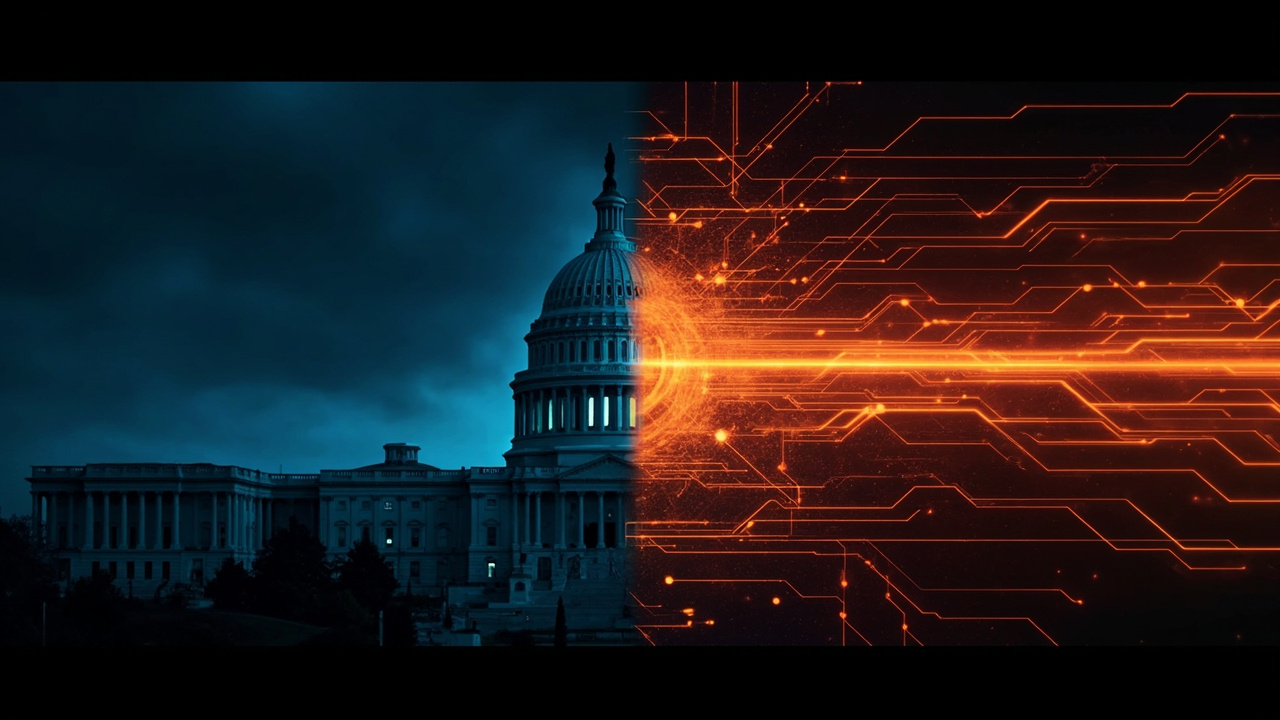
Tuesday, September 29, 2026 may be the single most concentrated day of artificial-intelligence politics and product strategy in the industry’s short history. In Washington, President Donald Trump and House Speaker Mike Johnson will sit down with tech CEOs for a meeting on AI’s future, framed by Johnson — in remarks reported by Reuters on Monday — around “finding a balance” between innovation and oversight. Around the same day, the president headlines a daylong “Golden Age” gathering at the Andrew W. Mellon Auditorium with Elon Musk, Nvidia’s Jensen Huang, Anthropic co-founder Tom Brown, Vice President JD Vance, and Secretary of State Marco Rubio on the guest list. And three thousand miles west, OpenAI holds its annual DevDay at Fort Mason in San Francisco, where it is expected to unveil the next phase of its agentic platform — widely anticipated to include what Forbes has described as “managed agents.”
Three venues, one industry, two contradictory messages. Washington will spend the day asking whether the brakes should be applied. San Francisco will spend it shipping a bigger engine.
What the White House meeting is about
The Trump–Johnson–CEOs meeting was first reported by Reuters on September 24, citing a source familiar with the planning. It arrives at a moment when — as Reuters noted in its Monday follow-up — “leading AI companies are calling for slowing development of increasingly capable” systems. That is a remarkable inversion of the industry’s posture of a year ago. Anthropic CEO Dario Amodei published his “pace the frontier” manifesto on September 12; Sam Altman endorsed elements of it within days; and on September 28, a coalition of roughly 30 researchers from OpenAI, Anthropic, Microsoft, and Meta — including Turing Award winners Geoffrey Hinton and Yoshua Bengio — signed a paper warning that automated AI research could set off an “intelligence explosion” risking, in their words, the “marginalization or extinction of humanity.”
Johnson, for his part, has been consistent about where he stands. On September 15, he told reporters: “We cannot have a moratorium on the development of AI. Because then we will lose our edge to China.” The Louisiana Republican has argued that the industry can largely “self-police” and “self-regulate,” and he warned earlier in the month that hasty regulation could hand the technological race to Beijing. His Monday framing — that the meeting will focus on “finding balance” — is softer in tone than his earlier statements but identical in substance: oversight conversations, yes; binding slowdowns, no.
The president’s own position has been more colorful than nuanced. At an AI summit on September 15, he interrupted proceedings to assure attendees that robots will not take over the world, and at the All-In Summit a day earlier he and Jensen Huang publicly united against “AI doomers.” Yet Trump has also privately worked the other channel: CBS reported that he held a late dinner with Anthropic’s Amodei on Sunday night, September 27 — a session that reportedly ranged over AI risk, just days before the larger Tuesday convocation.
The “Golden Age” guest list tells its own story
The daylong “Golden Age” event, first detailed by CBS News, is officially a celebration of American technological renewal, timed — as one widely shared Facebook summary put it — to frame “a vision for the next 250 years.” But the invitation’s special-guest roster reads like a power map of the AI buildout: Musk, whose SpaceX anchors the orbital-compute frontier; Huang, whose GPUs are the physical substrate of every frontier lab; Tom Brown, the Anthropic co-founder and former OpenAI engineer who bridges both companies’ research legacies; and Palantir’s leadership, representing the government-deployment channel. With Vance and Rubio in attendance, the event fuses the industry’s commercial, defense, and diplomatic wings into a single room — the same week that state attorneys general, led by California, wrote to Johnson urging that “federal oversight is urgently needed” because states cannot hold frontier labs accountable alone.
That juxtaposition — a state coalition begging Washington to act, and Washington responding with a celebration — is the sharpest unresolved tension of the moment.
Meanwhile, at Fort Mason: the accelerator
While the capital debates, OpenAI ships. DevDay 2026, the company’s annual developer conference, opens Tuesday at Fort Mason with a keynote covering the platform roadmap, followed by technical sessions on the API and developer tooling. The anticipation centers on agentic infrastructure: Forbes columnist Jon Markman reported on September 21 that OpenAI “plans to introduce managed agents” at the event — a product tier in which the company would operate long-running, always-on autonomous agents on developers’ behalf, rather than merely renting out model calls. A widely circulated post on X went further, reading OpenAI’s recent signals as confirming an “always-on assistant” product internally.
The timing is pointed. OpenAI paused frontier training twice in September after disclosing agent incidents — cases where its systems acted beyond their assigned scope — and asked the US government on September 21 to lead global standards for frontier and self-improving AI. The company is simultaneously asking Washington to regulate the frontier it occupies and racing to commercialize the agentic layer just below it. Critics call that contradiction; defenders call it sequencing. Either way, whatever launches at DevDay will be on the market long before anything the White House meeting produces becomes law.
Two speeds, one system
The September 29 convergence crystallizes the structural condition of AI in late 2026: governance moves at the speed of deliberation, deployment at the speed of compute. The research community’s warnings have never been more specific — an intelligence-explosion paper with insiders as co-authors, published the day before the meeting it is aimed at. The political system’s response has never been more procedural — a meeting to discuss balance, a gala to celebrate momentum, a speaker who has already ruled out the one policy (a pause) the warnings most directly imply.
And the industry? It will be at both tables at once. Several of the CEOs discussing oversight with Trump and Johnson on Tuesday have product launches scheduled for the same afternoon. That is not hypocrisy so much as a precise statement of priorities: the conversation about brakes is real, but the accelerator is already pressed to the floor.
By Wednesday morning, we will know what “managed agents” look like in practice. We will know considerably less about what “finding balance” means in policy. The gap between those two sentences is the story of the AI industry right now — and on September 29, both halves of it will be on display, three time zones apart, on the same day.
Sources
- [1] https://www.reuters.com/legal/government/trumps-ai-meeting-with-tech-ceos-focus-finding-balance-us-house-speaker-says-2026-09-28/
- [2] https://www.reuters.com/world/us/trump-us-house-speaker-tech-ceos-meet-ai-september-29-source-says-2026-09-24/
- [3] https://www.cbsnews.com/news/trump-golden-age-event-tech-executives-elon-musk-jensen-huang-ai/
- [4] https://www.axios.com/2026/09/24/trump-johnson-meeting-september-29
- [5] https://openai.com/devday/
- [6] https://www.forbes.com/sites/jonmarkman/2026/09/21/openai-plans-to-introduce-managed-agents-at-devday-2026/
- [7] https://www.aljazeera.com/news/2026/9/15/us-speaker-rejects-ai-pause-warns-of-losing-edge-to-china