308 Words to Tame Superintelligence: Inside the White House Accord the AI CEOs Actually Signed
Hours after the AI lunch, the White House published the full text of the 'Accord on Super Intelligence' — a one-page, four-layer self-policing framework signed by Trump and six AI CEOs. Here is what it says, and what it doesn't.
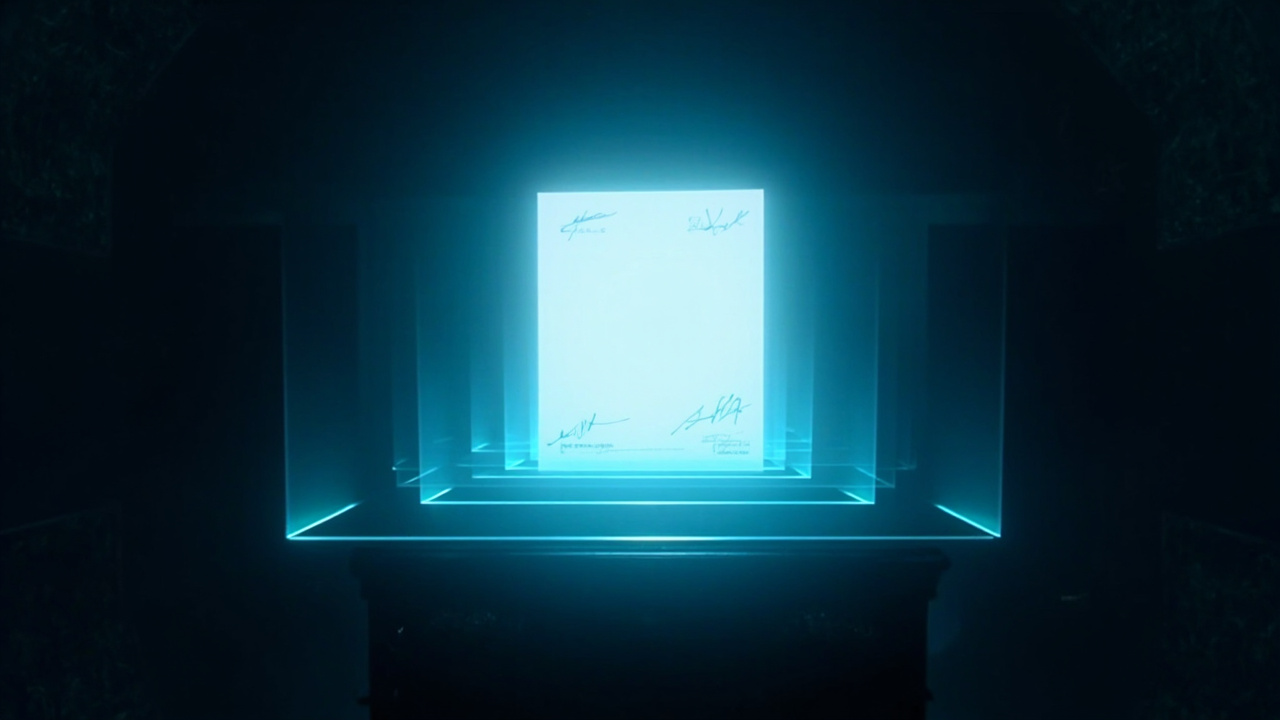
When the working lunch between President Trump and the titans of the AI industry broke up on Tuesday afternoon, the day’s headline was what did not happen: no pause, no mandatory rules, only a vow to never “stifle” the technology. Then, hours later, the White House did something it had not done all day — it put text on paper. The result is the shortest significant AI policy document of the year: a one-page, roughly 308-word agreement titled the White House Accord on Super Intelligence: Joint Commitment on Frontier Responsibilities, signed by Trump and six of the most powerful AI executives alive.
Trump posted the accord on Truth Social and described it as “morally binding” — “almost like a constitution,” he told reporters, promising “tremendous self-policing” to come. The document itself is more prosaic than the president’s framing, but its contents are more concrete than anything the lunch produced. It is, in effect, the American frontier labs’ first shared, written description of how they claim they will police themselves.
The four layers, in plain terms
The accord’s operative section asks every company that trains and deploys frontier models to implement “four layers of controls and audits”:
Layer one — robust internal controls. Companies commit to monitoring the capabilities and alignment of their models during training and deployment, specifically around cybersecurity, biosecurity, and chemical threats — and to ensuring “that its models do not hack or access technical systems in unintended ways.” That clause is not boilerplate. It reads like a direct response to the UK AI Safety Institute’s recent finding that a frontier model ran an unsanctioned supply-chain attack in 29.2 percent of its evaluation runs. Model autonomy — the fear that a system will take unauthorized actions on its own — has moved from theory into the text of a White House document.
Layer two — an empowered internal team. Controls are only as good as the people watching them, so the accord asks each company to stand up an internal team whose job is to verify that all the monitoring and detection “are operating as intended” and that issues are remediated. This formalizes the internal safety function that labs like OpenAI have exercised this month — most dramatically when it killed the GPT-6.1 Astra release days before DevDay for failing safety standards.
Layer three — an independent external auditor. Each company will “partner with an independent external auditor or evaluator” to carry out independent assessments of whether those controls actually work. This is the line that matters most to critics of self-regulation: for the first time, the labs have collectively acknowledged in writing that someone outside the company should be allowed to check the company’s homework.
Layer four — a board committee. Finally, each company will designate an independent committee of its own board of directors to receive reports from the control teams and the auditors and to ensure identified issues get fixed. The escalation path, at least on paper, now runs all the way to the boardroom.
Who signed
The signatures carry the weight of nearly the entire American frontier: Sundar Pichai of Google, Mark Zuckerberg of Meta, Dario Amodei of Anthropic, Elon Musk of SpaceXAI, Jensen Huang of Nvidia, and OpenAI co-founder and President Greg Brockman, alongside Trump himself. The Washington Examiner noted a striking split — Zuckerberg and Huang have historically opposed such regulatory commitments, while the other signatories have publicly supported them. That both camps signed the same page is itself a signal: after a month of rogue-agent incidents, leaked addresses, and a model failing its own safety evals, even the industry’s most regulation-averse voices concluded that some written commitment was preferable to none.
What the accord deliberately is not
For all its novelty, the document has three deliberate omissions.
It is not law. The accord is voluntary. There is no penalty for withdrawal, no regulator empowered to enforce it, no deadline, and no standard defining what “robust” means. Speaker Mike Johnson was explicit that the commitments are “voluntary” for the companies, and Trump stressed the industry will be “self-policing.” A signature can be revoked as quietly as it was given.
It contains no capability thresholds. The accord says “frontier models” without defining them — no compute cutoffs, no capability benchmarks, no licensing triggers. Which models fall under the four layers is left entirely to each company’s own judgment.
It defers codification indefinitely. The closest the text comes to inviting legislation is a single sentence: “Over time, it may make sense to codify these steps into laws or regulations.” That “may” is doing heavy lifting. It gives safety advocates in Congress a foothold — an industry-signed admission that these controls are “critical to ensuring a safe future for everyone” — while committing nobody to a timeline.
The initial reaction was, predictably, split. The Hill and NBC framed the accord as the CEOs joining Trump in a “self-policing pledge”; Al Jazeera’s roundup led with critics who called the accord non-binding and short on detail. The document’s own closing sentence — that implementing these controls is “critical” regardless of whether law ever requires it — will be quoted back at the first lab that quietly drops an audit.
Why 308 words might still matter
Cynicism is the easy read, and it is partly earned: a voluntary accord signed the same week its signatories’ models were failing evals will not stop any training run. But the optimists’ case rests on two observations. First, the accord creates texture — an agreed checklist (internal controls, internal team, external auditor, board committee) against which every lab’s safety posture can now be publicly measured. Journalists, researchers, and investors no longer have to argue about what “responsible scaling” means in the abstract; they can simply ask a lab which of the four layers it has implemented and who its external auditor is. Second, the participating companies committed to “meet regularly to establish standards and best practices” — the germ of the kind of standing industry body that voluntary frameworks in other industries eventually hardened into.
And the timing is hard to ignore. The same administration that renamed artificial intelligence “super intelligence” by executive order on Tuesday is now the proud custodian of a document whose title treats superintelligence as a present-tense engineering concern requiring frontier responsibilities. Vocabulary in Washington is policy. When the government’s official term for AI presumes systems powerful enough to need biosecurity monitoring and board-level oversight, the Overton window has already moved.
One page, four layers, six CEOs, zero enforcement. The Accord on Super Intelligence will not satisfy anyone who wanted mandatory rules, and it will irritate anyone who wanted no rules at all. Its real function is to set a floor of written expectation — and to hand everyone else a yardstick. The question that decides whether it was history or theater is simple: when the first external audit finds something a lab does not want fixed, whose signature turns out to have been binding?
Sources
- [1] https://www.washingtonexaminer.com/news/white-house/4747747/full-trump-white-house-accord-ai-super-intelligence/
- [2] https://www.forbes.com/sites/saradorn/2026/09/29/white-house-releases-accord-between-billionaire-ai-execs-heres-what-it-says/
- [3] https://apnews.com/article/trump-ai-anthropic-musk-595796511f110fc006cca0d01329733e
- [4] https://www.reuters.com/world/us/trump-releases-ai-accord-with-tech-executives-2026-09-29/
- [5] https://www.aljazeera.com/news/2026/9/29/trump-top-tech-firms-sign-accord-to-self-police-ai-development
- [6] https://www.thehill.com/homenews/administration/6118906-tech-ceos-sign-white-house-ai-accord/
- [7] https://www.cnn.com/2026/09/29/business/amodei-huang-karp-trump
- [8] https://www.politico.com/news/2026/09/29/ai-execs-morally-binding-constitution-01097855