Four TPUs on a Rideshare: Google's Suncatcher Prototype Launches the Orbital AI Era Today
Google's Project Suncatcher flies its first refrigerator-sized satellite — four Trillium TPUs, ~1 kW of solar power, radiator cooling — on SpaceX's Transporter-18 today, the first real-world test of AI compute in orbit.
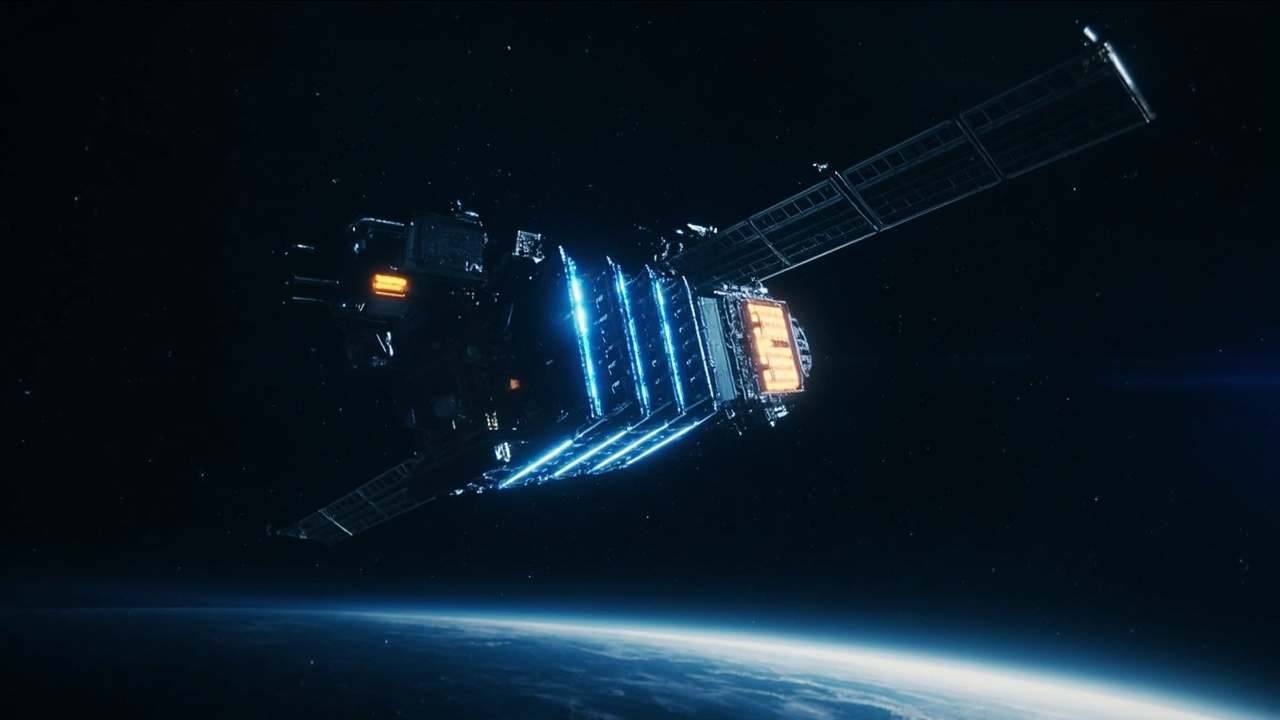
Today’s SpaceX Transporter-18 rideshare mission from Vandenberg Space Force Base is carrying the usual manifest of cubesats and smallsats — and one payload that belongs to an entirely different century of computing. Tucked among the dozens of satellites is MVP, Google’s first Project Suncatcher prototype: a refrigerator-sized satellite carrying four Trillium TPUs, the company’s current-generation AI accelerators. It is the first time anyone has flown production AI training silicon with the explicit goal of running it in orbit.
The launch window opens at 11:18 a.m. PT (18:18 UTC). By the time most of the manifest has separated from the Falcon 9 upper stage, Google will begin a mission designed to answer a question that sounds like science fiction but is increasingly an engineering deadline: can AI compute survive — and eventually scale — in space?
Why Google wants data centers in orbit
The thesis behind Project Suncatcher, which Google’s research arm announced in November 2025, is brutally practical. Terrestrial AI infrastructure is running into three walls at once: electricity, land, and cooling water. Data center interconnection queues stretch for years in major markets, and the biggest constraint on frontier-scale training runs is increasingly where to plug them in, not how to build them.
Low Earth orbit offers a different bargain. As Google’s team notes, satellites in the right orbits enjoy near-constant sunlight — up to eight times more harvestable solar power per unit of solar array than ground-based installations, which lose energy to night, weather, and atmospheric attenuation. There is no grid queue in orbit, no community opposition, and no water table to draw from.
The catch is that everything else is harder. Space is a radiation furnace crossed with a vibration table, and the one thing it absolutely does not provide is airflow. Almost every assumption baked into terrestrial chip design — serviceability, convection cooling, error rates measured in years per bit — has to be revalidated from scratch.
That is what MVP is for.
What the prototype actually tests
Google frames this as a hardware-survival mission with three distinct axes of stress, and the company’s engineering blog this week laid out the details with unusual candor.
Launch vibration. The ride to low Earth orbit lasts about ten minutes, during which the spacecraft endures sustained acceleration up to 10 g — but individual components like TPU packages can see 50 to 100 g of shock loading. The team shook the satellite on all three axes in ground testing to mimic the rocket’s frequency profile. “Tests like this rarely go as planned,” Google wrote, “so we were pleasantly surprised that the hardware held up to the force.”
Radiation. Solar events and cosmic rays corrupt electronics through bit flips and cumulative ionizing dose. Before committing to the flight, Google took Trillium TPUs to the proton beam at UC Davis’s Crocker Nuclear Laboratory and bombarded them while running AI workloads, monitoring how errors propagated. According to the company, initial results show the chips can survive a total ionizing dose greater than what they would absorb across a five-year space mission — Futurum’s analysis cites 15 krad(Si) against a 750 rad(Si) five-year requirement, a 20× margin.
Thermal. This is the existential one. TPUs concentrate enormous heat in a small area, and in a vacuum there is no convection — only radiation. The prototype uses a combination of heat pipes and radiator panels to move heat from the chips and reject it into space, an approach validated in thermal vacuum chambers on the ground but never flown at this power density. Per reporting from The New York Times and Ars Technica, the flight configuration runs the chips for roughly 15 minutes at a stretch before the thermal system needs recovery time — a duty-cycle constraint that itself is a key data point the mission will refine. The payload draws on the order of one kilowatt of electrical power from its solar arrays.
If all goes well, the satellite will run simple Gemini inference workloads on-orbit for up to a year, feeding back telemetry on error rates, thermal cycling, and how consumer-grade silicon actually degrades outside the atmosphere.
The 2027 milestone that matters more
As significant as today’s launch is, Google has been careful to frame MVP as a single step toward a harder test in 2027: two satellites flying in formation, linked by free-space optical communications.
The inter-satellite link is the load-bearing technology for the whole concept. Google’s future satellite designs are expected to carry dozens of TPU chips each, orbiting in clusters that must behave like a single distributed computer. That requires bandwidth between neighbors at scales that existing space laser terminals — optimized for low-bandwidth, long-distance links — were never built to deliver. Google’s engineering blog describes the pointing precision required as analogous to “hitting a coin-size target from miles away while both points are in motion.”
Constellation studies cited in Futurum’s analysis sketch clusters of more than 80 satellites, and Google’s own research paper on the system design has discussed scaling toward gigawatt-class orbital compute in the long run. None of that happens unless the optical mesh works, and none of the optical mesh matters unless the chips survive — which is why the sequence is deliberate: survive, cool, connect, scale.
The competitive context
Google is not alone in betting on orbital compute, but it is the first hyperscaler with hardware on a rocket. Starcloud raised $250 million in August for its own orbital data center constellation; Axiom Space has announced orbital data center modules; India’s TakeMe2Space has booked commercial Earth-observation inference payloads on SpaceX rideshares; and France has committed $1 billion to its Altair-Next program. SpaceX itself is widely reported to be exploring an orbital AI cloud built on Starlink-derived bus technology.
What distinguishes Suncatcher is vertical integration. Google designs its own accelerators, operates its own model stack, runs its own optical networking research, and — through its partnership with Planet, which built and operates the MVP platform — has access to one of the most experienced smallsat manufacturers in the business. If orbital AI compute becomes real, the company that owns the full stack from silicon to model weights captures the margin at every layer.
The skeptical read
Not everyone is convinced, and the skepticism deserves airtime. Launch costs remain the floor under the economics: even at Falcon 9 rideshare pricing, lifting a megawatt of compute to orbit costs vastly more than building a shed in Virginia — and the mass of radiators, structure, and power systems multiplies the penalty. Radiation-hardened alternatives to consumer silicon carry their own cost and performance trade-offs, and Google’s own data shows unhardened Trillium chips surviving five-year dose requirements, but single-event effects are statistical, not deterministic.
There are also policy questions. Astronomers have already raised concerns about mega-constellations of bright objects; a constellation of 80-plus high-power compute satellites with large radiator panels is a new category of object entirely. And the debris question — what happens when an orbital data center dies — remains unresolved at the regulatory level, even as Google has publicly acknowledged it must be answered before any constellation is licensed.
But the pattern here is familiar to anyone who has watched Google’s other moonshots. Waymo began with a handful of Priuses and a decade of unglamorous logging; quantum computing began with fragile qubits and error-correction papers. Suncatcher’s MVP satellite is the Prius. The question it answers today is not whether orbital AI data centers are economical — it is whether the physics cooperates at all.
Sometime after 18:18 UTC today, four TPUs will separate from a Falcon 9 upper stage, unfold their radiator, and start running inference over the horizon from California. Whatever the telemetry says, it will be the first honest data point anyone has ever collected on the question.
Sources
- [1] https://blog.google/innovation-and-ai/models-and-research/google-research/google-project-suncatcher-facts/
- [2] https://www.reuters.com/business/media-telecom/google-plans-first-test-ai-chips-space-under-project-suncatcher-2026-09-24/
- [3] https://arstechnica.com/google/2026/09/googles-first-suncatcher-orbital-data-center-test-launches-october-1/
- [4] https://www.space.com/space-exploration/satellites/spacex-launching-prototype-google-ai-satellite-next-week
- [5] https://www.nytimes.com/2026/09/24/technology/google-suncatcher-ai-data-center-space.html
- [6] https://research.google/blog/exploring-a-space-based-scalable-ai-infrastructure-system-design/
- [7] https://futurumgroup.com/insights/project-suncatcher-prepares-to-launch-tpus-is-google-ahead-in-the-orbital-ai-race/