Powering the AI Boom: US and Korea Unlock $200 Billion for Texas Gas, Eight Reactors, and Alaska LNG
Washington and Seoul formally activate Korea's $350 billion US investment pact: a $22.3 billion, 6,472 MW gas complex in Encinal, Texas built to feed AI data centers, up to $120 billion for eight nuclear reactors, and a $54 billion Alaska LNG review — the largest energy-infrastructure commitment of the AI era.
In an Oval Office announcement on September 30, President Donald Trump, flanked by Commerce Secretary Howard Lutnick, Interior Secretary Doug Burgum, and Senator Dan Sullivan, unveiled the first three projects under South Korea’s $200 billion strategic investment commitment to the United States. The package — the largest energy-infrastructure commitment of the AI era — is anchored by a Texas gas-fired power complex built explicitly to serve AI data centers, a framework for eight new large-scale nuclear reactors, and a review of Korea’s participation in the long-planned Alaska LNG pipeline. For an AI industry whose growth is increasingly bottlenecked not by chips or algorithms but by electricity, the deal signals that Washington now treats compute power as a matter of industrial policy — with a treaty ally footing a large share of the bill.
Project Star: a 6.5-gigawatt power plant for AI data centers
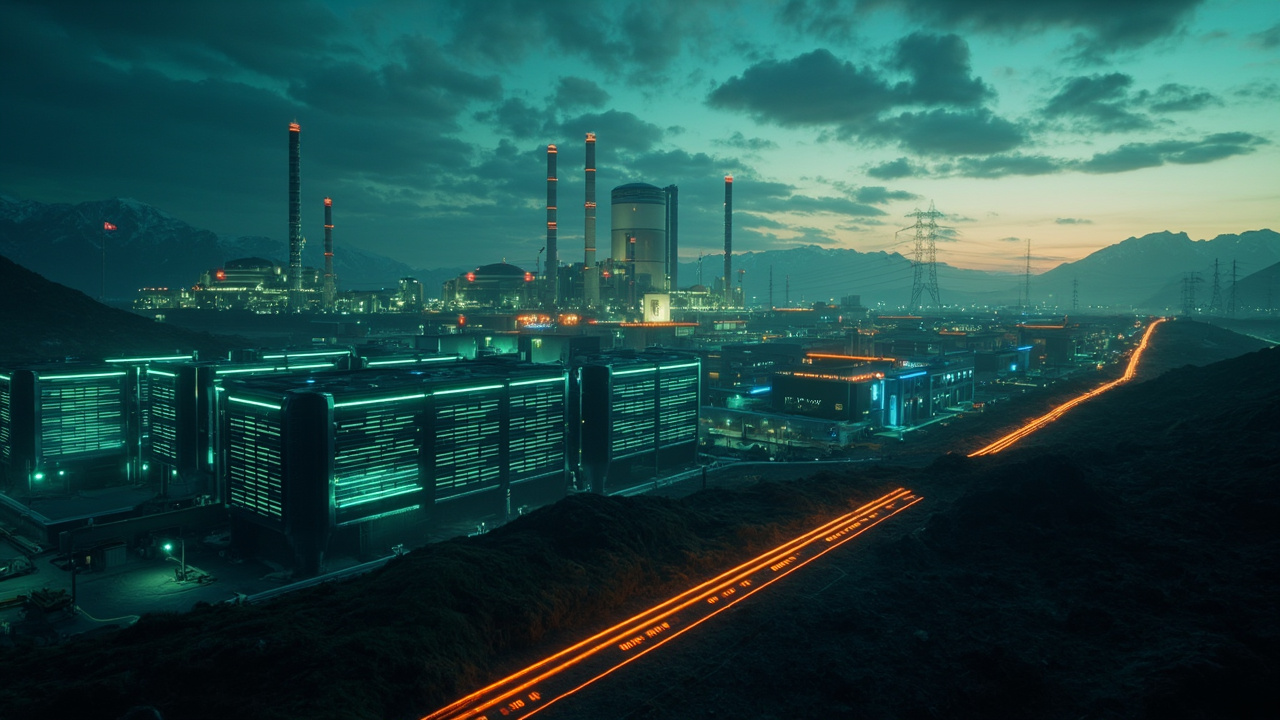
The centerpiece is “Project Star,” a $22.3 billion combined-cycle gas power complex in Encinal, in southern Texas. With a planned capacity of 6,472 megawatts — roughly the output of six large nuclear reactors — the plant will supply electricity directly to nearby AI data centers, according to Seoul’s Ministry of Trade, Industry and Energy. The first phase is scheduled to begin commercial operations in 2029, with the full complex coming online by 2032.
The developer lineup is as notable as the scale. Related Companies, the New York real-estate giant and world’s ninth-largest developer, will lead the project alongside NextEra Energy, the largest power plant operator in the United States. Lewis Energy Group, a Texas-based producer, will provide the site, natural gas, water, and other infrastructure. For Korean industry, the appeal is entry into the American gas-power market, where it has had little direct presence: Korean companies are expected to seek contracts for equipment, engineering, construction, and long-term maintenance.
“We’re thrilled to announce one of the largest energy infrastructure investments in American history,” Trump said at the announcement, listing the six-gigawatt Texas facility, the eight nuclear plants, and the Alaska LNG pipeline. Commerce Secretary Lutnick described the package as “a major step toward securing our critical energy supply chain, ensuring American energy dominance, and making our partnership with South Korea and the entire Pacific region stronger than ever before.”
The deal did not come together without friction. As recently as early September, Seoul publicly described the $22.3 billion Encinal project as “not final,” with negotiations continuing over commercial terms. Local reporting from Texas noted community backlash against data center development in the state, and Korean media flagged concerns about how much value Korean contractors would actually capture. The formal selection of Project Star as the first investment under the pact — announced by Korea’s Ministry of Trade, Industry and Energy on October 1 Korea time — puts those questions to rest for now.
Eight reactors and a stake in Westinghouse
The second pillar, “Project Power,” commits Korea to spend up to $120 billion — $100 billion in construction costs plus a $20 billion contingency fund — to build eight nuclear reactors in the United States through a bilateral nuclear cooperation framework, including two units of Korea’s homegrown APR1400 reactor design. The framework is a guideline rather than a shovel-ready plan: each plant will require separate approval, and the two governments have not yet agreed on specific reactor projects.
The strategic prize for Seoul goes beyond construction contracts. The framework opens the door for Korean companies, including state-run Korea Electric Power Corp. (KEPCO), to acquire a stake of less than 10 percent in Westinghouse Electric and share in its profits — a long-sought foothold in the Western nuclear market for a country whose reactor exports have often collided with Westinghouse’s intellectual-property claims. Detailed terms remain to be worked out among the companies involved.
Alaska LNG: the $54 billion question mark
The third project, “Project North,” is the least certain. The two governments agreed to review Korea’s possible participation in the Alaska LNG project — the decades-pending plan for an 800-mile pipeline from Alaska’s North Slope to a southern export terminal. Lutnick claimed Korea is moving to invest more than $50 billion in the project; sources familiar with the planning put the figure at roughly $54 billion. But Seoul’s ministry was careful to note that the review will assess commercial viability before any decision to proceed, a hedge that reflects both the project’s history of false starts and Korea’s insistence that “taxpayers’ money” not be wasted.
The safeguards: an unusual risk-pooling structure
What distinguishes this deal from a conventional foreign-investment pledge is its financial engineering. All projects will be executed through an umbrella Investment Special Purpose Vehicle (I-SPV) and separate Project Special Purpose Vehicles (P-SPVs) for each undertaking. More striking is a risk-pooling arrangement: proceeds from all individual projects will be divided equally between Korea and the United States until Seoul recovers the total principal and interest on its investments. Industry Minister Kim Jung-kwan, briefing the National Assembly on September 22, said the ministry had examined “each project’s returns and risks, the prospects for recovering the investment and opportunities for Korean companies” — a nod to persistent skepticism in Seoul about the pact’s economics.
Why it matters for AI
The AI buildout has quietly become an electricity problem. Forecasts cited by the Electric Power Research Institute suggest data centers could consume up to 17 percent of US power by 2030 in a high-growth scenario, and grid operators from Texas to the Mid-Atlantic have warned of capacity shortfalls as hyperscalers race to secure gigawatt-scale power for training and inference. Project Star is one of the first projects to be explicitly scoped around that demand: a dedicated, multi-gigawatt power complex whose offtakers are AI data centers, financed in part by a strategic ally rather than by the AI companies themselves.
The structure is revealing. Rather than waiting for utilities to catch up, the US is effectively importing capital — and, in the nuclear pillar, reactor construction expertise — to accelerate the energy buildout that AI requires. Korea brings proven on-time, on-budget nuclear delivery (the Barakah plant in the UAE being the showcase) and world-class gas-turbine and plant-engineering suppliers. Washington brings demand, sites, and regulatory fast-tracking. The bet is that the combination can move faster than either could alone.
There are real risks. Gas prices are volatile; nuclear frameworks have a long history of collapsing into paper; Alaska LNG has burned investors before; and the equal-split risk pool means Korea’s returns depend on projects actually generating revenue. Critics in both countries have already noted that the headline $350 billion figure (which also includes $150 billion for shipbuilding cooperation) obligates future administrations and legislatures. And the AI demand forecasts underpinning projects like Encinal could prove wrong — leaving ratepayers or Korean taxpayers holding underutilized assets, the very concern Senate Democrats raised this week when they blocked a separate ratepayer-backstop bill for AI data centers.
But as a statement of direction, the announcement is unambiguous. The competition to power AI is now a central axis of US economic statecraft, and allies are being enlisted as co-financiers of the energy infrastructure the compute race demands. For the AI industry, more committed gigawatts — however they arrive — are the constraint that matters most.
Sources
- [1] https://www.koreaherald.com/article/10889661
- [2] https://www.commerce.gov/news/press-releases/2026/09/korea-and-united-states-announce-historic-strategic-investment
- [3] https://www.koreatimes.co.kr/amp/southkorea/20261001/seoul-washington-pick-texas-power-plant-as-1st-project-under-strategic-investment
- [4] https://www.reuters.com/legal/government/trump-expected-announce-54-billion-south-korean-investment-alaska-lng-sources-say-2026-09-30/
- [5] https://dallasexpress.com/state/south-korea-says-22-3b-texas-ai-power-deal-is-not-final-as-talks-continue/
- [6] https://biz.chosun.com/en/en-industry/2026/09/23/7SKSFEMYERFXVHTJBZB73AOWSU/
- [7] https://www.asiae.co.kr/en/article/2026092217272763487
- [8] https://www.usnews.com/news/politics/articles/2026-09-30/trump-expected-to-announce-54-billion-south-korean-investment-in-alaska-lng-sources-say