Moratorium NOW: Eighteen Towns, One Sunday — Washington State Rallies Against the AI Data Center Buildout
From a 10 a.m. banner brigade on Seattle's John Lewis Bridge to a 3:30 p.m. 'Aquifers Over AI' march in Spokane, Washington's AI Resistance staged a statewide Day of Action demanding a moratorium on AI data centers.
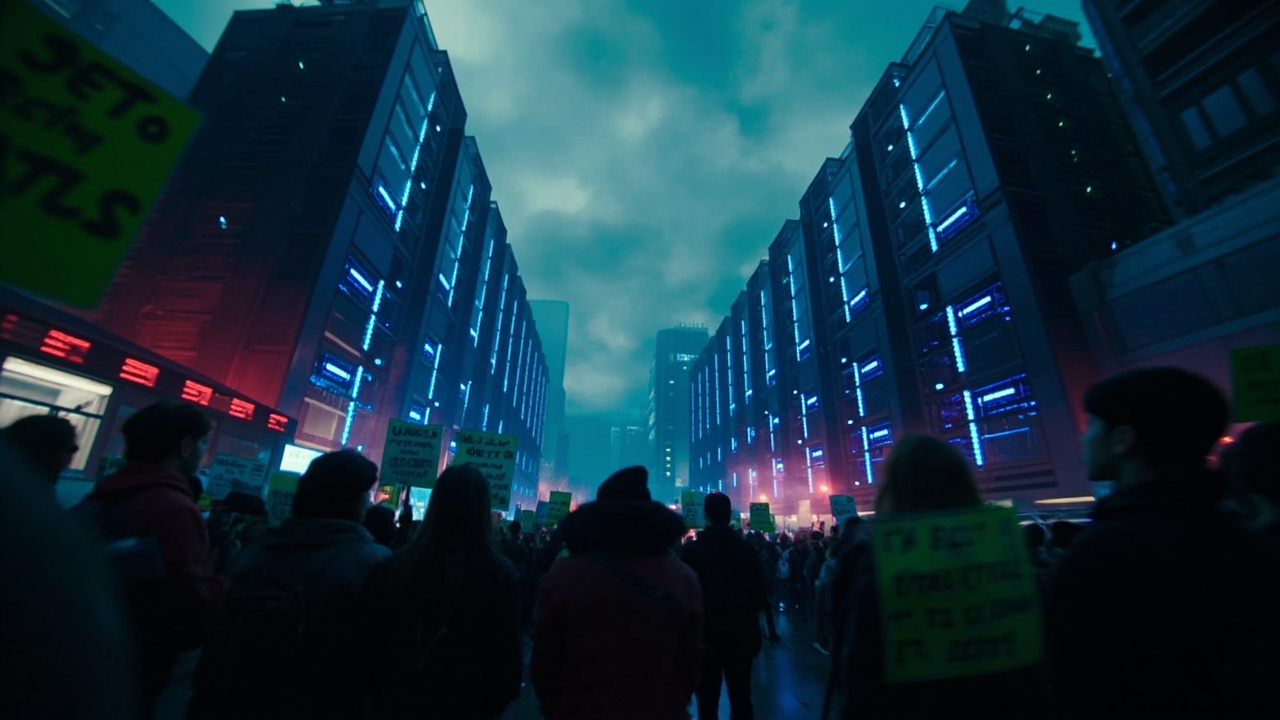
On Sunday, October 4, 2026, the statewide backlash against AI infrastructure reached its most coordinated expression yet. The Washington Artificial Intelligence Resistance (WA-AIR), working with a coalition that includes Food & Water Watch, Seattle DSA, the Oil & Gas Action Network, and the Philadelphia-based People’s Tech Project, staged a “Moratorium NOW” Day of Action — eighteen listed events spread across sixteen communities, running from a morning banner brigade on Seattle’s John Lewis Memorial Bridge to an afternoon march at Spokane’s Riverfront Park Rotary Fountain. The demand, identical at every stop: a statewide moratorium on new AI data centers, and what organizers call “real regulation of data centers and AI that puts people first.”
The geography of the day tells the story of how the data center fight has escaped the big cities. Yes, Seattle hosted four events — the overpass banner brigade at 10 a.m., a pedestrian-bridge protest above the West Seattle Bridge at 10:15, noon flyering at Beacon Hill Station, and a 3:30 p.m. “Rally for AI Regulation and Data Center Moratorium” at the University of Washington’s Red Square. But the roster also includes Wenatchee, Ellensburg, Cle Elum, Olympia, Tacoma, Bainbridge Island, Mountlake Terrace, Moses Lake, Walla Walla, Spokane, and three separate gatherings in Klickitat County — Dallesport, Lyle, and Bingen/White Salmon — a rural Columbia Gorge county that has become an unexpected flashpoint in the fight over where America’s compute gets built.
The tone ranged from confrontational to civic to unmistakably local. “Aquifers Over AI,” the name of the Spokane march, is a one-sentence summary of the region’s water anxiety. “More Pie Less AI,” a dessert potluck at Moses Lake’s McCosh Park at 1 p.m., channels the same politics through small-town conviviality. And the Klickitat County events — “STOP Klickitat County Data Centers,” “Klickitat Against Data Centers,” “Lyle Against Data Centers” — reflect a community that has watched neighboring Dalles, Oregon, absorb hyperscale campuses and is drawing its own line.
The road to October 4
The Day of Action did not appear from nowhere. Washington state now hosts at least 126 data center facilities and counting, by Cascade PBS’s tally, and the pressure has been building all year. In April, five large data center proposals were pending in Seattle alone — projects that 350 Seattle calculated would have drawn roughly one-third of the city’s electricity. The public response was overwhelming: more than 100,000 objections, and by May 1 two developers had withdrawn their plans to connect large-scale facilities to Seattle City Light’s grid, as GovTech reported at the time.
In June, the dam broke. On June 9, the Seattle City Council voted 9-0 to enact a one-year emergency moratorium on new data centers using more than 20 megawatts, paired with a policy framework directing impact studies on infrastructure, the economy, and public health. The Guardian framed it as the home city of Amazon and Microsoft joining a growing backlash against “energy-guzzling AI infrastructure.” The same day the moratorium passed, activists announced the new statewide coalition that would spend the next four months organizing toward October 4.
The political temperature has been rising in Washington, D.C. as well as Washington state. Representative Kim Schrier, whose 8th District spans the data-center corridor east of Lake Washington, told constituents this summer that data centers “have skyrocketed energy costs” for her district. Meanwhile Microsoft — the company that put rural Quincy, Washington, on the hyperscale map two decades ago — has spent 2026 holding up its Quincy operations as data centers “gone right,” even as GeekWire asked in May whether the model still works in an era of gigawatt-scale AI campuses.
Why this matters beyond Washington
Organizers’ framing is deliberately blunt. The Action Network campaign page describes AI data centers as having “massive water, power, pollution, and noise impacts — all to power the AI that’s spying on us, stealing our jobs and ripping us off.” That is a maximalist position, and it fuses two arguments that often travel separately: the environmental-logistical case (grid strain, aquifer depletion, ratepayer costs) and the political case against the AI industry itself.
The logistical case is the easier one to verify. Seattle’s five proposals and their combined load — a third of a major city’s electricity for a handful of buildings — is exactly the arithmetic that turned city councils from Boston to Philadelphia to Atlanta into skeptics this year. Datacentertracker.org, an open database of community responses to the buildout, now maps moratorium pushes, zoning fights, and legislative actions across dozens of states. Washington’s contribution to that map is distinctive in one respect: it is the home state of Microsoft and Amazon, the two companies whose cloud empires did the most to teach America what a data center is.
The harder question is what a moratorium actually buys. Seattle’s own one-year pause is explicitly a study period, not a ban — a breathing space for impact analysis while the state legislature decides whether to act. WA-AIR’s demand for a statewide moratorium would go further, and the group has published a “People’s Bill of Rights on AI” to give the movement a positive program, not just a stop sign. Whether Olympia answers is a 2027 legislative question. Governor-signaled interest in AI economic development, the state’s hydro-rich grid, and its proximity to the Canadian border all make Washington attractive to builders; none of that changes the fact that the state’s voters are now the most visibly organized anti-data-center constituency in the country.
The view from the rally
What stands out about October 4 is not the size of any single event — overpass banner brigades and courthouse-square rallies are modest by design — but the distribution. Eighteen events across a state of 7.8 million people, in counties rural and urban, coastal and inland, red and blue, all pressing the same demand on the same afternoon. The buildout debate is usually narrated through gigawatt announcements and hundred-billion-dollar capex rounds. Sunday’s Day of Action is the counter-narrative in its purest form: neighbors at a trailhead in Lyle, a potluck in Moses Lake, students at Red Square — each insisting that the pace and placement of the AI buildout is a decision that belongs to them, not just to the companies signing the power purchase agreements.
The moratorium demand may or may not reach the governor’s desk. But the organizing infrastructure behind it — a statewide coalition, a tracked event calendar, a published bill of rights, and now a recurring day of action — is the kind of thing that outlasts any single legislative session. The AI industry’s constraint equation has mostly been written in chips, land, and megawatts. In Washington state, on October 4, it acquired a civic variable.
Sources
- [1] https://actionnetwork.org/event_campaigns/moratorium-now-washington-state-day-of-action-on-data-centers
- [2] https://waair.net/october-4th-day-of-action
- [3] https://www.theguardian.com/us-news/2026/jun/09/seattle-ai-datacenters-ban
- [4] https://council.seattle.gov/2026/06/09/city-council-passes-emergency-data-center-moratorium-and-policy-framework/
- [5] https://www.govtech.com/products/data-center-developers-pull-seattle-plans-amid-opposition
- [6] https://350seattle.org/project/data-center-resistance/
- [7] https://www.geekwire.com/2026/microsoft-holds-up-rural-washington-as-data-centers-gone-right-but-does-the-model-still-work/
- [8] https://datacentertracker.org/