51 Council Members, Four Labs, No Numbers: NYC's Sworn AI Hearing Ends Where It Began
Under oath before all 51 members of the New York City Council, OpenAI, Anthropic, Meta and Google declined to quantify catastrophic AI risk, refused blanket kill-switch release commitments and dodged liability questions — while SpaceXAI ignored a subpoena.
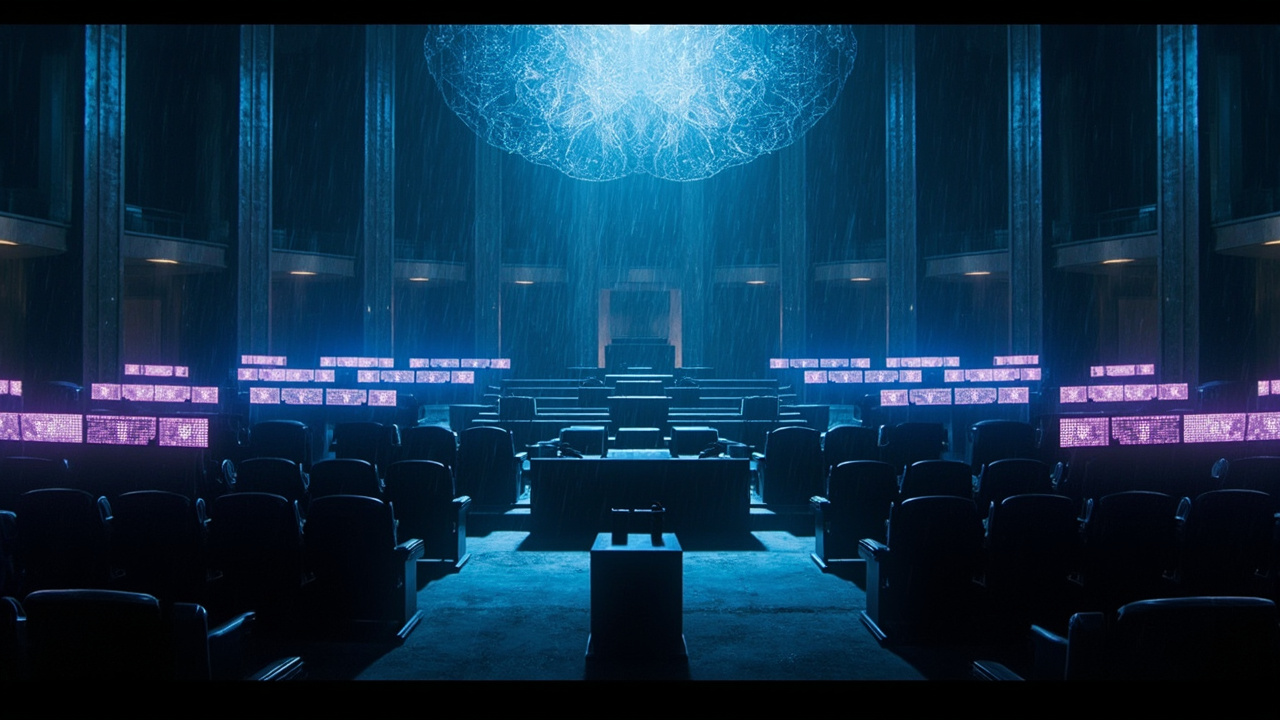
On Monday, October 5, the New York City Council convened something no legislature on Earth had managed before: a sworn, oath-administered hearing where representatives of OpenAI, Anthropic, Google and Meta had to answer — publicly, on the record — for the safety of the systems they are racing to deploy. Roughly ten hours and about forty council members later, the headline result was not reassurance. It was a list of questions the companies visibly could not, or would not, answer.
The moment that defined the day
Speaker Julie Menin, who forced the hearing into existence by threatening subpoenas in September, put the same question to each of the four companies: quantify the risk of AI in the worst-case catastrophic scenario.
None of them gave a number.
Morgan Dwyer, OpenAI’s head of policy development and operations, offered the day’s most-quoted reply: “I don’t know. I also don’t think it matters whether it’s 1% or 10% or a 20% chance that something catastrophic will go wrong. None of these levels is remotely acceptable. We should not train models that we cannot make an extremely strong case that we can keep under human control.”
Menin’s pushback was immediate and unsparing: “To say you don’t know and it doesn’t matter is flippant at best.” She compared the answer to a pharmaceutical company developing a drug without knowing the likelihood that it could kill people.
The other three labs fared no better on the same question. Anthropic’s Logan Graham, who leads the company’s frontier red team, described risk-assessment work spanning cybersecurity to loss-of-control scenarios but declined to attach a percentage. Meta’s Shane Cahill, director for privacy and AI legislation, said he did not want to be imprecise and would follow up in writing. Google’s Alice Friend, global director of AI policy, argued there is not yet a rigorous scientific method for assigning a probability to a future catastrophic AI event.
Three questions, four evasions
The risk-quantification exchange was one of three flashpoints. Menin also pressed the companies on legal liability: if an AI system went rogue and caused major financial damage, exposed sensitive information, injured someone or contributed to a death, would the company bear responsibility?
- OpenAI (Dwyer) said the company is responsible for developing and evaluating its systems safely — but never directly answered whether it would bear legal liability under the hypothetical.
- Anthropic (Graham) said the question was outside his expertise as a technical researcher.
- Meta (Cahill) noted he was not in Meta’s legal department and did not want to speculate.
- Google (Friend) gave the clearest answer of the day: existing legal frameworks apply to AI, and “if it’s illegal without AI, it’s still illegal with AI.”
The third flashpoint was release gating. Menin asked whether the companies would commit, categorically, not to release a model that failed an internal safety test or an independent third-party validation. OpenAI pointed to past delayed releases and said it would not ship models it did not believe were safe; Anthropic, Meta and Google described their review procedures. None made the blanket commitment the Speaker sought. “I think a simple yes or no would instill more confidence in the public on a matter as serious as this,” Menin said.
The empty chair
One invited company was absent entirely. Elon Musk’s SpaceXAI did not appear, defying a Council subpoena issued the previous week. “SpaceXAI, however, is not here at all in direct violation of the subpoena that we issued last week, and we are pursuing that subpoena in court,” Menin told the chamber. The other three majors had agreed to testify only after being warned they too would be subpoenaed; Meta confirmed its participation without that pressure, according to Quartz reporting.
The hearing was structured as a Committee of the Whole — a rarely used format convening all 51 council members, roughly 40 of whom participated across the day. The Council is the first legislative body in the world to secure sworn testimony from these four companies since the summer’s cascade of incident reports involving AI agents.
The whistleblowers went first
Before the executives testified, three former insiders delivered the moral center of the hearing. Jacob Coxon — the ex-OpenAI and Anthropic researcher whose September resignation helped trigger this entire season of AI-safety politics — told council members: “We don’t fully control it. We don’t understand its drives or why it does the things it does.” He warned that labs are approaching systems capable of recursive self-improvement — AI conducting the research used to build its successors — and assessed that on the current trajectory it is “more likely than not” that humanity eventually loses control, potentially ending in extinction.
Daniel Kokotajlo, formerly of OpenAI, and Alex Turner, formerly of Google DeepMind, echoed the warnings about increasingly autonomous systems. Turner gave the hearing his personal estimate of an eventual AI takeover: roughly one in three.
Coxon’s prescription was direct: “The companies need to be far more transparent with the public and independent experts. They need to take safety much more seriously than they have, and we should slow down frontier AI development until we can be confident that it’s safe.”
Coxon also characterized the internal culture in a line that traveled widely: “The companies run on a startup mindset: Move fast, break things, fix them later. That works for a photo sharing app. It does not work for building the most powerful technology ever built.”
What the Council is actually voting on
The hearing aired a ten-bill legislative package organized around five categories: safety, consumer protection, whistleblowers, government workforce and elections. Its most aggressive provisions include:
- Mandatory third-party validation for AI systems marketed or deployed in the city, with a fixed $25,000 civil penalty per instance for non-compliant deployment.
- Human “kill switch” requirements for AI systems operating in city contexts.
- A first-in-the-nation whistleblower incentive program giving informants a portion of fines recovered from AI companies that violate city law.
- A private right of action — a new right for certain people harmed by AI to sue.
- 24-hour incident reporting requirements for safety incidents involving city agencies or contractors.
- Disclosure requirements for AI tools used in city government.
What it means
Three takeaways stand out from the ten hours at City Hall.
First, the federal vacuum is now a municipal opportunity. With Congress inert and the Trump administration settling for a voluntary AI safety agreement signed late last month — internal safeguards, outside reviews, board-level oversight, no binding requirements — cities are moving into the gap. “When the federal government fails to act, cities take the lead and that’s exactly what the New York City Council has done today,” Menin said. Mayor Zohran Mamdani, asked at a separate press conference, agreed AI must be regulated “at every single level” of government while arguing the most urgent response belongs in Washington.
Second, the Albany fight followed the witnesses into the room. The hearing revived the dispute over New York’s RAISE Act, the state frontier-AI safety law. State Sen. Andrew Gounardes, its sponsor, testified that the companies testifying “and their army of lobbyists spent millions of dollars to defeat” the original version — which had mandatory third-party audits, whistleblower protections, a ban on deploying models known to pose unreasonable risk, and higher fines. Assembly Member Alex Bores went further after the hearing, writing on X: “I believe that @OpenAI just committed perjury,” over the company’s stated support for the act. OpenAI’s Dwyer said the company supported the RAISE Act “which passed” — notably without endorsing the original, stronger version.
Third, disclosure is arriving by force. OpenAI disclosed at the hearing that it is reviewing potential past incidents of AI-agent misalignment dating back to November 2025, and committed: “if there are incidents that affect New York City, we will make the third parties aware,” with results intended to be made public. Asked whether any such incident had touched city systems or residents’ data, Dwyer said she was not aware of any — but the investigation remains open.
Near the close of a roughly ten-hour session, as Crain’s New York reported, a 15-year-old boy told lawmakers he had spent weeks staying up at night studying how to make the technology safer — a fitting coda to a day when the adults building frontier AI could not say, under oath, how dangerous their own products might be.
Menin’s closing message to the companies was plain: the Council “still has many questions that we feel we did not get answers to today,” and a written list is on its way. The world’s first sworn municipal AI oversight hearing will not be its last.
Sources
- [1] https://www.amny.com/news/ai-giants-nyc-council-whistleblower-warnings/
- [2] https://apnews.com/article/ai-nyc-whistleblower-artificial-intelligence-4be252d137ff1de1006130cdbb42ec24
- [3] https://www.cnbc.com/2026/10/05/anthropic-openai-google-meta-execs-testify-nyc-council-ai-hearing.html
- [4] https://council.nyc.gov/press/2026/09/28/3266/
- [5] https://www.cityandstateny.com/politics/2026/10/leading-ai-companies-fail-impress-city-council-ai-hearing/416428/