BYD Unveils 'Xiao Di' Humanoid Robot: The World's Largest EV Maker Enters the Robotics Race
BYD confirms its first humanoid robot, Xiao Di, will greet customers at showrooms in August 2026 — a 1.61m service robot with 31 degrees of freedom, real-time multilingual translation, and dexterous hands.
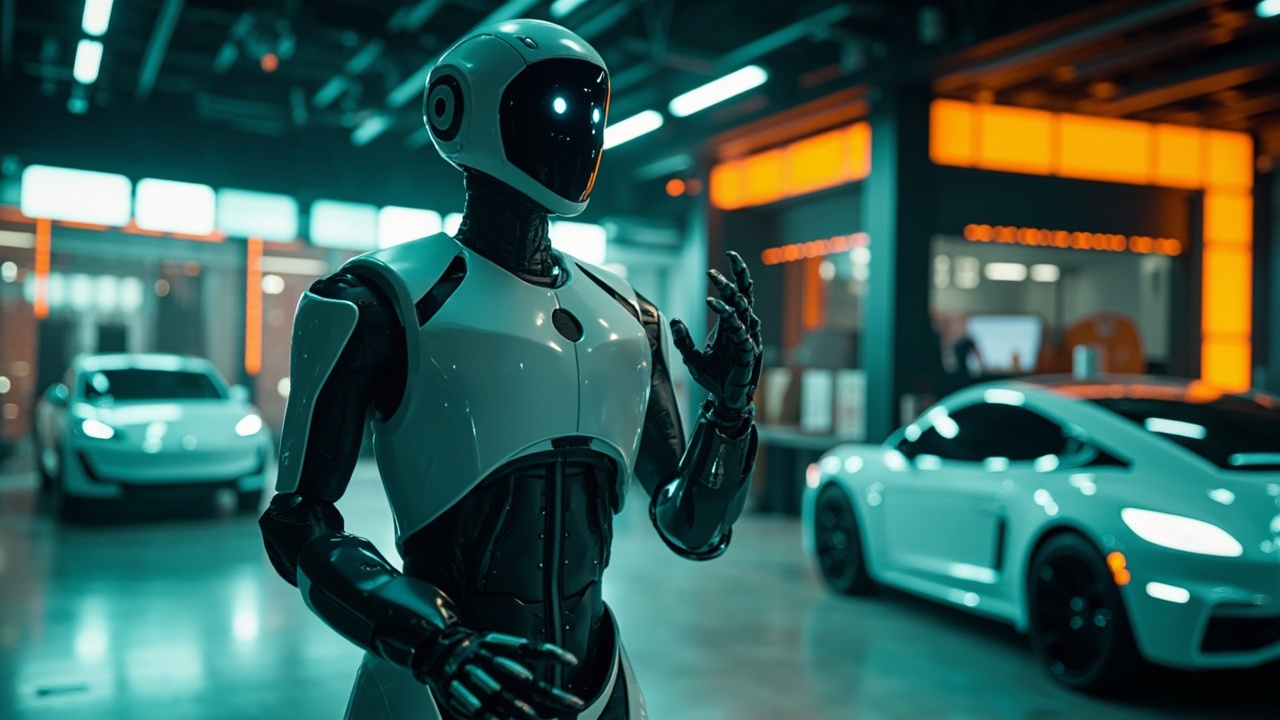
BYD Unveils ‘Xiao Di’ Humanoid Robot: The World’s Largest EV Maker Enters the Robotics Race
The world’s largest electric vehicle manufacturer has officially entered the humanoid robotics arena. BYD (Build Your Dreams) confirmed in late July 2026 that it will unveil its first humanoid robot — nicknamed Xiao Di (小迪) — in early August at the Zhengzhou Di Space exhibition center, marking a dramatic expansion of the Chinese automotive giant’s ambitions beyond cars and batteries.
The move sends a clear signal: the humanoid robotics race is no longer the exclusive domain of specialized robotics startups like Figure, Tesla, or Unitree. It has become a strategic frontier for the world’s most valuable manufacturing companies.
What Is Xiao Di?
Xiao Di is a service-class humanoid robot designed and built entirely in-house by BYD’s embodied intelligence team. According to leaked specifications and subsequent confirmations from multiple Chinese media outlets, the robot stands 1.61 meters tall (approximately 5 feet 3 inches) and weighs 58.5 kilograms (about 129 pounds). It possesses 31 degrees of freedom distributed across its body — with 7 in each hand, 6 in each leg, 3 in the waist, and 2 in the neck.
The robot’s dexterous hands are particularly noteworthy for a first-generation commercial product. Each hand can grasp objects weighing up to 1 kilogram with a positioning precision of ±1 millimeter, putting Xiao Di in the same dexterity class as purpose-built research manipulators from companies that have been working on robotic hands for years.
But the headline feature is Xiao Di’s communication system. The robot supports real-time, two-way translation across six Chinese dialects and six foreign languages — a total of 12 languages. It uses multimodal interaction, reading facial expressions, lip movements, and hand gestures to understand and respond to human speech. For a showroom environment, where customers speak different dialects and languages, this is a genuinely useful capability rather than a technical gimmick.
Xiao Di also features 360-degree vision and dynamic balance systems, enabling it to navigate crowded showroom floors safely.
The Strategy: Robots in Every Showroom
BYD’s initial deployment plan is striking in its specificity. Rather than targeting warehouses or factories — the deployment strategy favored by most humanoid robotics companies — BYD is putting Xiao Di directly in customer-facing showrooms, starting at the Di Space facility in Zhengzhou.
The robot will serve as a greeter, product guide, and translator, approaching customers as they enter BYD dealerships, explaining vehicle features, and bridging language barriers between sales staff and customers. BYD reportedly has a target of deploying 20,000 units across its retail network, though this figure has not been officially confirmed.
This is a bold strategic choice. Most humanoid robotics companies are pursuing industrial applications — warehouse logistics, assembly line assistance, hazardous material handling. BYD is betting that the first commercially viable use case for humanoid robots is customer experience in retail environments, not back-end labor.
The logic is clear when you consider BYD’s scale. The company operates thousands of dealerships across China and is rapidly expanding internationally. A robot that can greet customers in 12 languages, demonstrate vehicle features, and create a memorable showroom experience is a powerful brand differentiator — particularly as BYD pushes into European and Southeast Asian markets where language diversity is high.
Behind the Robot: BYD’s 15th Business Division
Xiao Di is not a side project. BYD established a dedicated embodied AI team in late 2024 under its 15th Business Division, a unit focused on electronic integration and intelligence. Executive Vice President Stella Li has publicly stated that humanoid robots will become one of BYD’s “next core businesses” — language that places robotics alongside electric vehicles, batteries, and semiconductor design in the company’s strategic hierarchy.
The 15th Business Division’s scope reportedly extends beyond Xiao Di. Industry sources indicate BYD is also developing an industrial humanoid robot codenamed “IRON”, designed for manufacturing tasks within BYD’s own factories, with production targeted for late 2026. This dual-track approach — a service robot for showrooms and an industrial robot for factories — mirrors the strategy of companies like Tesla, which is developing both Optimus for general use and factory-specific robotics.
BYD’s existing manufacturing expertise gives it a significant advantage. The company already produces its own batteries, motors, semiconductors, and electronic control systems. Adding actuators, sensors, and humanoid form factors to this vertically integrated stack is a natural extension rather than a leap into unfamiliar territory.
The Broader Humanoid Robotics Landscape
BYD’s entry comes at a pivotal moment for the humanoid robotics industry. Bank of America projects approximately 90,000 humanoid robot shipments in 2026, rising to 1.2 million by 2030. Analysts at KraneShares estimate the global humanoid robot market could reach 13 million units by 2035.
The competitive landscape is intensifying rapidly:
- Tesla continues development of Optimus Gen 3, with production expected to ramp in late 2026
- Figure has scaled manufacturing 24x in four months, moving from 1 robot per day to 1 per hour
- Unitree filed for a $9 billion IPO in August 2026, riding investor enthusiasm for humanoid robotics
- Chinese automakers including BYD, Chery, and Xpeng are all developing humanoid programs
What sets BYD apart is scale and vertical integration. While most humanoid robotics companies are startups burning through venture capital to build their first thousand units, BYD is a $100+ billion company with massive manufacturing infrastructure, a global dealer network, and deep expertise in electric motors, battery systems, and power electronics — all critical components for humanoid robots.
Implications and Challenges
BYD’s entry into humanoid robotics carries several implications for the industry:
First, it validates the humanoid form factor for commercial deployment. When one of the world’s most successful manufacturing companies commits to humanoid robots as a core business, it signals that the technology has crossed a threshold of practical viability.
Second, it highlights the growing dominance of Chinese companies in the humanoid space. Chinese automakers and tech companies benefit from lower manufacturing costs, strong government support for embodied AI, and large domestic markets for initial deployment.
Third, BYD’s showroom-first strategy challenges the prevailing assumption that humanoid robots will enter the market through industrial applications. If Xiao Di proves successful in customer-facing roles, it could reshape how other companies think about initial deployment.
However, significant challenges remain. BYD has not disclosed Xiao Di’s price, battery life, or autonomous capabilities. Questions about how the robot performs in unstructured environments, handles edge cases in human interaction, and maintains reliability over thousands of operating hours remain unanswered. The company’s experience with Xiao Di at the Zhengzhou Di Space will be closely watched as the first real-world test of a major automaker’s humanoid robot.
What Comes Next
BYD’s unveiling of Xiao Di in August 2026 is likely just the beginning. The company has signaled plans to expand its robotics division aggressively, with the IRON industrial robot reportedly next in the pipeline. If the showroom deployment proves successful, BYD could rapidly scale Xiao Di across its global retail network, creating the largest commercial humanoid robot fleet in the world.
For the broader AI and robotics industry, BYD’s entry is a reminder that the humanoid robotics race is far from settled. The winners may not be the startups generating the most venture capital buzz, but the manufacturing giants with the scale, expertise, and distribution networks to turn prototypes into products at industrial volumes.
As the world’s largest EV maker steps into the robotics arena, one thing is certain: the humanoid robotics revolution is accelerating, and it’s being driven by companies that already know how to build complex machines at massive scale.
Sources
- [1] https://cnevpost.com/2026/07/28/byd-confirms-plan-humanoid-robot-aug/
- [2] https://kr-asia.com/byds-humanoid-robot-to-begin-work-at-d-space-facility-in-august
- [3] https://thenextweb.com/news/byd-humanoid-robot-xiao-di-di-space-showrooms-august
- [4] https://autonews.gasgoo.com/articles/news/byds-humanoid-robot-to-debut-in-august-2083025852018163713
- [5] https://baike.baidu.com/en/item/Xiao%20Di/4324371
- [6] https://droids.substack.com/p/byd-says-humanoid-robots-will-be
- [7] https://www.thestreet.com/technology/byd-just-joined-the-fight-over-humanoid-robots
- [8] https://humanoid.guide/byd-confirms-august-unveiling-for-first-humanoid-robot/