Google's AI Brain Drain: Jeff Dean Exits After 27 Years to Launch Discovery Loop as DeepMind Unravels
Google's most significant AI leadership shakeup in a decade: Demis Hassabis steps aside as DeepMind CEO, legendary engineer Jeff Dean departs to co-found Discovery Loop, and Gemini 3.5 stalls amid burnout and internal revolt.
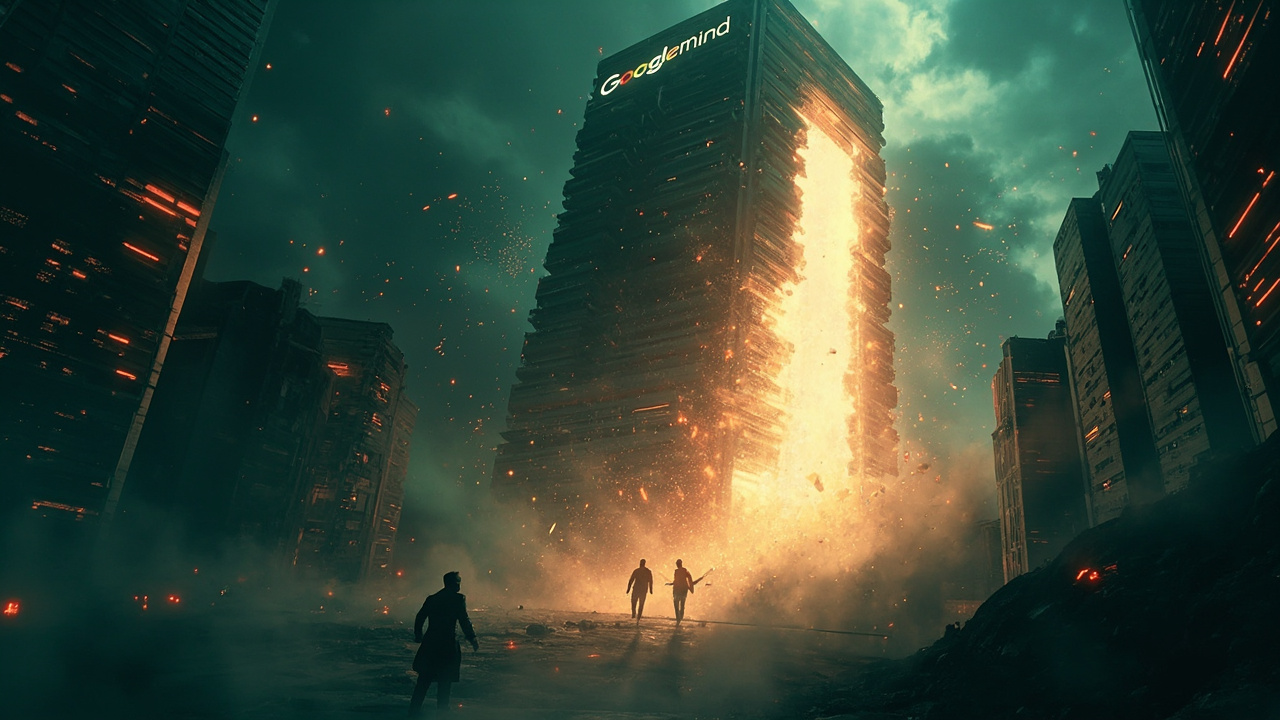
The first week of August 2026 will be remembered as the moment Google’s artificial intelligence empire showed its most visible cracks. In the span of a single afternoon on August 5, the search giant announced the most consequential reshuffling of its AI leadership in a decade — a restructuring that saw the co-founder and public face of DeepMind relinquish the CEO title, and the most celebrated engineer in the company’s history walk out the door to start a rival lab.
By the time Sundar Pichai’s memo landed in employees’ inboxes, a new narrative had crystallized: Google is no longer the undisputed heavyweight of AI research. It is a contender scrambling to hold its ground.
Demis Hassabis Steps Aside
Demis Hassabis, the Nobel Prize-winning neuroscientist-turned-entrepreneur who co-founded DeepMind and oversaw its absorption into Google, is ceding the CEO position at Google DeepMind. According to Google’s official blog post, Hassabis will transition to a strategic role as Chairman of Google DeepMind and Chief Scientist of Alphabet, where he intends to focus on the long-term pursuit of artificial general intelligence.
Taking over operational control is Koray Kavukcuoglu, DeepMind’s Chief Technology Officer, who will now oversee everything from frontier-model research to the Gemini consumer application. Kavukcuoglu, a longtime DeepMind researcher based in the United States, has been described internally as a pragmatist who can bridge the gap between research and product — precisely the bridge that multiple sources say had collapsed in recent months.
The official framing is one of evolution: Hassabis ascending to a higher strategic plane, a capable lieutenant taking the operational reins. But the timing tells a different story. Hassabis’s move comes after months of reported frustration inside DeepMind over missed deadlines, model quality issues, and an accelerating talent exodus that the lab’s leadership seemed unable to stop.
Jeff Dean’s Departure — and Discovery Loop
If Hassabis’s transition was framed as promotion, Jeff Dean’s exit was something else entirely. Dean — Google’s Chief Scientist, the co-creator of MapReduce, Bigtable, TensorFlow, and a living legend who joined the company 27 years ago when it was barely a search engine — is leaving to co-found a new startup called Discovery Loop.
He is not going alone. Joining him are three of Google’s most accomplished AI researchers: Sanjay Ghemawat, his lifelong collaborator and the other half of one of computing’s most famous engineering partnerships; Oriol Vinyals, who led the Gemini model effort; and Quoc Le, a pioneer of sequence-to-sequence learning. The four are departing to build what they describe as a public benefit corporation focused on automating scientific discovery — using AI agents to accelerate the scientific method itself, from hypothesis generation through experimental design to publication.
The choice of corporate structure is deliberate. By incorporating as a public benefit corporation, Discovery Loop signals that its founders are pursuing something beyond pure shareholder return — a stance that resonates with growing unease across the AI industry about the concentration of frontier capabilities in a handful of for-profit labs. Early reports suggest the startup will focus on domains like materials science, drug discovery, and computational biology, where AI-driven automation could compress research timelines from years to weeks.
For Google, the loss is difficult to overstate. Dean and Ghemawat designed the distributed systems infrastructure that powers virtually every Google product. Vinyals was the architect of Gemini’s model strategy. Quoc Le’s work on neural machine translation laid the foundation for modern sequence modeling. These are not replaceable employees; they are foundational figures whose departures leave structural holes in Google’s research organization.
Gemini 3.5 and the Morale Crisis
The leadership changes did not emerge from a vacuum. They are the visible symptoms of a deeper malaise that Fortune detailed in a sweeping investigation published August 10, 2026. According to the report, Google DeepMind has spent the last year “struggling to retain its technical edge, keep hold of top researchers, and contain an employee revolt over its defense work.”
At the center of the crisis is Gemini 3.5 Pro, Google’s next-generation frontier model, which has been repeatedly delayed. Axios reported in late July that organizational friction, competing teams, and engineer frustration were complicating the race to ship. Six current and former employees told the publication that low morale was directly slowing model releases — not a supply chain problem or a compute shortage, but a human one.
Several factors converged. Internally, DeepMind reportedly under-prioritized coding capabilities — the very area where competitors like Anthropic’s Claude and OpenAI’s GPT models have pulled ahead dramatically. Teams working on different aspects of Gemini operated with conflicting priorities and unclear ownership, creating bottlenecks that cascaded into missed milestones. Engineers described a culture of burnout, with extended crunch periods producing diminishing returns.
Externally, Google’s decision to pursue defense contracts — including work tied to military applications that nearly 200 DeepMind employees formally protested in a signed letter — created a rift between leadership and rank-and-file researchers. The company’s own AI Principles, published with fanfare years ago, became a point of contention as employees argued that certain contracts violated the spirit if not the letter of those commitments.
The Competitive Stakes
Google’s timing could hardly be worse. The AI landscape in mid-2026 is the most competitive it has ever been. OpenAI, fresh from filing for an IPO and reportedly targeting a valuation approaching one trillion dollars, continues to ship at a pace that makes DeepMind look deliberate to the point of sluggish. Anthropic’s Claude models have established themselves as the gold standard for coding and agentic tasks. Alibaba’s Qwen 3.8-Max, released August 3 with 2.4 trillion parameters, has demonstrated that the frontier is no longer an exclusively Western club.
In this environment, losing four top researchers and replacing your CEO mid-race is not a reset — it is a concession that the old playbook was not working. Kavukcuoglu’s mandate will be to streamline decision-making, consolidate the fragmented Gemini effort, and somehow reignite the momentum that Google’s rivals have been building while DeepMind wrestled with itself.
What Discovery Loop Means for the Field
While Google absorbs the blow, Discovery Loop represents something genuinely new in the AI ecosystem. The automated science thesis — that AI agents can be built to conduct research end-to-end, generating hypotheses, designing experiments, interpreting results, and iterating — has been circulating in academic circles for years. But no team of this caliber has yet committed to building it as a dedicated commercial venture.
If Discovery Loop succeeds even partially, the implications extend far beyond any single company’s competitive position. Compressing the scientific discovery cycle could accelerate progress in clean energy materials, pharmaceutical development, and climate modeling at a moment when humanity’s need for breakthroughs has never been more urgent. The public benefit structure, meanwhile, offers a template for how frontier AI labs might balance ambition with accountability — a question that Google itself is still struggling to answer.
A Pivotal Moment
Google has survived talent departures before. The company has depth, resources, and a research pipeline that remains the envy of the industry. But the August 2026 reorganization feels different from routine attrition. It marks the end of an era defined by Hassabis’s singular vision and Dean’s institutional gravity, and the beginning of something more uncertain — a Google that must prove it can still lead without the people who made it a leader.
For the broader AI community, the lesson is sobering. Even the deepest pockets and the longest track records cannot guarantee coherence when an organization loses its way. The companies that win the next phase of the AI race may not be the ones with the most compute or the biggest models, but the ones that can hold their teams together, ship reliably, and maintain the trust of both their employees and the public.
Google’s next move — and Discovery Loop’s first — will be watched closely.
Sources
- [1] https://fortune.com/2026/08/10/how-stalled-models-missed-deadlines-and-staff-burnout-lead-to-the-unraveling-of-googles-deepmind/
- [2] https://www.nytimes.com/2026/08/05/technology/google-researchers-ai-startup.html
- [3] https://www.cnbc.com/2026/08/05/google-chief-scientist-jeff-dean-leaving-company-after-27-years.html
- [4] https://www.reuters.com/business/google-shakes-up-ai-leadership-deepmind-chief-shifts-role-2026-08-05/
- [5] https://www.axios.com/2026/07/23/googles-deep-mind-ai-model-race
- [6] https://blog.google/company-news/inside-google/message-ceo/next-chapter-ai-momentum/