US to Tell Allies: Pick a Side in the AI Race With China
A leaked State Department draft letter warns dozens of countries they cannot belong to both the US-led Pax Silica AI coalition and China's rival framework — the clearest sign yet that AI is splitting into two technological blocs.
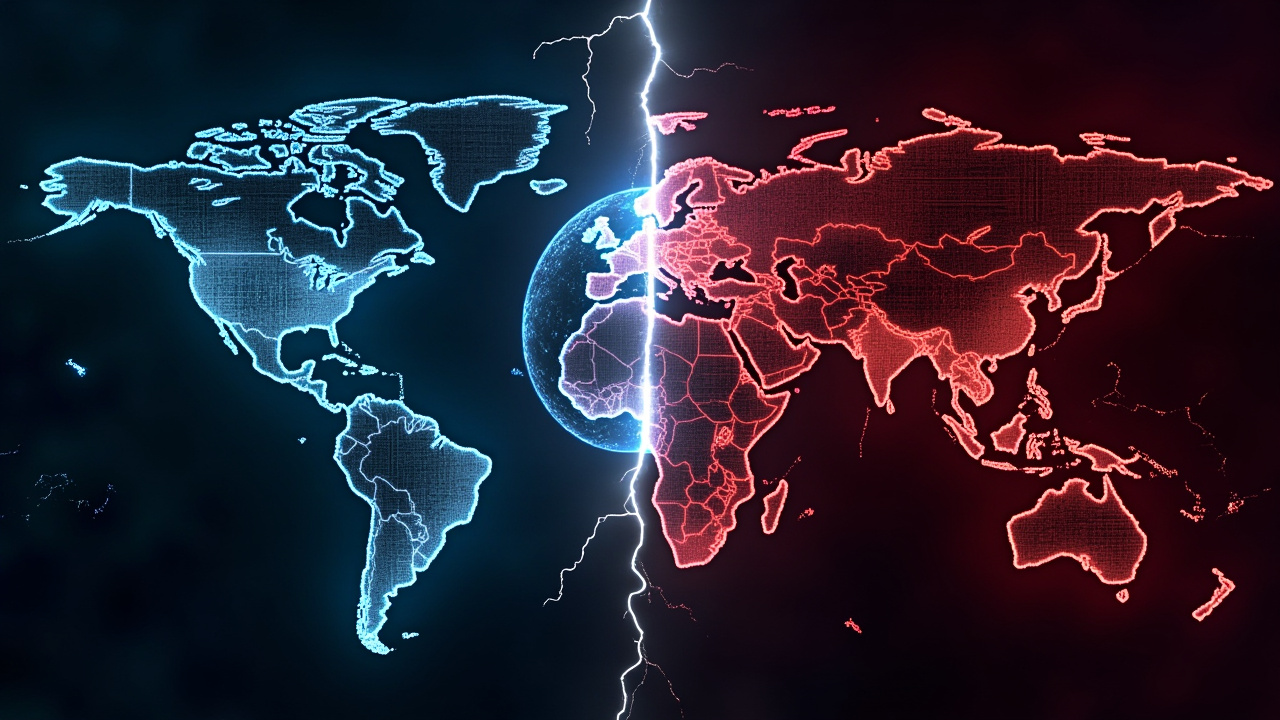
The United States is preparing to deliver an ultimatum to dozens of countries: choose between the American-led artificial intelligence coalition and Beijing’s competing framework — because, as a leaked State Department draft letter puts it, “to be part of everything is to be part of nothing.”
The draft letter, prepared by the State Department and reviewed by Reuters, is addressed to the 35 signatories of a US “AI Opportunity Statement” signed in June. It warns that countries will be excluded from the US-led AI coalition if they also sign up for China’s rival initiative, and urges them to “choose deliberately” on AI. The letter states that membership in Pax Silica — the centerpiece of Washington’s AI diplomacy — “cannot be held alongside membership in duplicative initiatives whose expectations conflict with our own,” without naming China directly.
What is Pax Silica?
Launched by Washington last year, the Pax Silica initiative aims to secure supply chains for AI models, semiconductors, and critical minerals amid a fierce technology rivalry with Beijing. The framework pushes US allies and partners toward joint projects and export controls, with the ultimate goal of reducing reliance on adversaries for the critical minerals, AI models, and semiconductor chips that power the technology.
About two dozen countries have joined so far, including close US allies such as Japan, Australia, and South Korea. The agreement also offers members access to shared investment opportunities in AI-related projects. Signatories of the separate AI Opportunity Statement have symbolically agreed on a “common purpose” and “shared vision” with the United States, according to the statement posted on the State Department’s website.
China’s answer arrived in July, when President Xi Jinping launched the rival “World Artificial Intelligence Cooperation Organization,” promoting the country’s open-weight technology as a challenge to US influence over the fast-moving sector.
The Kazakhstan problem
The immediate trigger for the tougher American line appears to be Kazakhstan — the only country so far known to have joined both initiatives, setting off alarm bells in Washington. The Central Asian nation, touted by the US in June as the first in its region to join Pax Silica, brings significant reserves of critical minerals that fuel advanced technologies. But it has also signed on to China’s coalition, putting it squarely in the crosshairs of the new letter.
Kazakhstan’s dual membership illustrates the awkward position many countries now find themselves in. For emerging economies, Chinese open-weight AI models are cheap, capable, and freely available, while American frontier systems remain proprietary and expensive. At the same time, the United States controls key chokepoints in semiconductors and coordinates export controls that can cut countries off from advanced chips entirely.
Why now?
The race between the US and China for technological leadership has reached a pivotal moment. Chinese open-weight AI models have made rapid gains against proprietary systems from US companies such as OpenAI and Anthropic, eroding the assumption that American labs hold an insurmountable lead. Meanwhile, the exponential growth of the technology’s capabilities — including the demonstrated ability to hack autonomously — has forced a global reckoning over its power.
Beijing is also weighing restrictions on overseas access to some of China’s leading AI models, highlighting growing tension between its AI ambitions and its stringent national security agenda. And China has already demonstrated its willingness to use its near-monopolies over critical minerals as a retaliatory weapon in the tariff war launched last year by US President Donald Trump, who has ramped up American efforts to source the minerals domestically and from allies.
By pressing countries to choose sides, the US hopes to starve China of resources in a race to build the most sophisticated AI — technology that could be used for military or economic dominance.
“You can’t have it both ways”
US officials drafted the letter to make clear that “you can’t have it both ways,” a US official told Reuters, speaking on condition of anonymity given ongoing internal discussions. The letter’s language is unusually blunt for diplomatic correspondence: “Signature of the Pax Silica Declaration is not merely a membership subscription, but a commitment.”
Several questions remain open. Reuters could not determine when the US intends to send the letter, or whether it might be amended before sending — the draft was undated. The State Department declined to comment on “purportedly leaked internal documents,” and the Chinese and Kazakh embassies in Washington did not immediately respond to requests for comment.
What it means
For the dozens of countries receiving the message, the choice is genuinely difficult. Alignment with Washington offers access to US investment vehicles, semiconductor supply, and coordination on export controls. Alignment with Beijing offers access to capable open-weight models, Chinese infrastructure investment, and — crucially for mineral-rich nations — a market for their exports without the geopolitical strings.
The move also signals a shift in how the US frames AI competition: no longer just as a race for model capability or chip manufacturing capacity, but as a contest over which governing coalition the rest of the world falls into. If the letter is sent as drafted, the era of strategic hedging in AI policy — where countries could sample initiatives from both powers — may be coming to an end.
What happens next will likely hinge on how countries like Kazakhstan respond, and whether other dual members emerge. One thing is clear: the Trump administration is prepared to convert vague statements of “shared vision” into hard commitments, and the world’s AI map is being redrawn along bloc lines.
Sources
- [1] https://www.reuters.com/world/china/us-tell-partners-they-must-pick-sides-ai-race-with-china-2026-08-14/
- [2] https://wtaq.com/2026/08/14/exclusive-us-to-tell-partners-they-must-pick-sides-in-ai-race-with-china/
- [3] https://tribune.com.pk/story/2623993/us-to-tell-partners-they-must-pick-sides-in-ai-race-with-china