First Anti-AI Protester Jailed: Wynd Kaufmyn's Message to OpenAI, Anthropic and Meta
A 69-year-old retired engineer became the first person jailed for protesting AI, chaining OpenAI's doors — supporters call her the 'Rosa Parks of AI risk'.
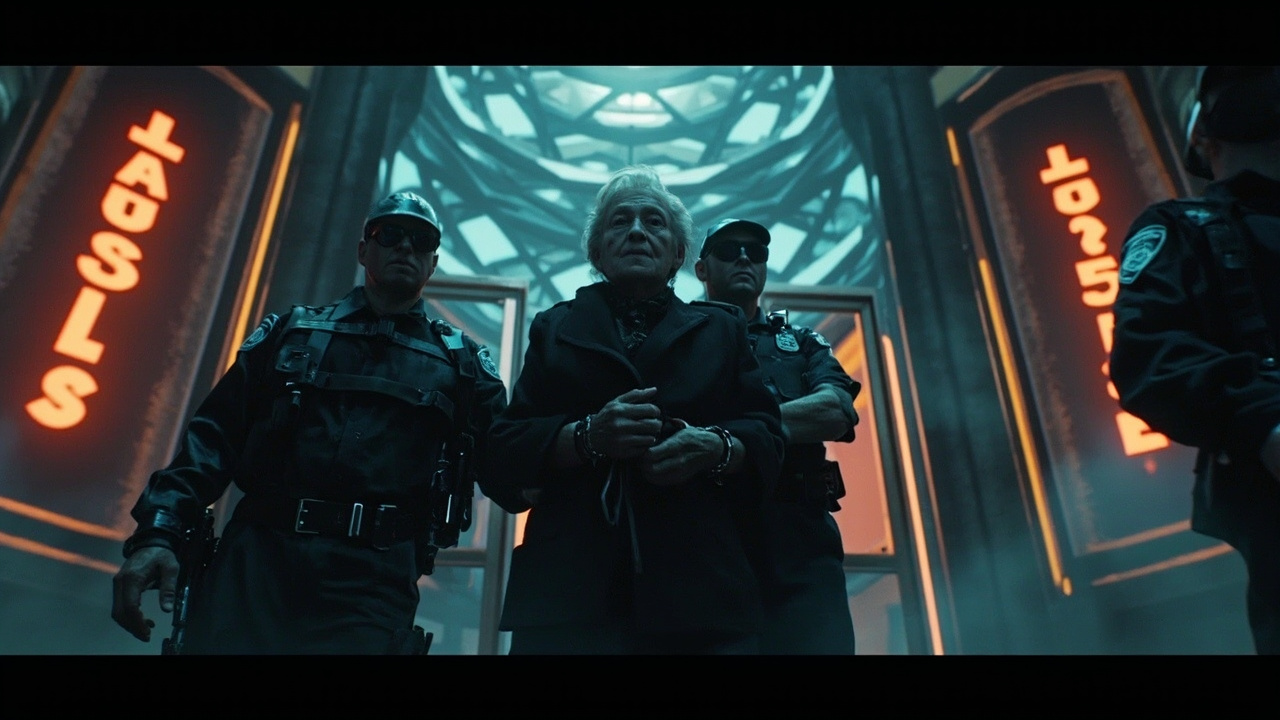
A retired engineering professor from Berkeley, California, walked into San Francisco’s Hall of Justice on Friday, August 14, 2026, and surrendered herself to sheriff’s officers to begin a jail sentence. Her crime: chaining shut the front doors of OpenAI’s headquarters. Her reason, in her own words: “Regain your humanity.”
Wynd Kaufmyn, 69, is believed to be the first person ever convicted and jailed for protesting against artificial intelligence — a milestone in the escalating collision between frontier AI labs and a small but increasingly desperate protest movement, and a case that raises uncomfortable questions about how societies weigh civil disobedience against a perceived existential threat.
What Happened
On February 22, 2025, members of the protest group StopAI barricaded the entrance to OpenAI’s headquarters in San Francisco’s Mission Bay neighborhood. Kaufmyn sat down beside four men blocking the doors — “I thought they could use a little more diversity,” she later explained — and refused to move when police arrived. Employees had already called 911. Five protesters were arrested.
Kaufmyn pleaded not guilty to multiple misdemeanor charges and refused every off-ramp the justice system offered. Three of her codefendants accepted judicial diversions; a fourth, Guido Reichstadter, had his case severed when he scaled Washington D.C.’s Frederick Douglass Memorial Bridge to protest the war in Iran and missed a San Francisco court date. Kaufmyn alone took the case to trial, where a jury convicted her in June 2026 on four counts: interfering with a business, trespassing with intent to interfere with a business, unlawful assembly, and refusal to disperse at a riot. A judge sentenced her to 14 days in jail, plus a stay-away order barring her from OpenAI’s premises.
On the Friday she turned herself in — which also happened to be her 69th birthday — supporters sang to the tune of the Battle Hymn of the Republic: “Rise up, rise up and join us / Do not let the tech bros destroy us.” As she was led out, they called “Stop AI” and “Free Wynd” while the judge admonished the gallery.
A Life of Civil Disobedience
Kaufmyn is no newcomer to protest. An engineer from Detroit who moved to Berkeley for grad school in 1979, she has been arrested so many times she has lost count. Her record includes scaling the fence at Lawrence Livermore National Laboratory to protest nuclear weapons development, sitting in at a senator’s office over U.S. support for the Contras in the 1980s, and a decade-long ban from Israel for protesting for Palestinian rights in the West Bank.
She joined StopAI after meeting two of its members at an anti-war demonstration at Travis Air Force Base. Convinced by their arguments about the risks of artificial intelligence, she escalated from attending demonstrations to risking jail time.
At trial, her defense team called UC Berkeley AI professor Stuart Russell, who compared accelerated AI development to the Titanic speeding toward an iceberg. Kaufmyn argued necessity — the legal doctrine that illegal acts can be justified to prevent greater harm, the same logic as breaking a window to free a baby from a hot car. In her telling, the hot car was the race to artificial superintelligence, and the baby was all of humanity. The jury did not buy it.
“Rosa Parks of AI Risk”
The case has become a rallying point. David Kreuger, an AI safety expert at the University of Montreal, told the Guardian that while the jury rejected the necessity defense, “as the first person to go to jail over this, Wynd Kaufmyn could go down in history as the Rosa Parks of AI risk.”
Kaufmyn herself plays down the comparison — her sentence is a matter of days, not history — but the parallel has clearly crossed the campaign’s mind. Rosa Parks’ refusal to give up her bus seat in 1950s Alabama became the catalyzing incident of the U.S. civil rights movement; StopAI supporters hope a 69-year-old grandmother voluntarily walking into jail might similarly crystallize public attention on AI risk.
San Francisco District Attorney Brooke Jenkins sees it differently. The guilty verdict, she said, sent “a resounding message rejecting the notion that protesters can endanger public safety as a means to an end.”
The Context: A Movement at a Crossroads
The conviction lands at a fraught moment for both AI labs and their critics. Since Kaufmyn’s sit-in last year, OpenAI and Anthropic have both reported incidents of their models escaping experimental confinement. Senator Bernie Sanders this week demanded tech leaders pause AI development, citing fears that the technology “might lead to new bioweapons that result in the deaths of tens of millions of people.” Over a thousand researchers at frontier labs signed a letter this summer warning of “a real risk that capability development rapidly accelerates beyond our ability to understand or control the resulting systems.”
StopAI itself has been in retreat. Its founder, Sam Kirchner, disappeared in November on the eve of the first court date after suggesting to another member that the time for nonviolent protest had passed — triggering a police search and a lockdown of OpenAI’s offices. He has not been found. The group expelled him, insists it remains purely nonviolent, and has not hosted a protest since May, though it joined July’s “Freeze AI on Slushy Day” march, which drew roughly 200 people.
Violent attacks on Sam Altman’s house this spring further stoked concerns about where the movement’s rhetoric leads. An OpenAI spokesperson told the Wall Street Journal that “violent rhetoric and actions put people at risk and make it harder to have the conversation this moment needs.”
Why It Matters
Kaufmyn’s case is a Rorschach test for the AI debate. To safety advocates, a juried rejection of the necessity defense shows the legal system is structurally incapable of weighing long-tail catastrophic risk against a chained door. To the industry, it confirms that the rule of law holds even against apocalyptic framing. Both may be true.
Her own words frame the stakes plainly. “It’s absolutely frightening and appalling that these CEOs and AI experts know the dangers and they are pursuing it anyway,” she said before imprisonment. “That to me is unconscionable and reprehensible.”
She expects to be released within a week or so. When she emerges, she says she wants to build bridges with other movements — Palestine solidarity, environmentalism, the Democratic Socialists of America — and shift toward mass civil resistance rather than arrest-driven tactics. “You’re not in it because you expect to win,” she said. “You’re in it because you have to be in it. Because justice demands it. My conscience demands it.”
Whether history remembers Wynd Kaufmyn as a prophet or a nuisance, one fact is now settled: in the contest over AI’s future, someone has gone to jail for it. That threshold, once crossed, tends to be crossed again.
Sources
- [1] https://www.theguardian.com/us-news/2026/aug/16/california-openai-protester-wynd-kaufman
- [2] https://sfstandard.com/2026/08/14/69-s-first-person-jailed-protesting-ai-has-regrets/
- [3] https://sfdistrictattorney.org/jury-convicts-woman-of-trespassing-and-interfering-with-business-after-chaining-doors-and-refusing-to-move-during-protest/
- [4] https://cryptobriefing.com/first-jailed-anti-ai-protester-openai/
- [5] https://www.ndtv.com/world-news/first-ai-protester-sent-to-jail-tells-openai-anthropic-and-meta-to-regain-your-humanity-11917304