AI Won't Give You the Job: Discrimination and Secrecy Lawsuits Take Aim at Automated Hiring
Class actions against Eightfold AI, Meta and IBM are testing whether AI hiring tools must obey the same transparency rules as credit bureaus — and researchers find newer models are more biased, not less.
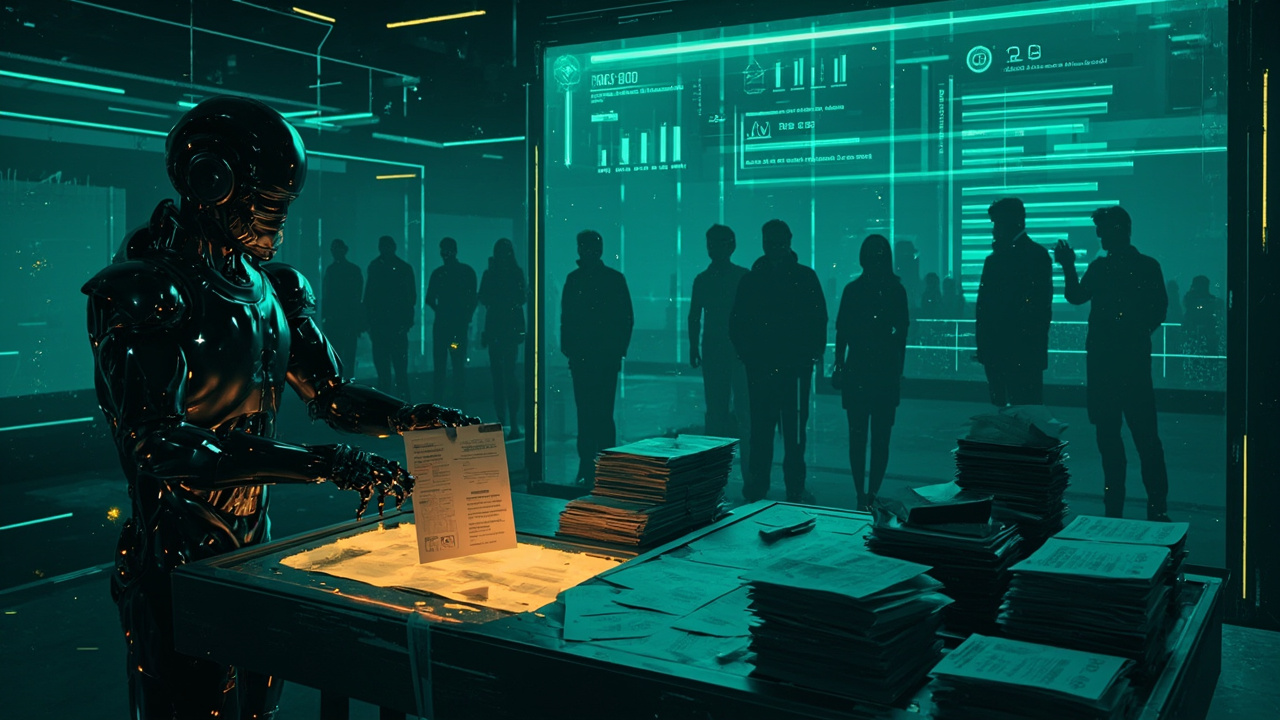
For four years, Erin Kistler applied for thousands of jobs at companies like PayPal, Microsoft and Netflix. A product manager with nearly two decades of experience, she believed she was qualified for every role she pursued. She never got a single interview. Her résumé, she concluded, had vanished into an algorithmic black hole — and now she is doing something about it in court.
Kistler is the lead plaintiff in a class-action lawsuit against Eightfold AI, the Silicon Valley maker of hiring software used by hundreds of employers, filed in California state court in January. The case, reported in depth by the Guardian on August 19, is one of the first to argue that automated résumé screening functions as an undisclosed consumer report — a ranked dossier on every applicant that predicts their likelihood of success, without ever giving them the chance to see or contest the score.
It is not an isolated case. Workers are also suing Meta over an internal AI system that allegedly flagged them for layoffs because they took parental or medical leave. Another suit against IBM alleges its AI tools discriminated against older workers. Together, these legal battles could determine how much transparency companies must provide when algorithms help decide who gets hired — and who gets fired.
The black box at the front door of employment
There is currently no US federal law requiring companies to disclose when AI is evaluating job applicants. “There’s actually no law requiring a notice or disclosure of the use of these AI hiring systems,” Ifeoma Ajunwa, a professor at Emory University School of Law and founding director of its AI and Future of Work program, told the Guardian. “So companies are not necessarily telling workers when they’re being evaluated with AI.”
The scale of the practice is enormous. According to a World Economic Forum report, 90% of employers used some form of automation in hiring last year. The tooling ranges from basic filters — excluding anyone without a four-year degree — to AI-driven skills assessments and fully automated initial phone interviews.
Eightfold sits at the center of this ecosystem. The company bills itself as “the world’s largest, self-refreshing source of talent data,” continuously updating profiles built from résumés, LinkedIn pages and social media of over a billion workers who have applied through its platform. Its AI scores each applicant from 0 to 5, predicting how well they would perform in a given job. Those scores can determine who gets pulled forward for an interview — and who never learns they were scored at all.
“A large part of the problem is that job applicants don’t know … what the reports say,” said Rachel Dempsey, an attorney representing Kistler. Her argument is straightforward: if Americans can see and dispute their credit reports, they should have the same visibility into algorithmic dossiers that shape their livelihoods. Eightfold denies the claims, saying in a statement that they are “without merit” and that it intends to defend itself vigorously. IBM says it does not use AI to automatically screen out candidates and “does not condone or tolerate discrimination of any kind.” Meta did not respond to a request for comment.
Newer models, older biases
The vendors’ pitch is objectivity: remove the human hiring manager’s personal biases and let the data decide. Researchers who study these systems say the reality is closer to the opposite.
“As we’ve done more of the research on AI hiring systems, we actually see that they tend to replicate a lot of the same biases that human managers have,” Ajunwa said. The canonical example remains Amazon’s experimental hiring tool, which learned to downrank résumés containing signals of female applicants because the company’s historical top performers were mostly men — and was scrapped once the bias was discovered. In her book The Quantified Worker, Ajunwa documented voice-interview AI that scored applicants with southern accents poorly simply because it struggled to understand them.
More unsettling is recent evidence that the problem is getting worse, not better. Xuechunzi Bai, an assistant professor at the University of Chicago, co-authored a study that asked AI models to make hiring decisions about fictional applicants assigned to invented demographic groups — Tufa, Aima, Reku and Weki — specifically so no real-world stereotype could contaminate the results. After a few rounds of simulated decisions, the models began stereotyping from scratch: if one Tufa had been a good doctor, Tufa candidates were more likely to be selected as doctors, while Weki candidates drifted toward janitorial roles.
The study found greater bias in AI decisions than in comparable human decisions, and — the finding that startled the researchers — found that newer, more advanced models produced hiring decisions with more bias. “AI models are very good at solving problems where there is one objective solution, as in math or coding,” Bai explained. “But they’re getting worse in terms of exploring the other alternatives. In the context of hiring, exploration is quite important, but these models are not trained to do it.”
Algorithmic blackballing
The deepest structural risk may be concentration. When a human hiring manager rejects you, you can apply elsewhere and meet a different person with different judgment. When the same AI system — or systems built on the same foundation models — screens candidates across many companies, rejection becomes a record that follows you.
The system “remembers the decision that was already made and makes it again for the sake of efficiency,” Ajunwa said. “In reality, you’ve been algorithmically blackballed.” Katie Creel, co-author of a recent study on what she and her colleagues call “algorithmic monoculture” in hiring, puts it bluntly: “People are going to be shut out of jobs more than they would have otherwise been.”
What regulation exists — and where it falls short
A patchwork of local rules is starting to emerge. New York City’s Local Law 144, in effect since 2023, requires employers using automated hiring systems to run annual independent bias audits and to notify candidates in advance. But the law only covers software that “substantially assists” or replaces human decision-making, leaving a loophole whenever a person remains nominally in the loop. Illinois and Colorado have enacted broader prohibitions on AI tools that produce unlawful discrimination, and a growing number of jurisdictions are converging on notification as a baseline requirement.
Notification alone isn’t enough, argues Jenny Yang, a partner at Outten & Golden — the firm representing the Eightfold plaintiffs. Candidates should be able to see what their algorithmic dossier actually says. “This initial transparency is helpful in better identifying where there may be problems,” she said. “There’s a lot of growing concern among workers that they may be denied opportunity for reasons that no one understands.”
Some vendors argue a human-in-the-middle model is the pragmatic fix. Incredible Health, an AI hiring platform used by more than 1,500 healthcare employers, deploys an AI agent to conduct phone interviews — but the agent doesn’t autoreject, score, rank or decide who advances. “It’s about collecting information from the candidates so a human is better armed to make the decision,” CEO Iman Abuzeid said. The company audits about 10% of its AI interviews for bias, a process that is quietly becoming a legal requirement in more cities and states.
Why this matters now
The lawsuits arrive as AI-driven layoffs are accelerating across tech — restructuring decisions increasingly assisted by the same class of tools. If courts accept the premise that AI-generated applicant scores are functionally consumer reports, vendors could face FCRA-style obligations: disclosure, access, and dispute rights. If they reject it, employers gain a durable layer of legal insulation between themselves and the algorithms acting in their name.
Either way, the Kistler case turns on a question every job seeker now implicitly faces: when an algorithm reads your résumé, do you have the right to read what it wrote back? For now, in most of the United States, the answer is no — and the outcome of these cases will decide how much longer that remains true.