Europe's AI Data Centres Are Fleeing the City: New Campuses Now Average 175 km From Major Hubs
JLL data shared by Reuters shows Europe's next wave of hyperscale AI data centres will sit nearly four times further from major cities than the last one — 175 km on average — as developers chase cheap power and land from rural Spain to northern Sweden.
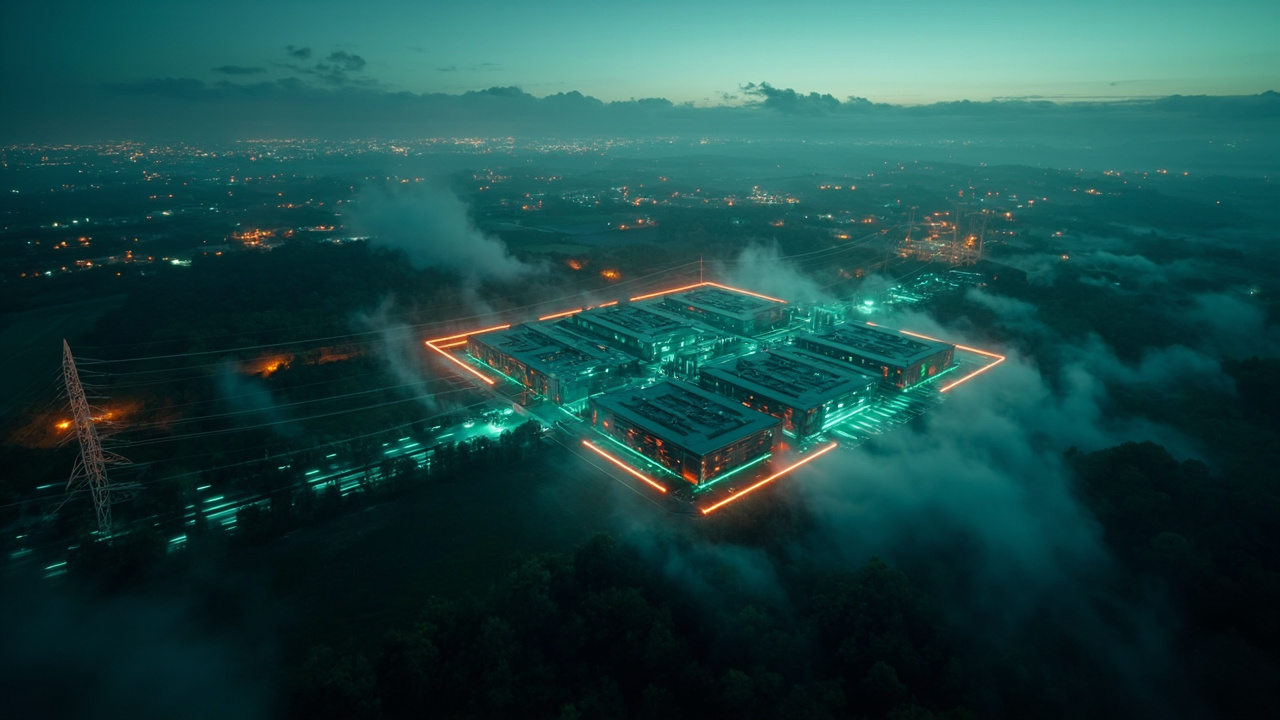
For two decades, the geography of the internet was dictated by latency: data centres clustered as close as possible to the users and exchanges of Frankfurt, London, Amsterdam, Paris and Dublin — the so-called FLAP-D markets. A data analysis shared with Reuters on Wednesday by commercial real estate giant JLL shows that logic is now being inverted by artificial intelligence. The hyperscale campuses coming online across Europe between 2026 and 2028 will sit an average of 175 kilometres (109 miles) from a major hub — nearly four times the 46-kilometre average of projects delivered between 2022 and 2025.
The reason, in a sentence, is that AI training does not care about latency, but it is ravenous for electricity, land and water. “The determining factor is increasingly where sufficient power can be secured, rather than simply where demand exists,” said Assad Noori, JLL’s head of data centres for Europe, the Middle East and Africa. “Data centres are being brought to where the power is, not the other way around.”
The numbers behind the exodus
The JLL pipeline data, reported by Reuters’ Simon Jessop and Iain Withers, sketches a structural break in how European digital infrastructure gets built:
- Distance from hubs: Hyperscale sites in the 2026–2028 pipeline average 175 km from a major city, versus 46 km for 2022–2025 deliveries — driven by power and land scarcity in cities like London and Frankfurt.
- Greenfield share: Brand-new builds on untouched land make up 39% of Europe’s future pipeline, compared with just 8% of the projects actually delivered to date.
- Inner-city collapse: The share of pipeline projects in inner-city locations is set to fall to 5%, down from 13% of existing stock, with the remainder in industrial or edge-of-city zones.
Independent tracking from DC Byte corroborates the shift. Of nine proposed gigawatt-plus data centres across Europe, only one — near Paris — sits close to a major city. The rest are strewn from rural Spain to northern Sweden, places chosen for grid capacity, cheap land and cool air rather than proximity to financial districts.
The economics of powered land
What makes a 175-kilometre detour worth it is the staggering price differential for land that already has electricity attached. JLL’s numbers show powered land in core FLAP-D markets costs an average of €2.36 million per megawatt of IT load. In secondary cities — Copenhagen, Warsaw, Milan — that falls to €978,000. In tertiary regions such as Bordeaux, it drops to €512,000, and can go as low as €200,000 per megawatt.
At the top of the market, Amsterdam is Europe’s most expensive market at roughly €2.7 million per megawatt, followed by London at €2.6 million and Frankfurt at €2.5 million. “London has already seen significant digital infrastructure development driven by cloud and has other asset classes competing for space, leading to high land prices,” said Rupert Duckworth, associate director of EMEA data-centre advisory at Savills. “Power is now constrained in the key cloud locations across the market.”
Against that backdrop, a hyperscaler planning a 500-megawatt AI training campus can save well over a billion euros in land and power costs alone by choosing a tertiary region — before counting faster grid-connection queues and cheaper cooling water.
A $725 billion spending wave
The siting shift is happening against the backdrop of an unprecedented capital expenditure boom. JLL estimates the world’s four largest hyperscale cloud providers — a group widely understood to include Amazon, Microsoft, Google and Meta — will spend $725 billion in 2026, up 77% from $410 billion in 2025, with the majority going to AI computing and data-centre infrastructure. By 2030, JLL expects AI workloads to account for roughly half of all global data-centre capacity.
“Europe’s core markets will remain critical because enterprise demand isn’t going anywhere,” said Martin Jensen, president of JLL’s EMEA data-centres division. “Hyperscale AI infrastructure requires a completely different scale of power and land.”
Winners, tensions, and the French question
The dispersion is not without friction. On one hand, it channels billions in investment into underprivileged regions where governments are eager to stimulate jobs and growth. On the other, developers face mounting opposition from residents worried about dwindling natural habitats and competition for power and water — a tension already visible in moratoriums and grid-priority rules from Dublin to Denmark.
The single biggest beneficiary may be France. A Reuters Breakingviews analysis published the same day argues that “Europe’s data centre crown is France’s to lose”: French electricity is predominantly nuclear and therefore both cheap and low-carbon, and the country’s data centres are projected to consume 15–20 TWh by 2030. SoftBank has already committed to 3.1 gigawatts of AI data-centre capacity in the Hauts-de-France region around Dunkirk by 2031, and the EU’s €20 billion AI Gigafactories programme — which opened its call for proposals on July 29 — is expected to anchor up to five continental-scale compute facilities, each combining AI processors, high-speed connectivity and dedicated energy.
Why it matters
The JLL data marks the moment Europe’s AI buildout stopped being a real-estate story about server halls near cities and became an energy-infrastructure story about where the continent’s electrons are. Three implications stand out.
First, the bottleneck is the grid, not the chips. With land in Amsterdam costing thirteen times more per megawatt than rural France, the binding constraint on European AI capacity is now the speed at which transmission lines, substations and generation can be brought to greenfield sites.
Second, regional policy just became industrial policy. National and local governments that can offer fast permitting, firm power and water access — as France is doing — will capture a disproportionate share of the $725 billion global spend, while constrained hubs watch capacity migrate away.
Third, the social contract for data centres is being rewritten in real time. As campuses move into communities that never hosted digital infrastructure, the industry’s licence to operate will depend on demonstrating local benefit — jobs, tax revenue, heat reuse — against fears of environmental strain. The projects that navigate that bargain successfully are the ones that will actually get built.
Europe’s AI future, it turns out, will be decided not in the capitals, but in the fields, old industrial zones and coastal towns where the power lines already run.
Sources
- [1] https://www.reuters.com/business/europe-ai-data-centres-seek-cheaper-quicker-energy-land-2026-08-19/
- [2] https://www.jll.com/en-uk/insights/emea-data-centre-report
- [3] https://www.jll.com/en-ae/newsroom/ai-boom-redraws-europes-data-centre-map-as-power-access
- [4] https://www.reuters.com/commentary/breakingviews/europes-data-centre-crown-is-frances-lose-2026-08-19/
- [5] https://ec.europa.eu/commission/presscorner/detail/en/ip_26_1708