Ulanqab: The Unlikely Inner Mongolian City at the Center of China's AI Boom
Nearly 100 data centers, 12.5 GW of committed capacity, and the world's largest single AI computing building — how a grassland city two hours from Beijing became China's AI data-center capital.
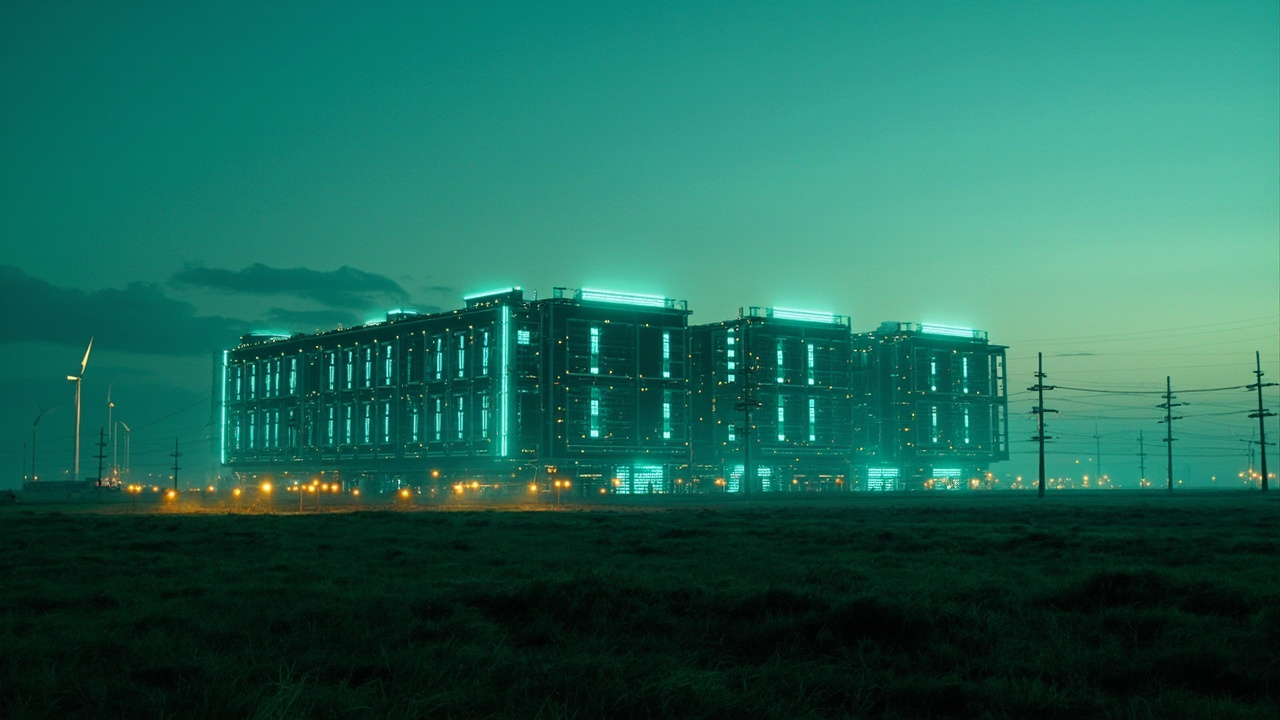
Travel just two hours west of Beijing by train, past the rolling grasslands and ancient cinder cones of Inner Mongolia, and you reach Ulanqab — a city of roughly 1.5 million people that was long known mainly for sheep farming and coal. As WIRED senior writer Zeyi Yang reported on August 21, 2026, it has quietly become something else entirely: the densest AI data-center hub in China, and arguably the clearest physical expression of where the country’s AI ambitions are being built.
Since 2016, nearly 100 data centers have opened or broken ground in and around the city. Local investment now totals roughly 12.5 gigawatts of committed capacity, according to the WIRED dispatch. The tenants read like a who’s-who of Chinese AI: DeepSeek, ByteDance, and Alibaba have all drawn on compute from the region. And on August 6, 2026, the stakes were raised again when green-energy giant Envision commissioned what it calls the world’s largest single AI data-center building — the Galaxy Campus — on the city’s outskirts.
Why Ulanqab?
Three blunt economic reasons explain the boom, and none of them involve prestige or talent density — the usual ingredients of AI-cluster geography.
Cheap power. Inner Mongolia sits atop vast coal reserves and some of China’s best wind and solar corridors. Grid electricity is inexpensive by national standards, and for a workload where electricity is the dominant operating cost, that is nearly the whole game.
Free cooling. At around 1,400 meters of elevation, Ulanqab is cold for much of the year. Low ambient temperatures let operators use outside air for cooling instead of energy-hungry chillers — a meaningful cut in a facility’s lifetime energy budget.
Land and latency. The region offers abundant, cheap land, and — critically — a high-speed rail and fiber position close enough to Beijing to keep round-trip latency tolerable for inference and training workloads serving the capital’s enormous user base.
Ulanqab’s rise also maps onto national policy. Under China’s “East Data, West Computing” (东数西算) program launched in 2022, the state deliberately steered new compute capacity toward energy-rich western regions while keeping demand concentrated in the east. Inner Mongolia is one of the designated national computing-hub clusters, which means land, grid interconnection, and project approvals flow faster there than almost anywhere else in the country.
The Galaxy Campus: A Million Accelerators Under One Roof
The flagship of the boom is the Envision Galaxy Campus, officially commissioned on August 6, 2026. At its heart is a single 120,000-square-meter AI supercomputing building — the footprint of about 20 football pitches — that Envision describes as the world’s largest of its kind.
The headline numbers are designed for the gigawatt era:
- Over 2 GW of planned campus capacity at full build-out
- One million PFLOPS of designed AI computing capacity
- Up to one million AI accelerators supported within the single structure
Powering a building of that scale is its own engineering project. Envision’s approach, which it brands the “AI Power System,” integrates directly connected renewable generation, dedicated transmission infrastructure, and large-scale storage to deliver stable green power to the chips. “Supporting a million accelerators requires a purpose-built AI Power System,” said Ricky Zheng, General Manager of Envision’s AIDC business. The company claims the design delivers “up to ten times more compute output per square meter than conventional data centers.”
The Galaxy Campus is the first flagship project under Envision’s Mission Gobi initiative, unveiled at VivaTech in Paris in June 2026, which targets 5 GW of green AI computing capacity in desert and arid regions worldwide by 2030.
The Geopolitical Subtext
What makes Ulanqab strategically significant goes beyond gigawatts. Under successive rounds of US export controls, Nvidia’s most advanced accelerators are largely off-limits to Chinese buyers. The racks filling Inner Mongolian halls are therefore increasingly domestic — Huawei Ascend parts, and a widening field of homegrown accelerators — powering homegrown models like DeepSeek’s.
The contrast with the United States is stark. While American governors who once courted data centers now backtrack amid voter anger over power bills and grid strain — Texas Governor Greg Abbott has frozen approvals on roughly 1,800 proposed projects, and Pennsylvania’s Josh Shapiro signed an executive order letting the state block new sites — China’s buildout proceeds with state coordination, cheap coal-and-wind power, and none of the local veto points that have slowed hyperscaler projects in Virginia or Texas.
None of this means the Chinese approach is problem-free. A hub built partly on coal-heavy grid power carries its own carbon and water questions, and utilization of some western data-center capacity has historically lagged construction. But as a statement of intent — that compute capacity is now a strategic resource to be manufactured at speed — Ulanqab is hard to ignore.
What to Watch
Three indicators will tell us whether Ulanqab is a durable AI hub or an overbuilt one:
- Accelerator supply. Whether domestic chips can ship in the volumes needed to actually fill a million-accelerator building, or whether the campus runs below design capacity waiting on silicon.
- Utilization economics. Whether demand from DeepSeek, ByteDance, Alibaba, and the next generation of Chinese AI labs keeps pace with 12.5 GW of committed power.
- The Mission Gobi export model. Whether Envision’s formula — purpose-built green power plus hyperscale density — can be replicated in the Middle East, Central Asia, or elsewhere, turning Chinese data-center engineering into an export industry.
For a decade, the geography of AI was written in the Bay Area — labs, talent, venture capital. Increasingly, it is being written in places like Ulanqab, where the limiting factors are power, land, and cooling rather than researchers. The city that once shipped sheep and coal now ships tokens. The speed at which it does so may say more about the AI race’s endgame than any benchmark chart.
Sources
- [1] https://www.wired.com/story/the-unlikely-place-at-the-center-of-chinas-ai-boom/
- [2] https://www.prnewswire.com/news-releases/envision-commissions-galaxy-campus-in-ulanqab-establishing-a-new-model-for-gigawatt-scale-ai-infrastructure-302844834.html
- [3] https://www.enerdata.net/publications/daily-energy-news/envision-commissions-2-gw-ai-data-centre-inner-mongolia-china.html
- [4] https://www.techtimes.com/articles/323410/20260806/envision-commissions-worlds-largest-ai-data-center-building-using-site-renewables.htm