Nvidia Pays Poolside $6 Billion for Its 'Model Factory' — the Largest AI Licensing Deal Yet
Nvidia licensed Poolside's Model Factory for $6B, invested $1B at a $12B valuation, and hired 109 staff to build a US open-weight challenger to China's best models.
In a deal that rewrites the playbook for how Big Tech acquires AI talent and technology, Nvidia has agreed to pay San Francisco startup Poolside $6 billion to license its AI model-building software — and will extend job offers to more than 100 of the company’s engineers. Add a reported $1 billion equity investment at a $12 billion pre-money valuation, and the chip giant’s total commitment climbs toward $7 billion, making this the largest pure technology-licensing deal the AI industry has ever seen.
The agreement, first reported by The Information and later detailed by The Wall Street Journal, is structured as a “reverse acqui-hire”: Nvidia gets the technology and the team, while Poolside’s existing investors walk away with a massive payout rather than waiting years for an IPO or acquisition. According to Techmeme’s roundup, existing shareholders will be paid out at $76.20 per share by the end of 2027.
What Nvidia Actually Bought: The ‘Model Factory’
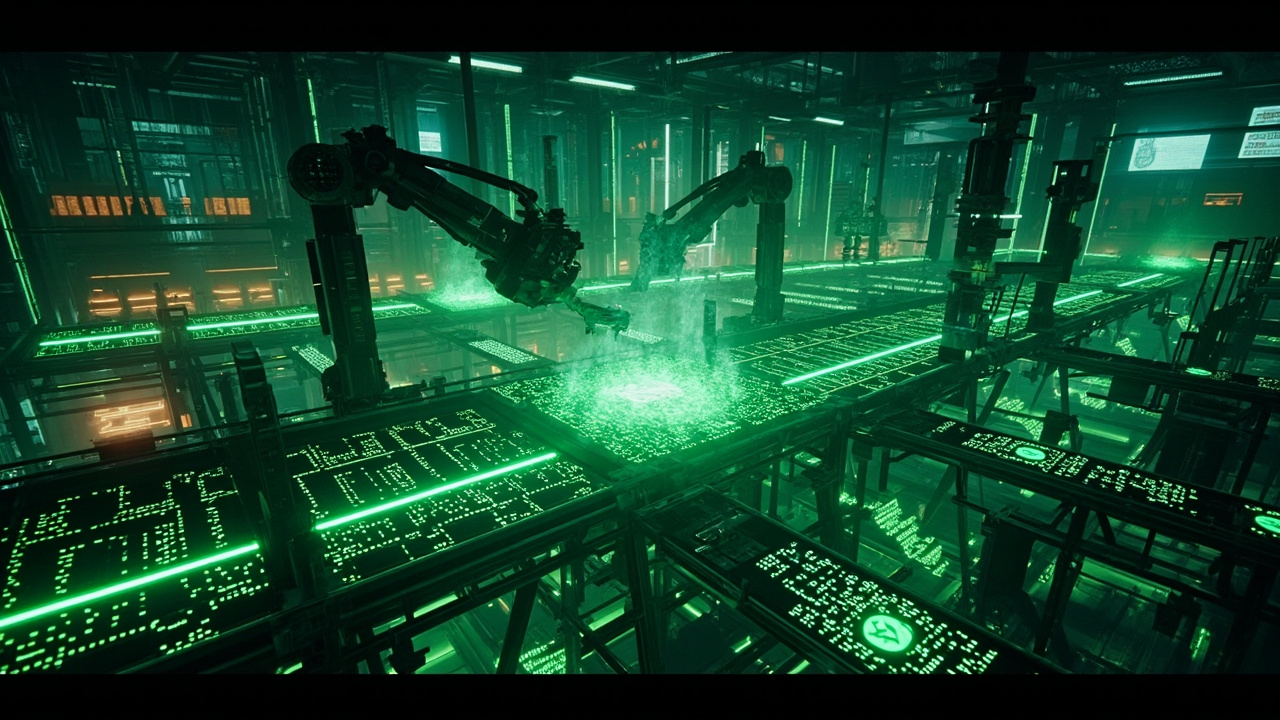
The centerpiece of the deal isn’t a model — it’s the machine that builds models. Poolside calls it the Model Factory: an industrialized pipeline spanning data curation, pre-training, reinforcement learning, evaluation, and inference, all orchestrated as an automated system rather than a collection of hand-tuned experiments.
That may sound like consultingware. It isn’t. Poolside’s public track record in 2026 shows what the factory approach delivers: the company shipped Laguna S 2.1, a 118-billion-parameter open-weight coding model pitched as “the West’s answer to DeepSeek and Qwen,” in July, alongside smaller variants like Laguna M.1 and XS.2 released under Apache 2.0. Multiple smaller releases shipped in rapid succession — a development velocity that analysts attribute directly to the factory’s automated evaluation and retraining loops.
Nvidia didn’t buy those checkpoints. It bought the ability to produce them at scale, on its own silicon, under its own brand.
Why This Matters: The Open-Weight Cold War
The strategic logic, as the WSJ headline framed it, is blunt: Nvidia is spending billions to build “a powerful U.S. alternative to Chinese AI.”
Since DeepSeek’s breakthrough releases, the open-weight frontier has been dominated by Chinese labs — DeepSeek, Qwen, GLM, and Kimi routinely trade benchmark wins with (or ahead of) Western open models, while US lab Llama has struggled to keep pace. For enterprises and governments wary of relying on Chinese-trained weights, the pickings have been thin.
Nvidia’s answer is Nemotron, its homegrown open-weight model family. The 109 Poolside engineers joining Nvidia will be assigned directly to the Nemotron team, according to Korea’s Chosun Biz. Combine Poolside’s model-building machinery with Nvidia’s compute empire — and its recently announced moves like the reported Perplexity investment and flagship chip price hikes — and Nvidia is positioning itself as the default open-weight vendor for the Western world.
The Deal Structure, Decoded
Three numbers define the agreement:
- $6 billion licensing fee — non-exclusive, covering Poolside’s Model Factory software. Non-exclusive matters: Poolside can still license the stack to other customers, and its own models remain available under Apache 2.0.
- $1 billion investment at a $12 billion pre-money valuation — roughly 33% above the $9 billion valuation Poolside commanded in its May 2025 round, a healthy but not runaway markup that suggests both sides priced the deal soberly.
- 109 employees receive job offers — the bulk of Poolside’s model-building organization, effectively transplanting the company’s core technical capability into Nvidia.
Notably, Poolside’s founders — CEO Jason Warner (former GitHub CTO) and Eiso Kant — are expected to remain outside Nvidia and continue independent research, according to USA Herald. Whether that arrangement holds long-term is an open question; losing the architects of the factory you just bought is the deal’s most obvious risk.
Analysis: A New Template for AI M&A
Regulators have made traditional acquisitions of AI startups painfully slow. Nvidia’s response — license the tech, buy in at a premium valuation, hire the team — achieves ~90% of an acquisition’s effect while sidestepping antitrust review almost entirely. Expect this template to be copied: latent.space aptly dubbed it a “$12B reverse-execuhire.”
For Poolside’s investors, including Bain Capital Ventures, Citi Ventures, and Nvidia itself (an earlier backer since October 2024), the payout structure converts an illiquid Series C bet into cash by end-2027 — a rare liquidity event in a frozen IPO market.
For the broader market, the signal is unambiguous: model-building infrastructure is now valued like a strategic asset class of its own. The scarcity isn’t GPUs anymore; it’s the software and the people who know how to turn GPUs into frontier-quality models. Nvidia just paid $6 billion to make sure it owns both sides of that equation — and the open-weight race between the US and China now has its most serious American entrant yet.
Sources
- [1] https://www.wsj.com/tech/ai/nvidia-is-spending-6-billion-to-build-a-powerful-u-s-alternative-to-chinese-ai-c51c38cc
- [2] https://thenextweb.com/news/nvidia-poolside-6bn-model-factory-licence
- [3] https://seekingalpha.com/news/4636058-nvidia-compete-us-chinese-ai-models-under-6b-poolside-deal
- [4] https://www.newcomer.co/p/sources-poolside-strikes-6-billion
- [5] https://www.theinformation.com/briefings/nvidia-reportedly-pay-6-billion-licensing-hiring-deal-ai-model-startup-poolside